March 10 - Stocks sold off as tariff anxiety rose on Wall Street today, led by weakness in the tech sector. The VIX traded above 27 for the first time since December 18, reflecting the heightened nerves, as the S&P 500 stock index and the Nasdaq each fell to their lowest levels in half a year. The dollar index firmed to 103.9. Yields on 10-year Treasuries are trading near 4.22%, while yields on 2-year Treasuries are trading near 3.92%. Crude oil prices are more than 1% lower, after failing to hold this morning's bounce, while the grain and oilseed sector is mixed.
The South China Morning Post reports that President Trump may travel to China to meet with President Xi Jinping as soon as April. The two typically do not meet in person unless their teams have first been able to work out an agreement that would allow them to triumph at the meeting. However, diplomatic sources suggest that talks thus far have merely focused on Trump's potential visit. China likes to negotiate with face-to-face meetings. It took 13 such meetings to reach the Phase One trade deal during Trump 1.0, but Trump is trying to push for a quicker agreement this time around. Relations were thawing in January, but they seemed to cool in February into March.
Corn and wheat prices started the day in the green as end users stepped up coverage on the recent price break, combined with some speculative bottom picking. Prices had fallen to levels that made it attractive to end users to extend some coverage once the free-fall stopped. The low prices came at a time when the Northern Hemisphere winter wheat crop is at its greatest risk, and when drought stress is mounting for Brazil's winter (safrinha) corn crop. Yet, soybean prices felt the pressure of an active harvest in Brazil combined with collapsing oil prices. China's 100% tariff on Canadian canola caused oil prices to collapse near the daily limit lower. That dragged soybean oil down with it. Now everyone is watching to see if the Trump tariffs on Canada are reinstated on April 2nd, which could block canola oil from flowing south to displace soybean oil.
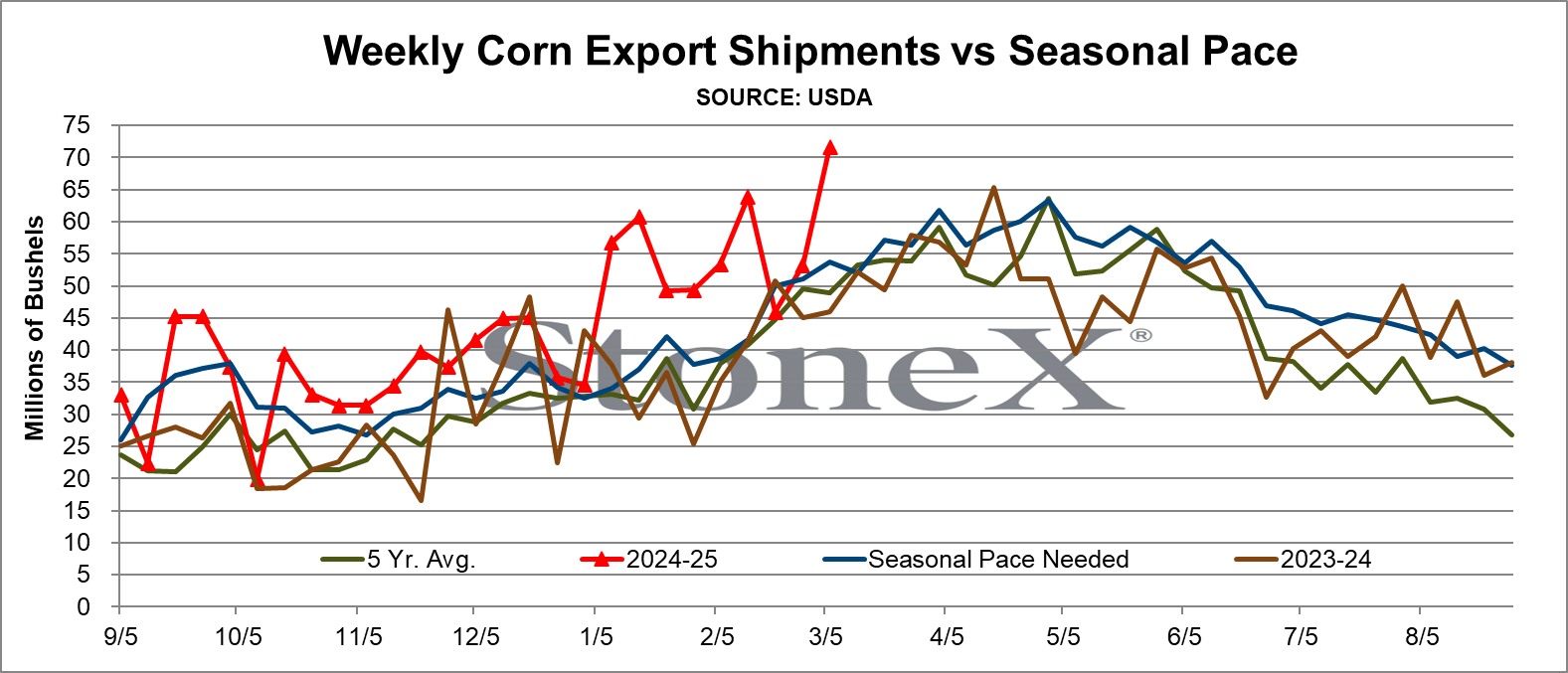
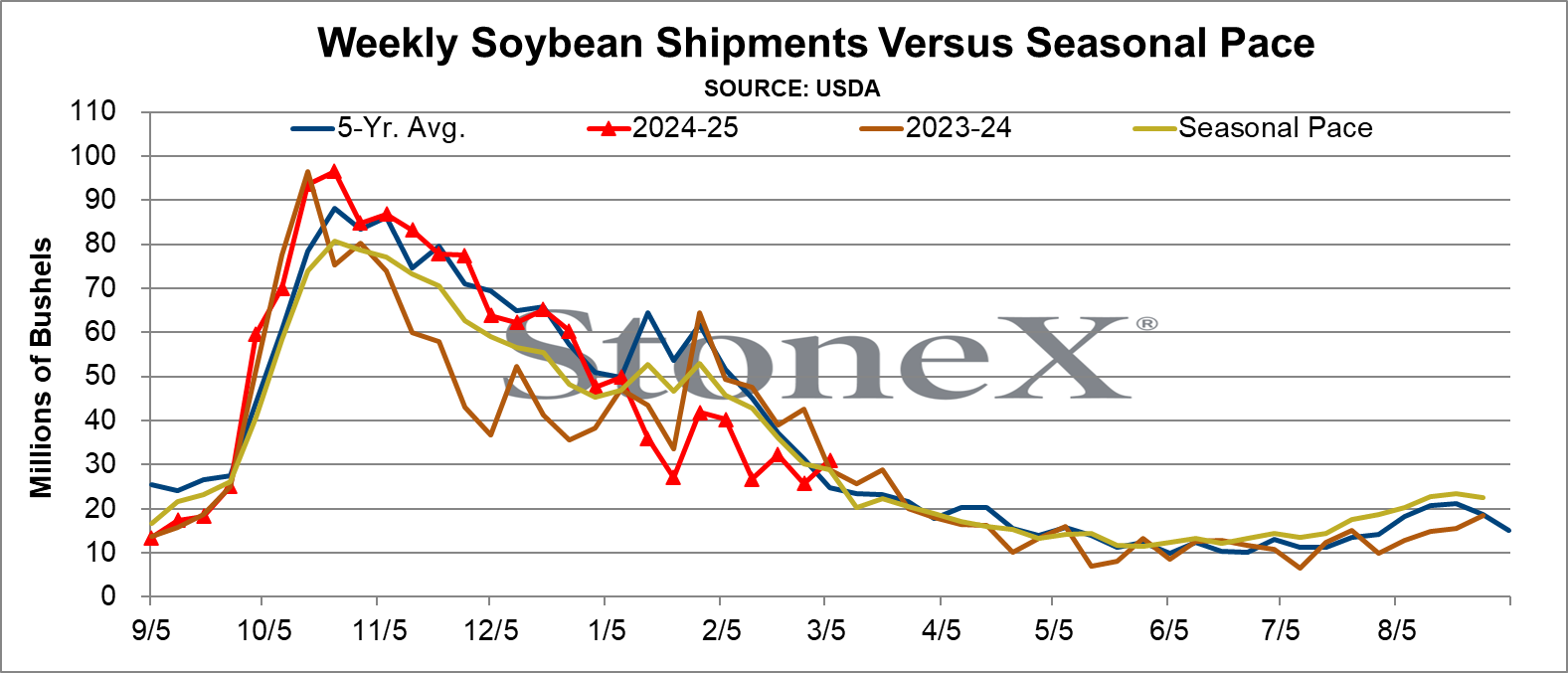
USDA inspected 71.6 million bushels of corn for export shipment in the week ending March 6, as shown below, which is the largest weekly total since May 2021. It's weekly inspections also included 31.0 million bushels of soybeans, 7.9 million bushels of wheat and 2.1 million bushels of grain sorghum. The wheat inspections were particularly disappointing, with the marketing year to date pace now falling 28 million bushels below the seasonal pace needed to hit USDA's target, with just three months left in the year. Marketing year to date grain sorghum export inspections fall 22 million bushels below the seasonal pace needed to hit USDA's target.
Marketing year to date corn export inspections total a strong 1.145 billion bushels, up 284 million bushels or 30% from the previous year's pace, and up 179 million bushels from the seasonal pace needed to hit USDA's target. It was widely expected that USDA would increase its export target in February, but prices collapsed when the agency failed to do so. I fully expect that it will do so tomorrow. My export target for the year is 2.560 billion bushels, up 110 million from USDA's current target, which drops my ending stocks estimate for the current marketing year to 1.415 billion bushels. Marketing year to date soybean export inspections total 1.412 billion bushels, up 123 million bushels or 9% from the previous year's pace, and up 62 million bushels from the seasonal pace needed to hit USDA's target for the year. A weaker dollar and strengthening Brazil basis has really closed the gap between U.S. and Brazilian soybeans recently.