March 19 – Stocks are continuing their rebound at mid-day, with the Nasdaq leading the major indexes higher as the tech sector sees a bounce from its recent selloff and the market awaits the results of the FOMC’s meeting later this afternoon. The relative calm on Wall Street today has allowed the VIX to push down toward its lows for the month of March, hovering around 20.6 at the time of writing. The dollar is attempting to erase this week’s losses as it pushes above 103.7, settling into a new, lower range over the last two weeks after wiping out all of the gains seen post-election. Treasuries are up slightly on the day, with 10-year yields back at 4.30% and 2-year yields just above 4.07%. Crude oil remains in the green despite a larger than expected build in U.S. crude stocks as tensions in the Middle East heat back up amid the deterioration of the ceasefire between Israel and Hamas. The ags are mostly lower on the day, save for the cattle complex, as this storm system brings welcomed moisture for the U.S. winter wheat crop and helps build soil moisture profiles in the Midwest ahead of upcoming corn planting.
30-year mortgage rates rose for the first time in nine weeks to 6.72% in the week ending March 14th, up from 6.67% the week prior but still solidly off the 2025 high of 7.09% reached in mid-January. In turn, overall mortgage applications in the U.S. fell 6.2% week-on-week after sharp gains seen in each of the two weeks prior. The drop in overall applications was driven entirely by a 12.8% decline in refinancing applications, which are much more sensitive to short-term rate changes, while applications to purchase a new home were effectively unchanged from the week prior. The U.S. housing market has certainly seen a slowdown in recent years after the red-hot period of the early 2020’s, but we have seen some better-than-expected data recently, including yesterday’s sharp jump in February housing starts. We’ll get another fresh update with February existing home sales and prices on deck tomorrow.
U.S. crude oil inventories rose by 1.75 million barrels on the week ending March 14th, excluding the SPR. This was a sharper than expected build and puts stocks excluding the SPR at 436.97 million barrels, their highest weekly level thus far in 2025. Meanwhile, gasoline inventories saw a smaller than expected draw of only 0.53 million barrels, remaining seasonally high for this time of year. Conversely, distillate stocks declined 2.81 million barrels week-on-week, much sharper than market expectations. This was driven by notable declines in both the Gulf Coast and Midwest, with exports of 1.261 million barrels marking an 8-week high and estimated demand of 5.272 million marking a 4-week high.
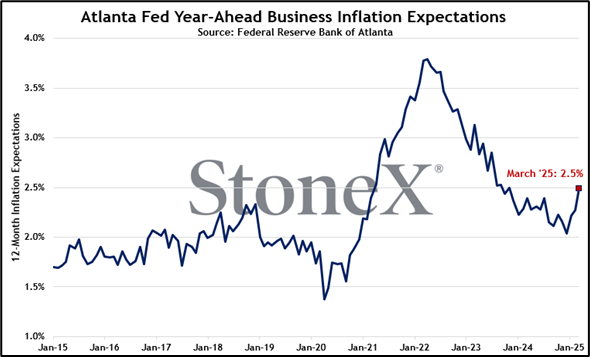
The Atlanta Fed’s Business Inflation Expectations (BIE) Survey showed an uptick of 0.2 percentage points month-on-month to 2.5% in March, rising from December’s recent low of 2.0% and marking the highest level seen since November 2023. This is still well below the peak of 3.8% hit back in April 2022 but remains elevated relative to the pre-pandemic average around 2.0%. Long-term inflation expectations, surveyed quarterly and defined as a period of 5 – 10 years ahead, rose 0.2 percentage points as well, now sitting at 2.8%. This breaks the trend of declining long-term inflation expectations seen in the last two quarters and puts us back at where they sat in June 2024.
Today’s BIE Survey results, along with rising consumer inflation expectations, highlight the challenge the Fed is facing going forward in this increasingly uncertain and rapidly changing economic environment. Observed inflation data has been better-than-expected recently, but that doesn’t yet reflect the impact of said policy changes. While the market is fully expecting the FOMC to hold rates unchanged today, much focus will be given to their updated economic and rate projections, as well as their prepared comments. Expectations are for Fed Chair Powell to be intentionally cautious and relatively vague, emphasizing the high levels of uncertainty and need for a “wait-and-see” approach as more economic data trickles in during the months ahead. Meanwhile, traders must continue to click “refresh” and react to fresh headlines as they arise.