March 20 - Stocks are modestly weaker at midday as Wall Street braces for this afternoon's Federal Reserve monetary policy update and press conference. The VIX is trading near 14, while the dollar index is trading near 104.0. Yields on 10-year Treasuries are trading near 4.28%, while yields on 2-year Treasuries are trading near 4.68%. Crude oil prices are down by more than 2% after hitting fresh four-month highs on Tuesday, while the grain and oilseed complex, as well as the livestock protein complex, are both mixed to weaker. All of these markets are vulnerable to potential surprises from the Fed at 2 p.m. EST today. All of them may be influenced by Fed statements made in trade the rest of the week. Until then, we're basically seeing a back and fill day from yesterday, where we've simply reversed yesterday's price action as the markets consolidate while waiting for direction.
USDA will release its Quarterly Grain Stocks and Planting Intentions survey results next week on Thursday. Both of these reports are known for their market-moving surprises, which has fund managers holding large short positions nervous. Which way might those surprises lean? For the stocks reports, I have found that the surprises often defy logic in their direction, therefore making them very difficult to predict. For the planting intentions survey results, as well as many of the WASDE monthly crop reports, potential surprises are a bit easier to predict as to their direction. I'm going into next week's reports expecting corn planting intentions to fall to 92.1 million acres, down from 94.6 million the previous year, while soybean planting intentions rise to 85.6 million acres, up from 83.6 million the previous year. The surprises can be in either direction, but my bias is that there's likely greater risk to the downside on my corn acres estimate, and to the upside to my soybean acres estimate. Most of the acreage shift typically does NOT happen in the core of the Midwest, but rather in the peripheral areas of the crop belt - in the South and in the Plains. I expect a modest increase in cotton acres in the South, along with rice as well. New crush facilities scattered through various portions of the Northern Plains and Midwest should encourage more soybean acres as well. Note that next week's report will reflect farmer intentions as of March 1st. Spring weather patterns can shift those intentions one way or the other by a percent or two or more, which would be expected to be reflected in the June 28 report.
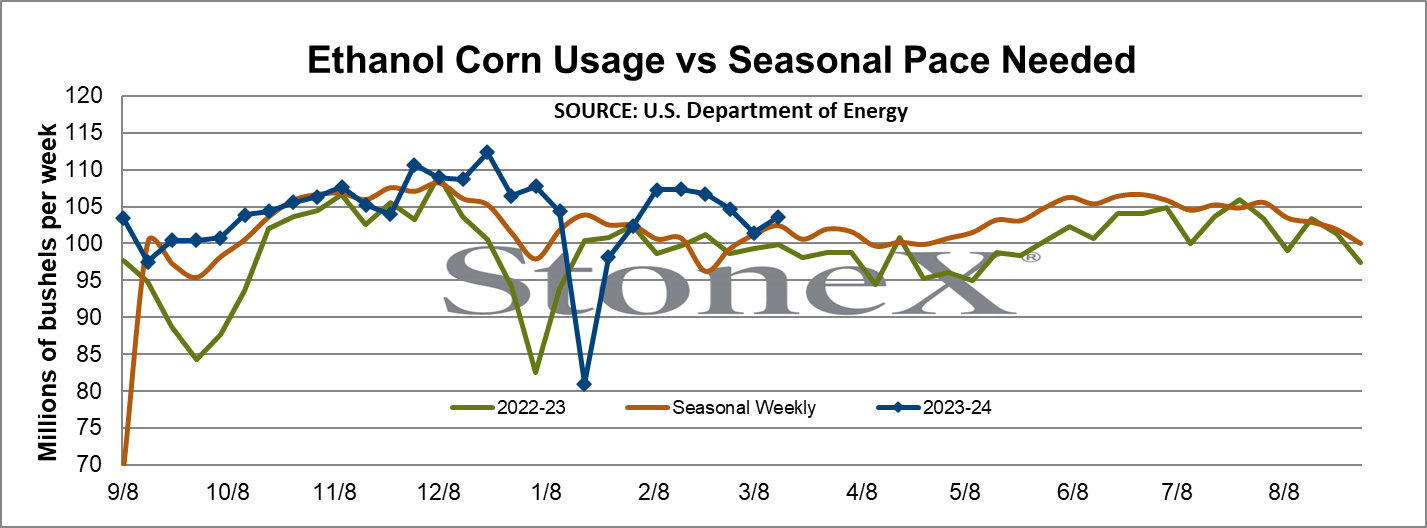
U.S. commercial crude oil inventories (excluding the Strategic Petroleum Reserve) fell by 2.0 million to 445 million barrels in the week ending March 15, leaving them 3% below the five-year average for mid-March. Gasoline stocks dropped by 3.3 million barrels during the week, putting them roughly 2% below seasonal levels. Distillate stocks rose by 0.6 million barrels, putting them 9% below levels typically seen in mid-March. Ethanol stocks rose to 26.0 million barrels in the week ending March 15, up from 25.8 million the previous week, but down from 26.2 million barrels in the same week last year. Ethanol production rose to 1,046K barrels per day during the week, up from 1,024K bpd the previous week, and up from 997K bpd in the same week last year. The production of ethanol utilized an estimated 103.6 million bushels of corn in the week ending March 15, as shown below, up from 101.4 million the previous week, and up from 98.1 million bushels in the same week last year. That brings estimated marketing year to date corn use for ethanol to 2.925 billion bushels, up 137 million or 4.9% from the previous year's pace, and 92 million bushels above the seasonal pace needed to hit USDA's target for the year. Cheap prices create demand, and this is another example of it happening.