March 4 – A broad selloff continues at mid-day, with the major stock indexes down anywhere from 1.6% - 1.8% at the time of writing, while the VIX rises to a ~2.5-month high above the 25.3 level as tariff talk continues to dominate headlines with more retaliatory measures being announced. While we’ve gotten some specifics from Canada and China, Mexican President Claudia Sheinbaum announced this morning that Mexico’s retaliatory measures will be announced on Sunday. The U.S. dollar is caught up in today’s selloff, dipping to a 3-month low near 105.8 earlier in the session before bouncing back to trade around 106.1 at mid-day. Treasuries remain in the red too, with 10-year yields trading at 4.16% and 2-year yields at 3.91%. Crude oil is falling as well, with the nearby WTI contract pushing to 3-month lows around $66.80 earlier in the session before rebounding to hang around $67.60 at the time of writing. The ags are mostly sharply lower, though front-end live cattle and oats futures are providing us with a little bit of green on the screen.
U.S. consumer sentiment continues to decline amid the ongoing economic uncertainty, with this morning’s RCM / TIPP Economic Optimism Index falling back into pessimistic territory for the first time since October with a 49.8 reading. This was down from 52.0 in February and follows the trend seen in the February University of Michigan Consumer Sentiment release that showed consumer sentiment dip to its lowest level since November 2023. The biggest decline seen in today’s reading was on the six-month economic outlook, which fell by 9.6% month-on-month in March down to 46.2. Confidence in federal economic policies declined 1.8% month-on-month to a 47.9 reading (though it should be noted that this subindex has been in pessimistic territory for 43 consecutive months). The personal financial outlook is the only one of the three components that remains in optimistic territory at 55.3, though that still marked a 1.3% decline from February. The main concern here is how this declining confidence will impact consumer spending going forward, with personal consumption expenditures accounting for nearly 70% of U.S. GDP.
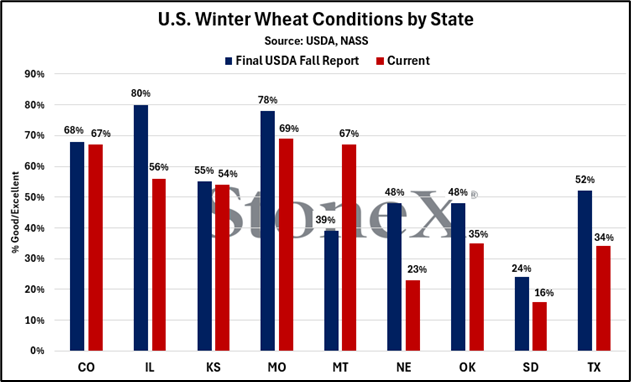
A handful of winter wheat growing states published their updated state level crop conditions after the close yesterday, showing a bit of a mixed bag across the board. Colorado saw the biggest month-on-month improvement at 10%, bringing their crop to an impressive 67% good/excellent (G/E), followed by Kansas rising 4% to sit at 54% G/E. Other hard red winter states saw declines, with South Dakota down a sharp 9% month-on-month to only 16% G/E, Montana down 4% to 67% G/E, and Nebraska down 2% to 23% G/E. On the soft red side of things, both Illinois (-9%) and Missouri (-6%) saw declines to now sit at 56% G/E and 69% G/E, respectively. Oklahoma and Texas are now reporting weekly due to their crop being further along in the season, with the former seeing a 1% week-on-week improvement to 35% G/E and the latter seeing a 3% week-on-week decline to 34% G/E.
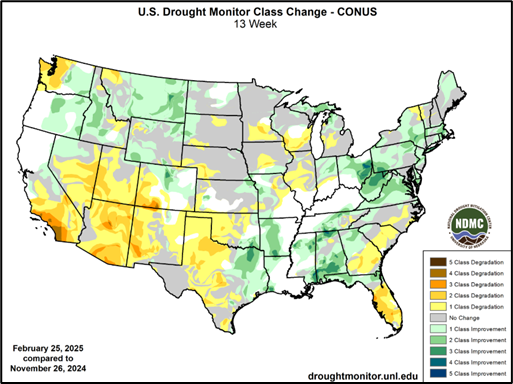
The below chart shows how these current ratings compare to the final official USDA Crop Progress report published back in late November as the winter wheat crop entered dormancy. All of these states except Montana have seen ratings decline through the winter, with some of them quite sharp (NE -25%, IL -24%, TX -18%). Much of this can be attributed to the drying out seen over the winter in these areas, as shown in the accompanying 3-month class change from the U.S. Drought Monitor included below. With the calendar now turned to March and spring-like temps forecasted in the weeks ahead, the trade will be shifting more focus to the condition of the winter wheat crops in both the U.S. and eastern Europe as they emerge from dormancy. Current long-range forecasts for the winter wheat growing season here in the states do show potential risks of a wet east/dry west pattern emerging, though we obviously must take these forecasts with a grain of salt that far out. Obviously, today’s price action is being dominated by panic selling over tariff impacts, but we must keep an eye on the fundamentals going forward as we prepare for the growing season ahead.