May 14 - Federal Reserve Chair Jerome Powell still expects inflation to trend downward, but his confidence in such is weaker than it was previously, according to comments he made this morning. That, and the new tariffs on Chinese imports, were the fodder for the markets today, with stocks mixed and commodities weaker. The VIX is trading just below 14, while the dollar index is trading near 105.0. Yields on 10-year Treasuries are trading near 4.46%, while yields on 2-year Treasuries are trading near 4.83%. Crude oil prices are 1% lower, while the grain and oilseed sector is mostly weaker as well, after nearing over-bought territory on recent price strength.
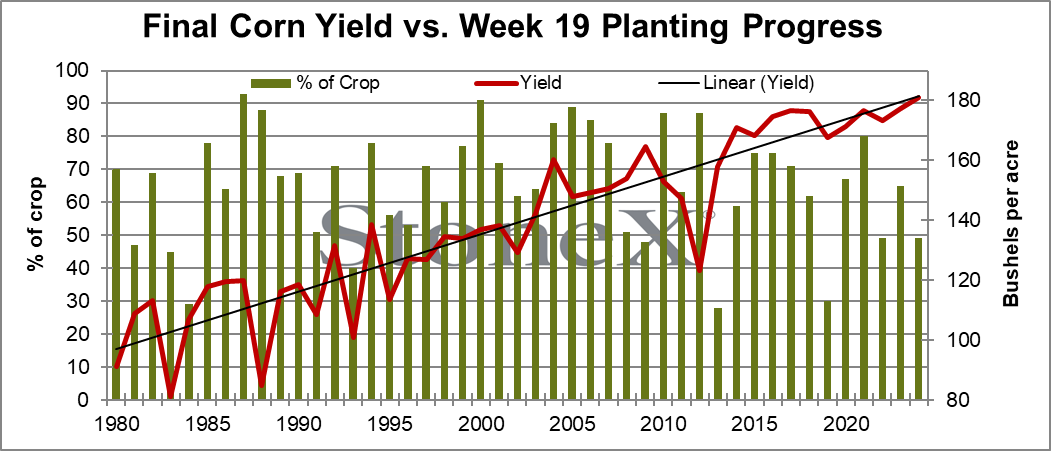
USDA reports that 49% of the U.S. corn crop was planted as of Sunday, up from 36% the previous week, but down from the five-year average for the week of 54%. Is that a problem? Not necessarily, but it does raise some concerns in light of today's forecast. The graphic below shows this week's planting progress numbers versus the same week over the past four plus decades. The red line shows final yields for each of those years. The correlation is rather weak. We've done the correlations on a state-by-state basis, and we find generally poor correlations between planting date and final yield in central and eastern areas of the Midwest, but a much higher correlation in the northwestern Midwest, where the growing season ends sooner. Fortunately, the planting windows look better in the northwestern belt. The forecast suggests that planting windows will be much smaller than preferred in other areas over the next couple of weeks. Late planting doesn't guarantee a small crop, but it narrows the margin for error relative to other potential problems later in the year, such as heat for pollination, a possible early frost, etc. The market would be more concerned if old-crop ending stocks were closer to 1.5 billion rather than above 2 billion bushels, but it certainly is something that traders are monitoring, and that will take on added importance as we move into the latter half of May.
China continues to revise its soybean demand downward, as revealed by its latest supply and demand balance sheets (CASDE) that were released this week. It cut soybean meal demand by 2 million metric tons to 95.8 mmt for the current marketing year as it pushes the industry toward a lower meal inclusion rate in rations, and reflecting a smaller hog breeding herd. USDA's estimate for current year China soymeal demand is 99 mmt. China also lowered its soybean import target by 1.1 mmt to 96.1 mmt, which is well below USDA's estimate of 105.0 mmt. It's differences with USDA are even larger for the 2024-25 marketing year. CASDE cut new-crop soybean crush to 94.9 mmt, dropping soybean imports to 94.6 mmt. That comes in well below USDA's crush target of 103.0 mmt, with imports estimated at 109.0 mmt for the next marketing year. The truth will likely come out somewhere between the USDA and CASDE numbers, but the latter reflects a philosophical goal of China to reduce dependency on imported products amid rising geopolitical tensions with the West.
Chinese buyers purchased roughly 30 cargos of soybeans last week, primarily for shipment in June and July, and primarily sourced from Brazil, which continues to be priced well below U.S. prices. China has booked roughly 310 million bushels of soybeans for shipment in June, and it looks likely to book shipment of 275 million bushels in July and 220 million bushels in August. Brazilian soybeans continue to be cheaper into the port at China than U.S. soybeans all the way through September. Current crush margins in China for Brazilian soybeans in March 2025 is +$30 per metric ton, while October crush margins for U.S. soybeans in China are at -$15 per metric ton. Year to date U.S. soybean shipments to China stand at 791 million bushels, down 272 million bushels on the year.