May 22 - Stocks continue to trade mixed midday, with the tech sector being the strength of Wall Street, even as debt ceiling talks in Washington remain on rocky ground. The VIX is trading near 17 at midday, so no signs of panic are seen. The dollar index is trading near 103.3, while yields on 10-year Treasuries are trading near 3.72%, which represents a fresh two-month high for Treasury yields. Crude oil prices are modestly higher at midday, while the grain and oilseed sector is split. Corn, soybeans and wheat have tried to rally following last week's sharp losses. The three wheat markets all traded in negative territory midday, while corn and soybeans continue to post impressive gains. Yet, only corn has been able to take out Friday's session high to this point, and it is now back below that level on the charts. As such, we can only consider this a short-covering bounce in an oversold market to this point. U.S. farmers still have clean-up sales to make ahead of this year's harvest, and Brazilian farm sales are behind normal levels as well, especially for corn, keeping a lid on rallies. The protein sector is mostly in the red today, with high feed costs weighing on the market, along with excessive pork product supplies. Friday's USDA cattle-on-feed report was as expected, while last week's cash trade was stronger than expected, although we're seeing a bit of weakness from Friday's report of an atypical BSE case in South Carolina, which risks a short-term suspension of Chinese imports; something that matters now more that China is a larger importer of U.S. beef.
USDA inspected 52.1 million bushels of corn for export inspection in the week ending May 18, along with 15 million bushels of wheat, 5.7 million bushels of soybeans and 4.6 million bushels of grain sorghum. The portion of the above that was loaded onto ships for China included 12.4 million bushels of corn, 4.6 million bushels of grain sorghum, 2.5 million bushels of wheat and 0.3 million bushels of soybeans. The corn shipments to China were again impressive, but based on this month's cancellations, we expect those shipments to dry up over the next 30 - 40 days as new-crop Brazilian supplies become available. Marketing year to date corn export shipments fall short of the seasonal pace needed to hit USDA's target by 107 million bushels, which is an improvement of about 10 million bushels from the previous week. Marketing year to date soybean export shipments exceed the seasonal pace needed to hit USDA's target by 50 million bushels, but that surplus is eroding away amid dismal sales this spring and a sharp decline in shipments in recent weeks as a result.
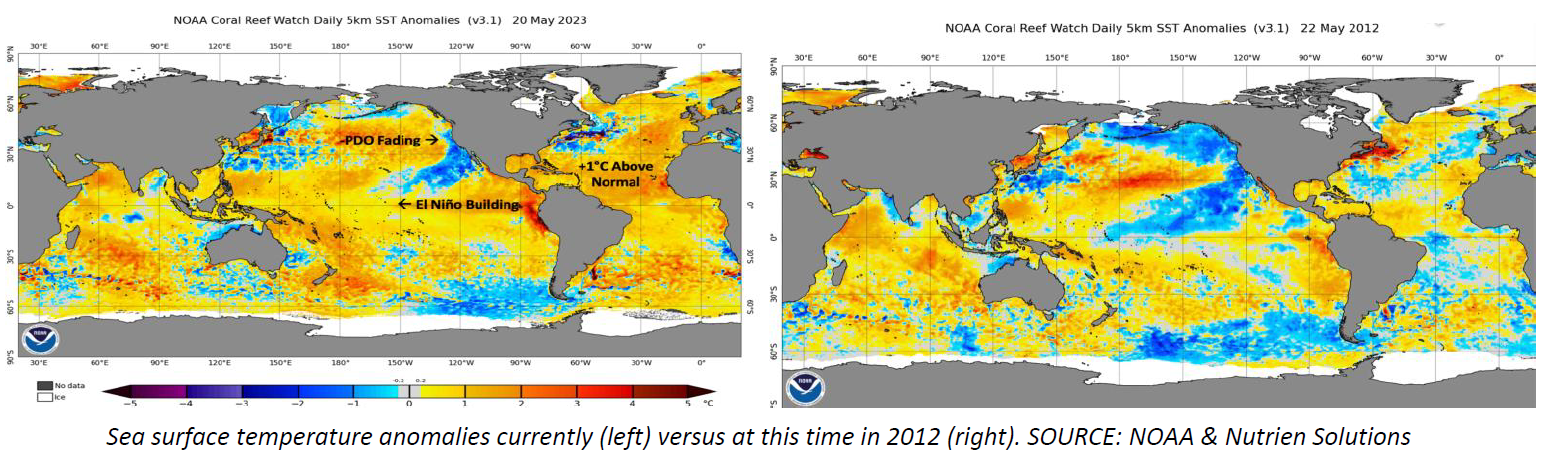
The modern-day drought threat conjures up calls for a 2012 repeat. Those comparisons have been strong throughout the winter and spring, even though there are many differences this year from the setup in 2012. Note the graphic on the left below showing sea surface temperature anomalies that reveal rapidly warming waters in the equatorial Pacific taking us into what is expected to be a strong El Nino this summer. The graphic on the right shows that El Nino was very slow to develop in 2012, keeping it from being a dominant feature driving weather patterns that year. Instead, the dominant feature was the -PDO signal, which is seen by the very cold waters stretching from the Gulf of Alaska along the West Coast and then back to the southwest toward Hawaii, with warm waters in the central Pacific. Those warm waters in the central Pacific are present again this year, but they're pushing east to the West Coast of Canada and the United States, displacing the cool waters present for much of the summer in 2012. The other feature noticeable in the left graphic is the warm waters in the Atlantic, versus how cool they were in 2012. There's still a chance that we could have a drought this summer. That can never be ruled out. But the odds would appear to be against it. Today's updated forecast models continue to suggest that we should see the current dry bias in the Midwest start to flip by the second week of June, washing away drought fears and 2012 comparisons once and for all if they verify.