May 29 – The jump in stocks in reaction to the U.S. Court of International Trade’s ruling against the bulk of Trump’s tariffs appears to be short-lived, with the major indexes fading throughout the morning to now trade mixed at mid-day. With the administration immediately filing an appeal to the ruling, this story is likely far from over and will continue to move markets as headlines arrive. The tech-heavy Nasdaq is leading the major indexes higher, bolstered by bellwether Nvidia’s better than expected earnings after yesterday's close, but is now only up ~0.2% at the time of writing. Meanwhile, the VIX has risen slightly to hover around 19.8, still relatively low compared to recent levels. The dollar is sharply off its highs above 100.5 seen earlier in the session to trade near 99.3 at the time of writing. Treasuries are in the red at mid-day as well, with 10-year yields trading at 4.43% and 2-year yields at 3.95%. Crude oil is still down on the day but has bounced a bit from its lows following today’s holiday delayed DOE report, with nearby WTI trading near $61.20 at the time of writing. The ags are largely mixed, with Minneapolis wheat and the cattle complex the main bright spots, while most of the remaining grains and soy complex hang in the red.
Minutes from the Fed’s May meeting showed FOMC members express concern over growing uncertainty, agreeing that a cautious approach was appropriate until the realized economic impact of the Trump administration’s policy shifts becomes clearer. In layman’s terms, this essentially means the Fed looks to remain in a holding pattern for the time being, which has largely been reiterated by various members in their public remarks since. It does appear that the market is finally shifting toward taking the Fed at their word, with the first rate cut now not expected until their September meeting and only two cuts seen in 2025. A lot has changed in the three weeks since the Fed’s May meeting, with tariff fears easing significantly, especially given the federal court ruling against most of these new tariffs. The FOMC will reconvene for their next meeting on June 17-18 and, given how rapidly things continue to change in 2025, they’ll likely have plenty more to react to. We’ll get an update on the Fed’s preferred inflation metric, PCE, for the month of April tomorrow morning.
U.S. pending home sales sank 6.3% month-on-month in April, much sharper than the 1.1% drop anticipated by analysts and marking the sharpest monthly contraction seen since April 2024. March sales were revised lower as well, now pegged at 5.5% month-on-month growth versus the 6.1% previously reported. In year-on-year terms, home sales were down 2.5% in April, the fifth consecutive month in the red. National Association of Realtors Chief Economist Lawrence Yun noted that “despite an increase in housing inventory, we are not seeing higher home sales,” while also remarking that “at this critical stage of the housing market, it’s all about mortgage rates.” With this being April data, it’s likely that economic uncertainty was playing a role as well, with potential buyers less willing to commit to long-term financial decisions amid the stock selloff and widespread negative headlines circulating at the time.
USDA reported flash sales this morning of 104,000 MT of old crop (‘24/’25) corn to Mexico, in addition to another 101,096 MT of old crop corn to unknown destinations. We won’t get our full weekly export sales report until tomorrow due to the Monday holiday, but cumulative corn sales to Mexico totaled just under 823 million bushels as of last week’s report, up 3.9% from last year’s record pace at this time. Record demand to Mexico has played a big role in pushing U.S. corn exports to their second highest on record at 2.60 billion bushels during the ‘24/’25 marketing year, and Mexican demand will continue to be important for reaching USDA’s ‘25/’26 export target of 2.675 billion bushels. USDA is calling for Mexico’s own corn production to rebound 5.2% year-on-year to 24.5 MMT in ‘25/’26, with exports expected to match this year’s all-time high at 25 MMT.
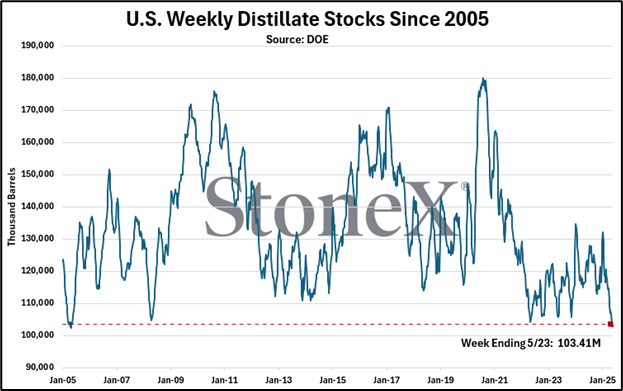
U.S. crude oil stocks fell by 2.8 million barrels week-on-week to 440.36 million, excluding the SPR, sharper than analyst expectations. The refined products saw sharper than expected drops as well, with gasoline stocks down 2.44 million barrels week-on-week and distillate stocks down 0.72 million. Gasoline production and imports both rose while exports fell, but a five-week high in demand contributed to the tightening. Total distillate stocks of 103.41 million barrels now fall below the 103.55 million seen two weeks ago to mark a fresh 20-year low.