May 6 - Stocks maintained their positive tone today, supported market expectations of interest rate cuts later this year. The VIX is trading near 14 at midday, while the dollar index is trading near 105.1. Yields on 10-year Treasuries are trading near 4.50%, while yields on 2-year Treasuries are trading near 4.82%. Crude oil prices are modestly higher at midday, while the grain and oilseed complex is stealing the show for the bulls today.
Soybean prices are leading the way higher, although wheat prices are leading when considered as a percentage gain with upwards of 4% gains. There are a lot of fundamental factors being thrown around, some of which are true, but none of which justify the move that we're seeing in the sector overall. It's true that the charts will sometimes lead the fundamentals, and it's also true that sometimes the markets trade illogically on money flow before the fundamentals of supply and demand bring them back to reality.
What we do know is this - the known soybean losses in Brazil due to excessive flooding and the known corn losses in Argentina due to the leaf hopper spreading a disease and the known wheat losses in Russia due to current warm and dry conditions due not justify rationing U.S. demand with higher prices. That doesn't mean that prices can't continue to go higher as the charts turn and momentum-trading Algos add buy orders. However, it does mean that we become increasingly vulnerable to a selloff, either before Friday's big USDA WASDE crop report, or after it. That report is expected to show ample domestic corn and soybean stocks for the 2024-25 marketing year, and it comes after the latest Euro-Monthly forecast model updates called for a nearly ideal growing season in the Midwest this summer. Obviously, that could change. But for now, we have not seen evidence of enough bushels lost to justify rationing U.S. demand with higher prices, the same as I was saying back in November when the soybean market was rallying on Brazil's weather story. The Russian wheat story may still end up having legs to it IF the current weather pattern holds into the summer, but that's still an unknown. The Brazil soybean losses are not enough by themselves to justify the rally either, unless we see some significant losses for Argentina as well - more than are currently expected. The above problems take away some of the margin for a U.S. weather problem this summer, although that risk is decreasing. Rather, this continues to be about fund managers abandoning their "commodity deflation" mode that they've held for the past two years, and for now, it's providing strong upward momentum that may be challenged on Friday.
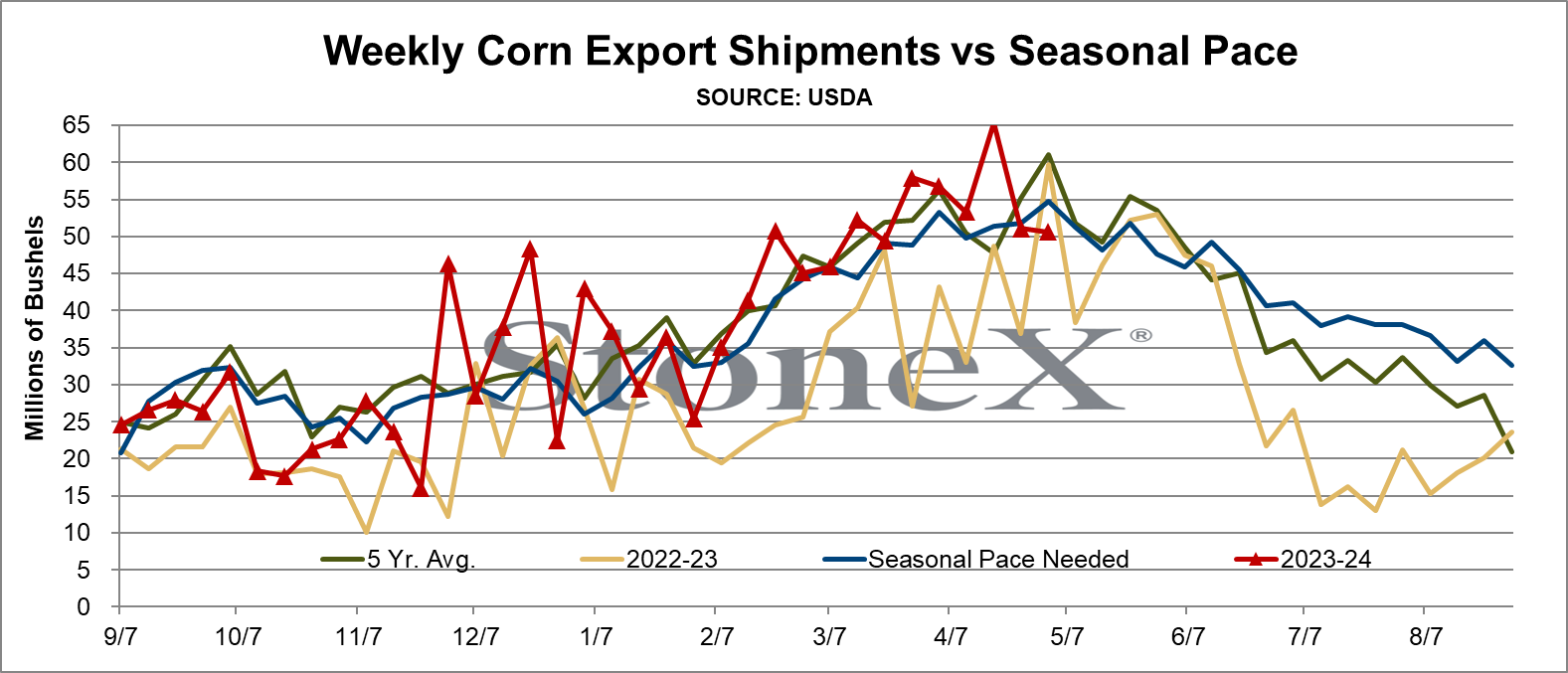
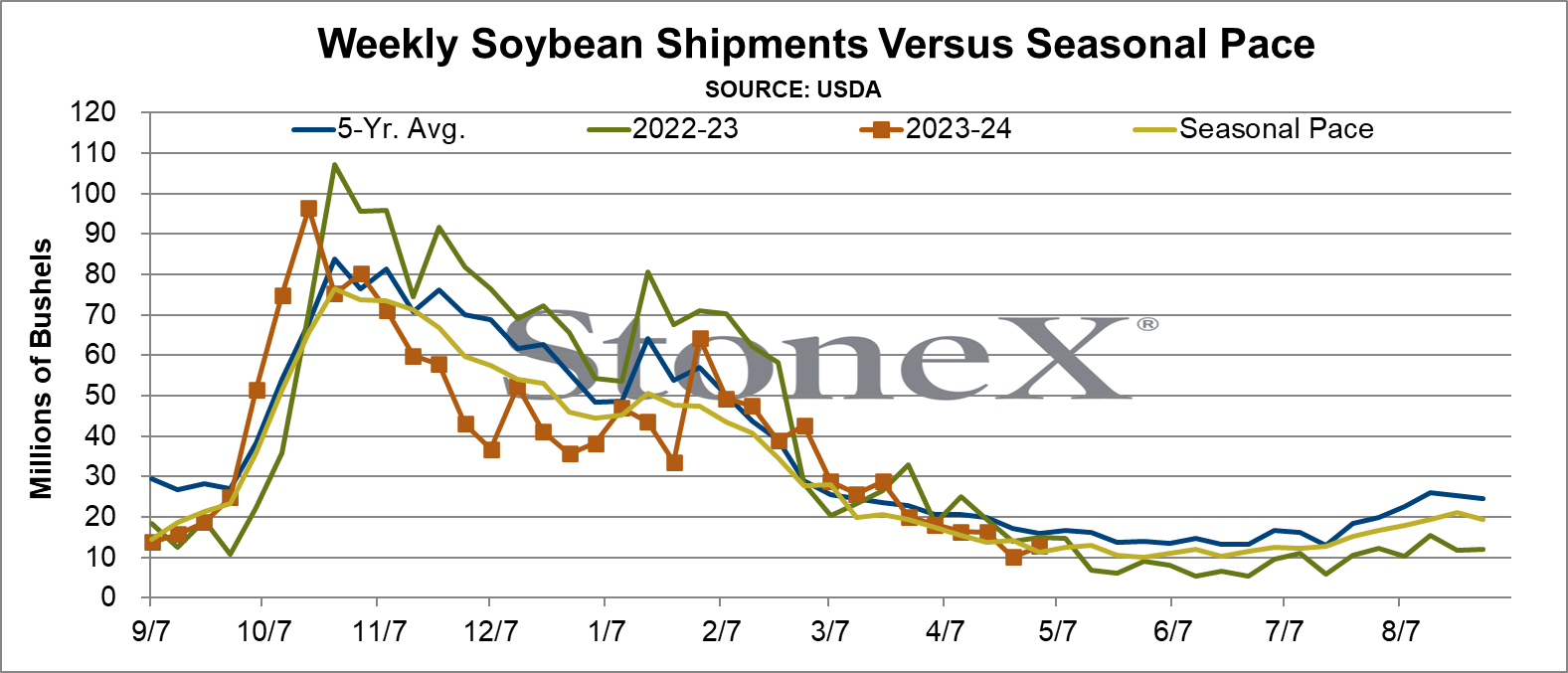
USDA inspected 50.6 million bushels of corn for export inspection in the week ending May 2, as shown below, along with 12.8 million bushels of soybeans, 11.8 million bushels of wheat and 5.4 million bushels of grain sorghum. The portion of the above inspected specifically for shipment to China included 2.8 million bushels of corn, 3.1 million bushels of soybeans, 2 million bushels of wheat and 5.4 million bushels of grain sorghum. Marketing year to date corn export shipments total 1.298 billion bushels, up 319 million bushels of 33% from the previous year's pace, and 65 million bushels above the seasonal pace needed to hit USDA's target for the year. That gap is holding. Marketing year to date soybean export inspections total 1.437 billion bushels, down 321 million bushels or 18% from the previous year's pace. Note that! This year's marketing year to date soybean export inspections are nearly 20% below last year's pace. They still exceed the seasonal pace needed to hit USDA's lower target by 33 million bushels, but I expect that gap to diminish in the final two months of the marketing year due to cheap Argentine & Brazilian supplies.