October 1 - Stocks came under pressure this morning amid a bit of a flight to safety on concerns that the Middle East war may be on the cusp of spreading, even as this morning's economic data was mixed. The flight to safety pressured stocks, while commodity prices were generally well supported. The VIX traded north of 20 late morning before pulling back when stocks seemed to find firmer footing. The dollar index rallied to trade near 101.3 after posting a fresh 12-day high. Yields on 10-year Treasuries fell in a flight to safety to trade near 3.73%, while yields on 2-year Treasuries are trading near 3.61%. Crude oil prices quickly erased their losses to surge more than $4 off their session low, while currently trading more than 4% higher on the day. The grain and oilseed markets are mostly in the green across the board as well.
Wheat prices led the Ag sector higher this morning, with both Chicago and Kansas City posting double-digit gains that put them on the cusp of testing September highs on the charts. They seemed to garner energy from the crude oil rally, but the primary focus remains on speculation that Russia will be restricting exports in the last half of the marketing year following a short crop in 2024, and amid ongoing drought that is hampering emergence of the 2025 crop, with additional dryness in Argentina, the U.S. Plains, and elsewhere. Major exporter stocks outside of the United States are relatively tight.
The White House confirmed this morning that its intelligence believes that a direct attack by Iran on Israel is imminent. It believes that Iran is preparing ballistic missiles to be fired into Israel. This occurred several months ago, but Israel's "Iron Dome" defense system was able to intercept the missiles at that time. The current threat comes just hours after Israel began a limited ground incursion into southern Lebanon to take out military capabilities of Iran-backed Hezbollah fighters. Israel recently took out many of Hezbollah's leaders through strategic air strikes, while also taking out its communication systems by coordinated explosions of pagers and phones being used by Hezbollah. This may have put Iran in position of having to do its own fighting, after Israel has rendered its proxy groups less effective. However, pulling Iran into the fight risks a broader war that could disrupt energy shipments and infrastructure. Keep in mind that half the world's urea fertilizer production comes from the Middle East / North Africa. The general thinking is that Israel will again use restraint versus Iran if its Iron Dome is again effective at stopping the missile attack, but as one analyst put it, "hell could break loose" if the missiles effectively get through to Israel. Thus the surge in crude oil prices this morning amid the general flight to safety in the financials.
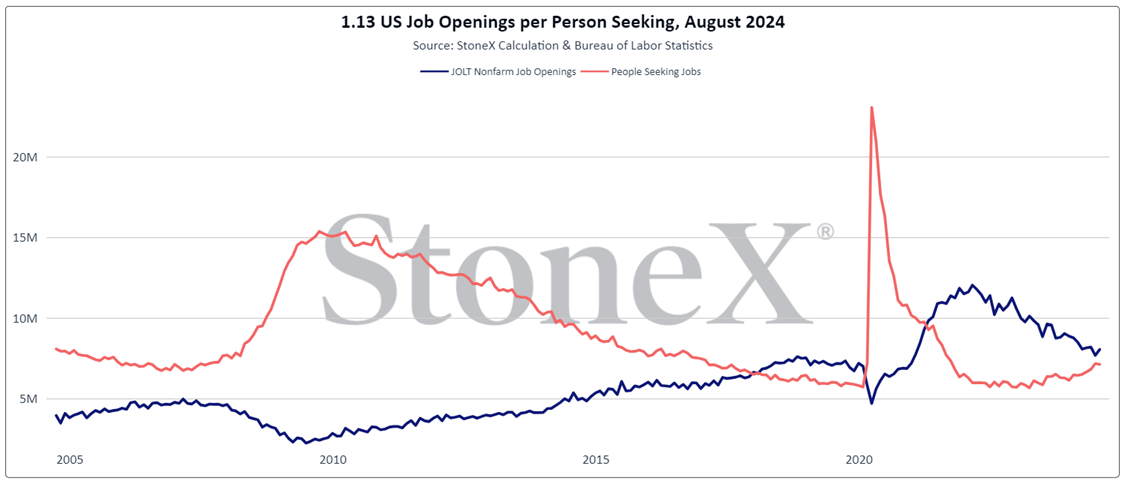
The JOLTS report this morning showed that job openings at the end of August totaled 8.04 million, as shown below, up from an upwardly revised 7.711 million in July, and up from analyst expectations of 7.7 million. That suggests that the jobs market is strengthening again, with 1.13 job postings for every person looking for a job, although we'll get plenty more data on that the rest of the week. However, this morning's PMI manufacturing index remained stagnant at 47.3, down from 47.9 previously, reflecting ongoing contraction in that sector, while the ISM manufacturing index remained unchanged at 47.2. The most intriguing part of the latter report was a sense from purchasing managers that they're in a holding pattern pending interest rate cuts and the results of the election. They're reluctant to make big purchases until interest rates get lower, since that's what's largely been telegraphed to them, and they're holding out on major investments until they know who will be in the White House for the next four years. That could have significant tax and economic policy implications. Perhaps the biggest headwind going forward is the uncertainty over policy development impacting businesses as determined by the upcoming election.