October 28 - Stocks opened the week with solid gains, which they've largely held through the morning. The VIX continues to trade above 19 at midday, while the dollar index trades near 104.2. Yields on 10-year Treasuries are trading near 4.29%, hitting their highest level since July 11th this morning, while yields on 2-year Treasuries are trading near 4.15%, which is their highest level since the first of August. Crude oil prices were more than 6% lower overnight as traders removed war risk premium to focus on soft demand and abundant supplies, while prices have come off those lows a bit at midday. The grain and oilseed sector continues to trade mostly lower at midday with ongoing harvest pressure and ample supplies.
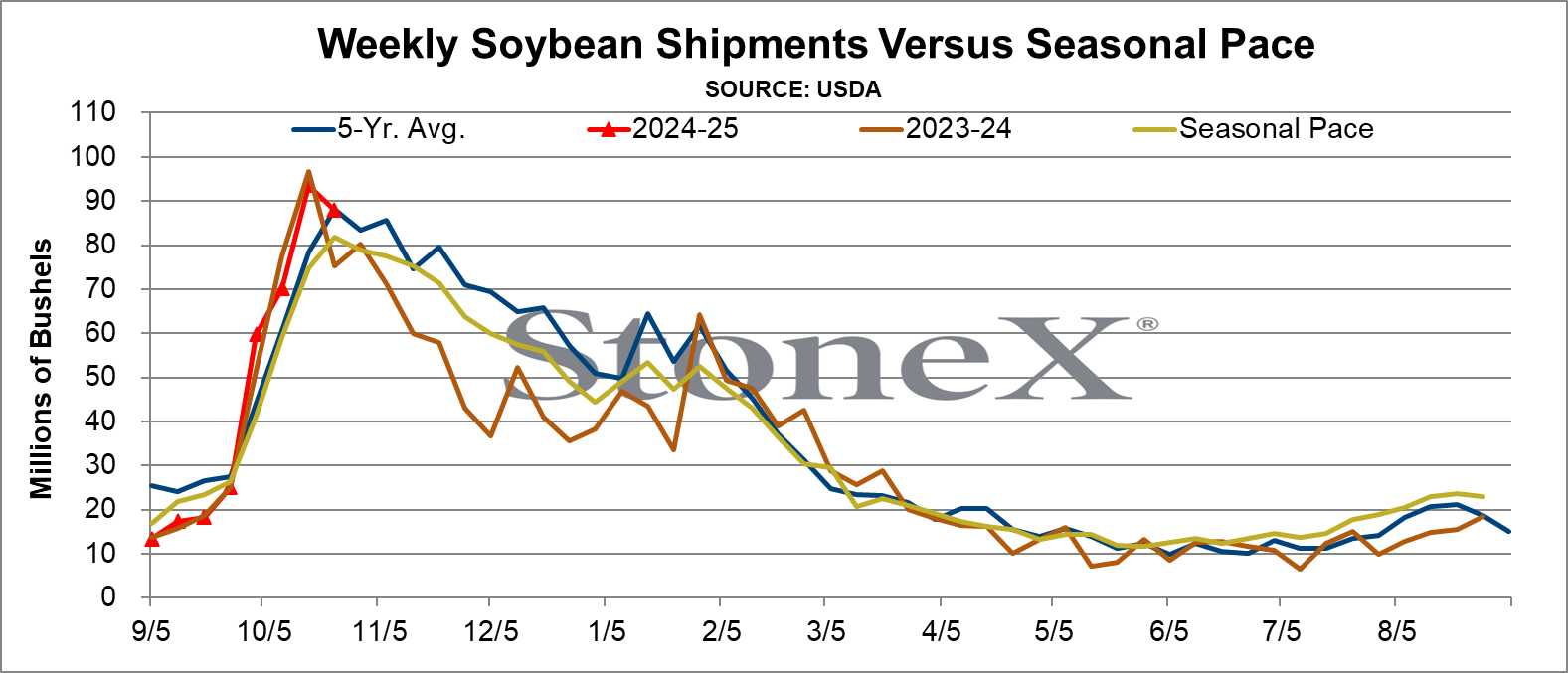
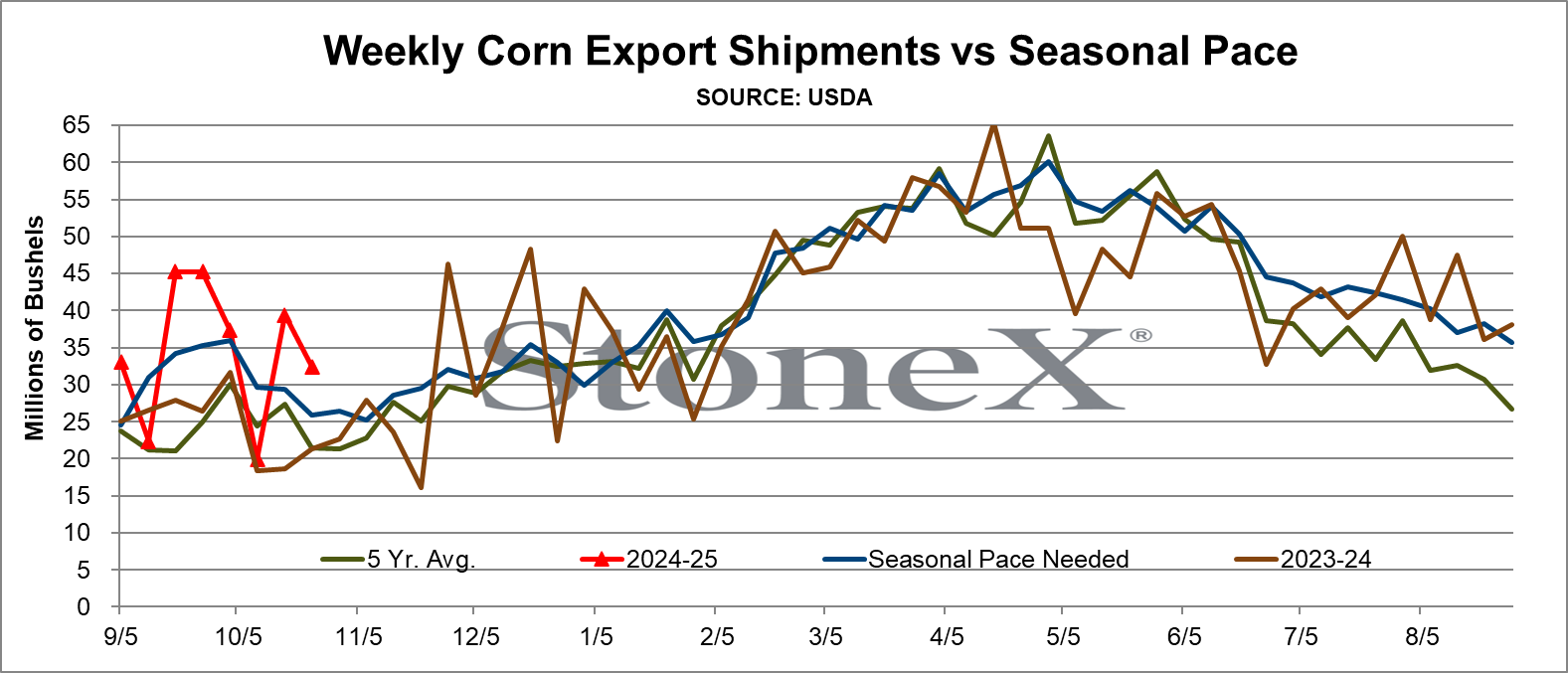
USDA inspected 87.9 million bushels of soybeans for export shipment in the week ending October 24, as shown below, along with 32.4 million bushels of corn, 9.1 million bushels of wheat and 0.1 million bushels of grain sorghum. Of the above, the portion that was inspected specifically for shipment to China included 29.2 million bushels of soybeans, miniscule amounts of corn and grain sorghum, and no wheat. This leaves marketing year to date wheat export inspections exceeding the seasonal pace needed to hit USDA's target by 8 million bushels, down from 9 million the previous week. Marketing year grain sorghum export inspections are 2 million bushels below the seasonal pace needed to hit USDA's target, and they're slowly losing momentum.
We've had a strong start to the export year for both soybeans and corn. Marketing year to date soybean export inspections total 382 million bushels, up 8 million bushels or 2% from the previous year's pace, with the weekly inspections matching the previous year's pace very closely thus far. In fact, marketing year to date export inspections exceed the seasonal pace needed to hit USDA's target by 37 million bushels, up from 26 million the previous week. The strong early start to the export season was largely expected. The key question is, can that pace be sustained? That can only happen if we pick up the pace of sales commitments. Marketing year to date commitments actually fall short of the seasonal pace needed to hit USDA's target by 100 million bushels, suggesting that we could struggle to maintain shipments later in the year, similar to the past marketing year. I started the marketing year with my export target at 1.735 billion bushels, down 115 million from USDA. I have since bumped that to 1.790 billion bushels due to the delayed planting of Brazil's soybean crop. Brazil's delayed planting should delay the harvest, and therefore the early shipments, extending the U.S. shipment season a bit, which is why I bumped my target.
It's been a more erratic start to the corn marketing year shipment season, with weekly inspections swinging largely between 20 and 45 million bushels per week. Overall though, marketing year to date shipments through the first eight weeks of the year total 261 million bushels, up 65 million bushels or 33% from the previous year's pace, and 15 million bushels above the seasonal pace needed to hit USDA's target for the year. This is a bit more noteworthy. Corn typically has its strongest export shipments in the last half of the marketing year, and that is especially expected to be the case this year as well, with a shorter crop in the Black Sea, Argentina reducing planted area by around 20%, and Brazil's winter corn crop expected to be planted late due to a late soybean harvest. So, a strong early export pace adds positive sentiment to the export season that we could end up having this year. And unlike soybeans, corn export commitments are strong to support continuation of strong shipments, with marketing year commitments to date exceeding the seasonal pace needed to hit USDA's target by 125 million bushels.