October 29 - The Nasdaq firmed while the Dow slipped in trade this morning as Wall Street consolidates amid a plethora of uncertainty ahead of jobs data, the election and the next Fed meeting - all in the next eight days. The VIX slipped back below 20 by midday, while the dollar index pulled back from nearly four-month highs to trade near 104.4. Yields on 10-year Treasuries are at nearly four-month highs of their own currently as they trade near 4.33%, with yields on 2-year Treasuries trading near 4.16%. Crude oil prices are modestly lower on Middle East peace talk chatter, while the grain and oilseed markets are mixed to higher. Kansas City wheat prices bounced off September lows on low condition ratings, while January soybeans test support at their October lows, and corn prices follow wheat higher.
Today's JOLTS report pegged September 30 posted job openings at 7.443 million, down from a downwardly revised 7.861 million the previous month, and below analyst expectations of 7.9 million. Those numbers are somewhat contrary to indicators in some of the recent industry surveys regarding small business hiring plans and job postings, which would suggest that the pullback in demand for labor may be moderating in recent weeks. Nonetheless, today's report suggests 1.1 job openings per person looking for a job, which is basically unchanged from the previous month, indicating more job openings than people looking. The job quit rate fell to 1.9% in September, which is below the 2.3% rate that prevailed pre-pandemic. In effect, this is a solid, but static job market.
The consumer confidence index surged to 108.7 in October, up from an upwardly revised 99.2 previously, and above analyst expectations of 99.1. The Conference Board, which conducts the surveys, noted improvement in all five categories, with the index posting its strongest month-on-month gain since March 2021. The Present Situation Index rose 14.2 points this month to 138.0, while the Expectations Index rose by 6.3 points to 89.1. The Conference Board noted that consumers were "substantially more optimistic about future business conditions and remained positive about future income. Also, for the first time since July 2023, they showed some cautious optimism about job availability." The rise in optimism came across all age groups and most income groups. This data is more current than the JOLTS data. Surprisingly, survey respondent mention of the elections was fifth in frequency as a key word of concerns, behind "prices, inflation, food and groceries." "Election" was first in frequency ahead of the 2016 election, and second only to "COVID" in 2020.
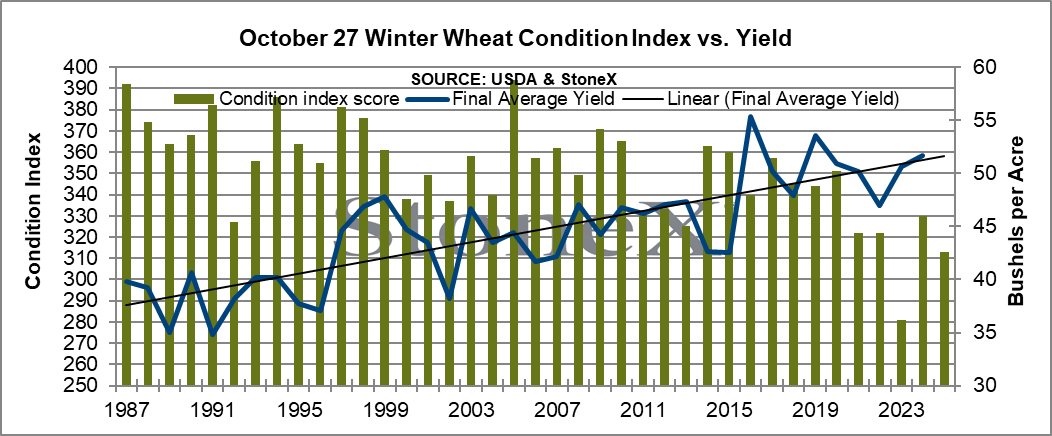
USDA released the first condition scores of the year on Monday for the 2025 winter wheat crop. USDA rated 38% of the crop Good to Excellent, down from 47% in the same week last year. That compares to 28% G/E in the same week two years ago, but as the graphic below shows, that crop ended up just below trend yields. The market will take notice of a poor start to the winter wheat crop due to drought, but it also understands that spring rains mean a lot more than fall rains in determining yield. A poor start does leave the crop more vulnerable to winter kill from harsh cold between now and spring, but we typically do not see conditions cold enough to do winter kill in January in the States, like they do in Russia. My condition index score also takes into account that 23% of this year's crop is currently in Poor to Very Poor condition, and that's just rating what has emerged thus far. That compares to 18% P/VP a year ago and 35% two years ago at this point. The wheat-state of Kansas has a condition index score of 317, up from 281 a year ago and up from 266 two years ago. The state that currently has the lowest condition score is Arkansas at 234, while the best rating is currently in California at 405.