October 3 - Wall Street took on a "risk off" sentiment this morning as Treasury yields continue to rocket higher, pushing the dollar to new highs for the move in the process. The VIX traded above 20 for the first time since May 24th as we approached midday, reflecting elevated fear levels on Wall Street. The VIX set a new high for the move after today's JOLTS report showed a much larger than expected jump in job openings at the end of August, raising fears that the Federal Reserve might respond with higher interest rates. The dollar index hit a fresh 10-month high above 107.3, although it is trading just below that level at this hour. Yields on 10-year Treasuries are trading near 4.78%, representing fresh 16-year highs, and well above the 3.25% level we saw in April. Yields on 2-year Treasuries are trading near 5.14%. Crude oil prices continue to battle these headwinds, with relatively strong fundamentals of tightening supplies, while the grain and oilseed markets are not doing as well. We're still seeing some fund short-covering in wheat in follow-through trade, following Friday's flush to new lows, while corn and soybean prices are under pressure from better-than-expected harvest results amid weak demand. Lean hog futures saw follow-through selling from Thursday's bearish USDA hogs and pigs report, while the cattle market gave way to the above headwinds.
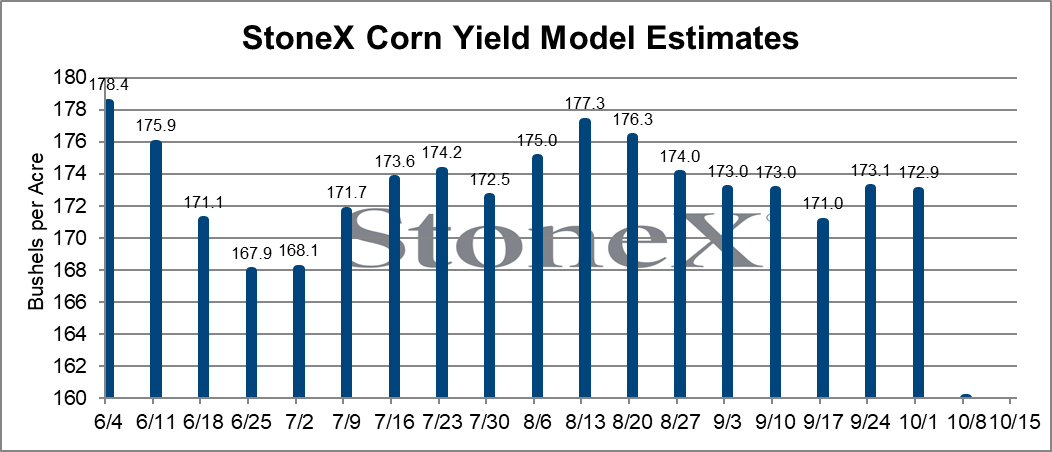
USDA's crop progress report revealed Monday afternoon that this week's corn condition index score rose 1 point to 339 (500=perfect crop), up from 331 a year ago, although still down from the 10-year average for the week of 362. That puts my yield model at 172.9 bushels per acre, down from 173.1 bpa the previous week. I've stated here many times over recent weeks that I expected the harsh weather at the end of the growing season - last half August and first half September - to reduce seed size, and therefore reduce yield, although I also stated that I would be curious to see the impact of very favorable weather in the first half of August. I was unable to find another analog year like this one for pollination and grain fill, but my past experience as an agronomist said that we probably reduced seed size on net. That may be true in some cases, and we should get a better feel for that when USDA releases the results of its field sampling next week on the 12th. But our customers are telling us that the problems with the crop are not as significant as feared, and my yield model may be under-stating corn yields this year. I mentioned another factor in my comments released earlier this morning, and that has been the response to posting the StoneX results on social media. Both my character and intelligence were attacked on "X" - formerly Twitter - when I posted the results of our September survey pegging the corn crop at 175.0 bpa. But not a single person has challenged my post from Monday afternoon of our October survey results putting the crop at 175.5 bpa. I decided to state that on X this morning to see if I could stimulate some conversation, and all of the response has affirmed higher-than-expected yields.
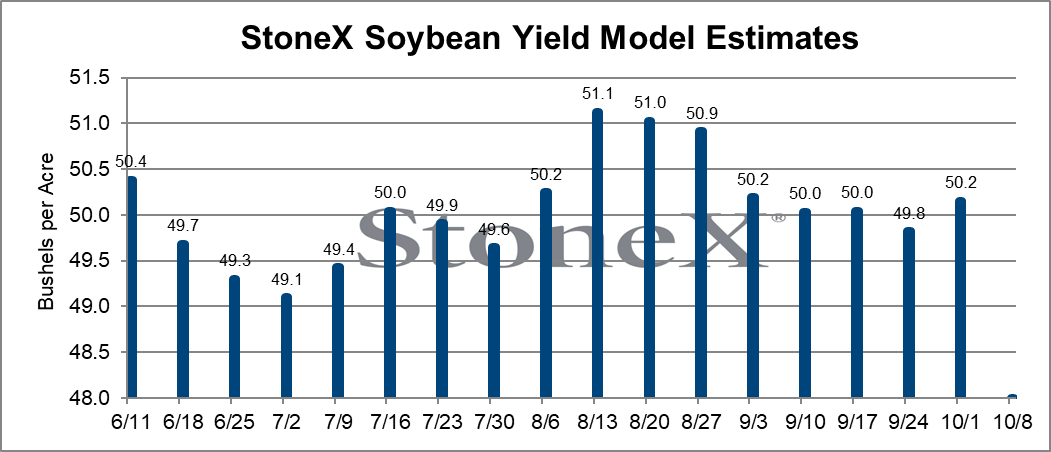
This week's soybean condition index score is also 339, up from 334 the previous week, but down from 342 in the same week last year and down from the 10-year average for the week of 362. That puts my yield model at 50.2, which is very close to our October StoneX estimate of 50.4 bpa from our customer survey and USDA at 50.1 bpa. Again, the response on X has been the same. My bias is that we may see lower yields from the later maturing corn and soybean fields, but the data thus far has not given the trade a reason to be concerned about tighter stocks amid weak export demand, and that allows grain and oilseed prices to be influenced by headwinds coming from the outside markets.