September 27 - Early stock strength quickly faded following the release of a stronger-than-expected durable goods report this morning that showed a more robust outlook than expected that could keep the Fed leaning hawkish. The VIX is trading closer to 19 once again at this hour, with the dollar index trading at fresh 10-month highs near 106.6. Yields on 10-year Treasuries are trading near 4.56%, which puts them on the cusp of fresh 16-year highs, while yields on 2-year Treasuries are trading near 5.09%. Crude oil prices are up by more than 3.5% to fresh 13-month highs as supplies tighten, while the grain and oilseed sector is mixed. Wheat prices drifted lower with a stronger dollar in the absence of fresh supportive news, while corn and soybean prices posted modest gains ahead of Friday's USDA quarterly grain stocks report that is known for its market-moving surprises. There's a bit of a bias that we could see USDA tighten supplies in Friday's numbers, possibly followed by lowered yields in its October 12 crop report if the government stays open.
Grain is moving out of Ukraine ports once again. It's not a lot of grain at this point, but it is slowly gaining momentum. Ukraine established a humanitarian corridor that hugs its coastline toward Romanian waters some weeks back, which allowed ships trapped at port since the start of the war to slowly start to leave. Roughly 100 ships were trapped at Ukraine ports when the war started in February 2022, with 50 of them remaining there today. Most of the blocked ships currently are in ports of the Mykolaiv region (29), with another 14 ships at Kherson and 5 at Mariupol and 2 remain at Odessa. Slowly, these ships have started to test the humanitarian corridor, with Russia thus far doing little to stop them. That's given courage to other ships to enter Ukraine ports via the corridor to pick up grain and other cargo. The first ship carried just 3,000 metric tons of grain, but they've grown successively larger. Ukraine was successful in getting an insurance facility set up to cover these ships, albeit at a cost. Ukraine said weeks ago it was working on a subsidy package to help cover insurance coverage, so I assume that is currently being used, but I have no confirmation of such. The goal is to get water exports to 30% of pre-war levels, that when combined with land exports, would bring total shipments to roughly 4.5 million metric tons per month. Russia has thus far avoided direct attacks on ships, choosing instead to target the port facilities. That is slowly destroying Ukraine's loading capabilities, while raising risks for ships docked for loading. Those port strikes increased notably this week as ship movement has escalated as well. Meanwhile, Ukraine continues to work with its neighboring countries towards negotiating solutions for moving grain over land to the west through those countries toward other export terminals.
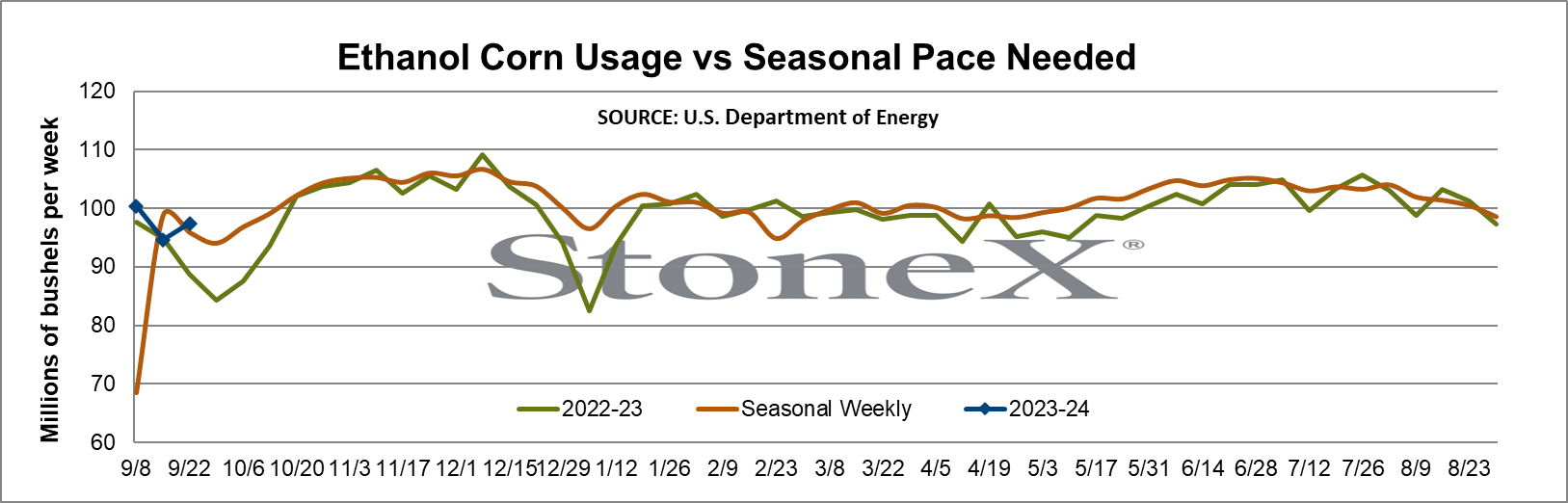
U.S. commercial crude oil stocks (excluding the Strategic Petroleum Reserve) fell by 2.2 million barrels to 416.3 million barrels in the week ending September 22, leaving them roughly 4% below levels normally expected this time of year. Gasoline stocks rose by 1.0 million barrels, putting them about 2% below seasonal levels. Distillate stocks increased by 0.4 million barrels, leaving them 13% below levels typically seen this time of year. Ethanol stocks rose to 22.0 million barrels in the week ending September 22, up from 21.7 million the previous week, but down from 22.7 million in the same week last year. Ethanol production rose to 1,009K barrels per day last week, up from 980K bpd the previous week, and significantly higher than the 855K bpd the previous year. Estimated corn use for producing ethanol totaled 97.5 million bushels last week, up from 94.7 million the previous week, and up from 94.3 million bushels in the same week last year. That brings estimated corn use for ethanol through the first 22 days of the corn marketing year to 306 million bushels, up about 10.5 million or 3.6% from the same period last year. Overall corn use for ethanol is a bit stronger to start this year than it was a year ago, as shown below.