September 28 - Good news is bad news on Wall Street, with the opposite true as well. A strong economy raises fears of more aggressive action by the Federal Reserve to slow it down to contain inflation, whereas poor economic data raises hopes of a pivot by the Fed. Treasury yields reversed notably lower this morning as housing data came in poorer than expected, supporting a rebound in stocks and a decline in fears on the Street. The VIX is trading near 17 at midday, while the dollar index is notably lower near 106.1. Yields on 10-year Treasuries are trading near 4.62%, after hitting new 16-year highs just below 4.69% earlier in the session, while yields on 2-year Treasuries are trading near 5.10%. Crude oil prices are 1% lower after hitting fresh 10-month highs earlier in the session, while the grain and oilseed markets are mixed in quiet trade ahead of tomorrow's set of USDA reports.
Soybean prices came under modest pressure this morning as unconfirmed rumors floated through the markets that Chinese buyers had washed out some U.S. soybean purchases. It wouldn't be unusual for China to do so, but it would be unusual for them to do so in late September - just ahead of our peak export season, especially when their purchases of U.S. soybeans are already at low levels for this time of year. Marketing year soybean sales to date to all destinations are down 330 million bushels from year ago levels, mostly due to slower sales to China. Year-to-date sales at 652 million bushels for the 2023-24 marketing year fall short of the seasonal pace needed to hit this year's lower target by 137 million bushels, and the deficit is rapidly growing. Meanwhile, marketing year to date corn export sales total 495 million bushels, which are down 90 million bushels from seasonal levels needed to hit USDA's target.
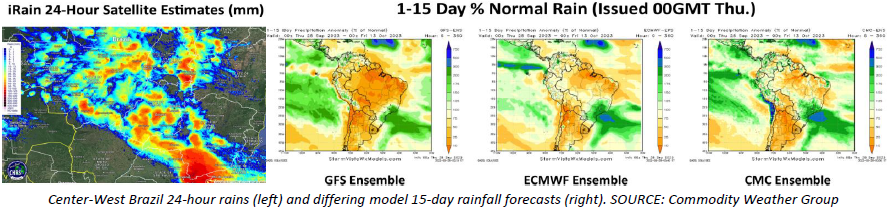
I reported yesterday that China has much of what it needs booked through November, but that it is holding off purchases for December and January until it sees when the monsoon rains will start for Brazil. A timely start in the days ahead would suggest a normal crop and harvest, while a late start would suggest production risks and delayed harvest. Forecast models have varied widely, with some turning wet late this week, while others remain quite dry. Commodity Weather Group notes that notable rains began to fall in dry areas of Center-West Brazil over the past 24 hours that were best anticipated by the CMC (Canadian) model, and totally missed by the American GFS model. The European ECMWF model was next closest to the CMC. Those models show chances for more rains over the next 15 days - not heavy totals, but adequate to start the growing season.
Negotiations continue in Congress to get something moving that would fund the government. Both the House and the Senate have stopgap bills in hand to keep the government open, but there are doubts whether the Senate will pass anything currently coming out of the House. The House has approved bills for funding four of the 12 sectors of government, but that doesn't keep the government open and it is doubtful that the Senate will approve any of them. It's not unusual to see an eleventh hour agreement to keep the government open, but the current sense is that we are headed into a partial shutdown that will have the markets operating in a vacuum of official fundamental data starting next week. That means little to no official supply and demand data from USDA or the Department of Energy.
The pending home sales index for August fell 7.1% month-on-month to 71.8, down from a downwardly revised 77.3 in July. Rising mortgage rates above 7% helped push pending home sales lower in all four U.S. regions. The index is based on contract signings that typically lead to a closing. Pending transactions are currently down 18.7% year-on-year. The industry continues to indicate a lot of pent up demand for housing, but that demand isn't translating into sales currently due to high mortgage rates and uncertainty about the economy.