September 3 - Subdued manufacturing and construction activity put a damper on Wall Street's enthusiasm today, with traders also looking ahead to a plethora of jobs data later this week. The VIX traded to a three-week high above 18 by midday, while the dollar index traded higher to 101.8. Yields on 10-year Treasuries are trading near 3.85% at midday, while yields on 2-year Treasuries are trading near 3.89%. Crude oil prices are down by more the 4% at fresh seven-month lows on demand concerns amid weak Chinese economic data, while the grain and oilseed markets are solidly higher.
The grain and oilseed sector was the weakest of the commodity sectors over the past year, raising chatter that perhaps they are undervalued. That may hinge on whether the market is comfortable with the size of this year's corn and soybean crops, which won't be determined until we see September updated estimates. StoneX is due to release the results of its September customer survey yield and production estimates tomorrow afternoon. In the meantime, we're seeing active speculative short covering as chart signals begin to turn. Little has changed fundamentally, but prices are rising with the short covering until the farmer begins to sell his massive supplies. Weakness in the equities seems to be encouraging today's short covering as well. Harvest pressure is expected to start ramping up over the next couple of weeks.
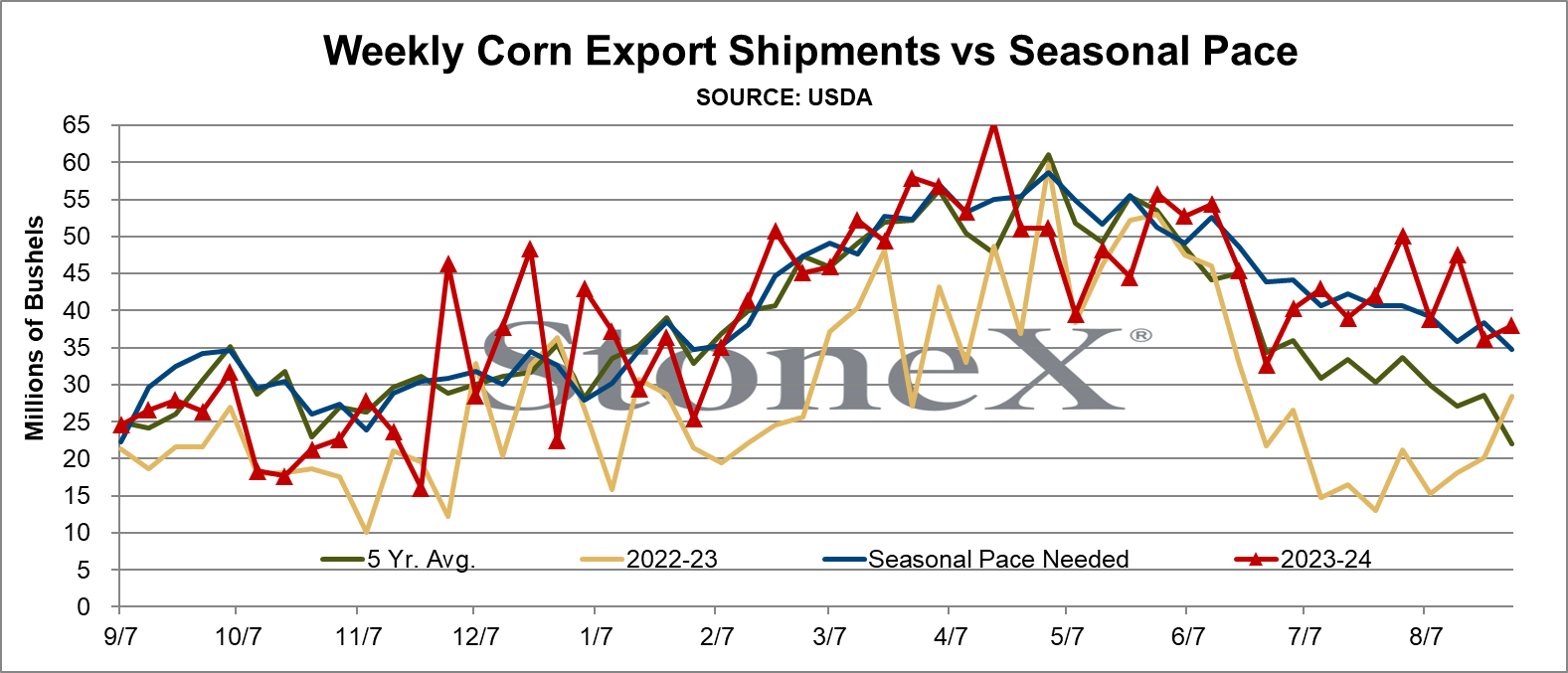
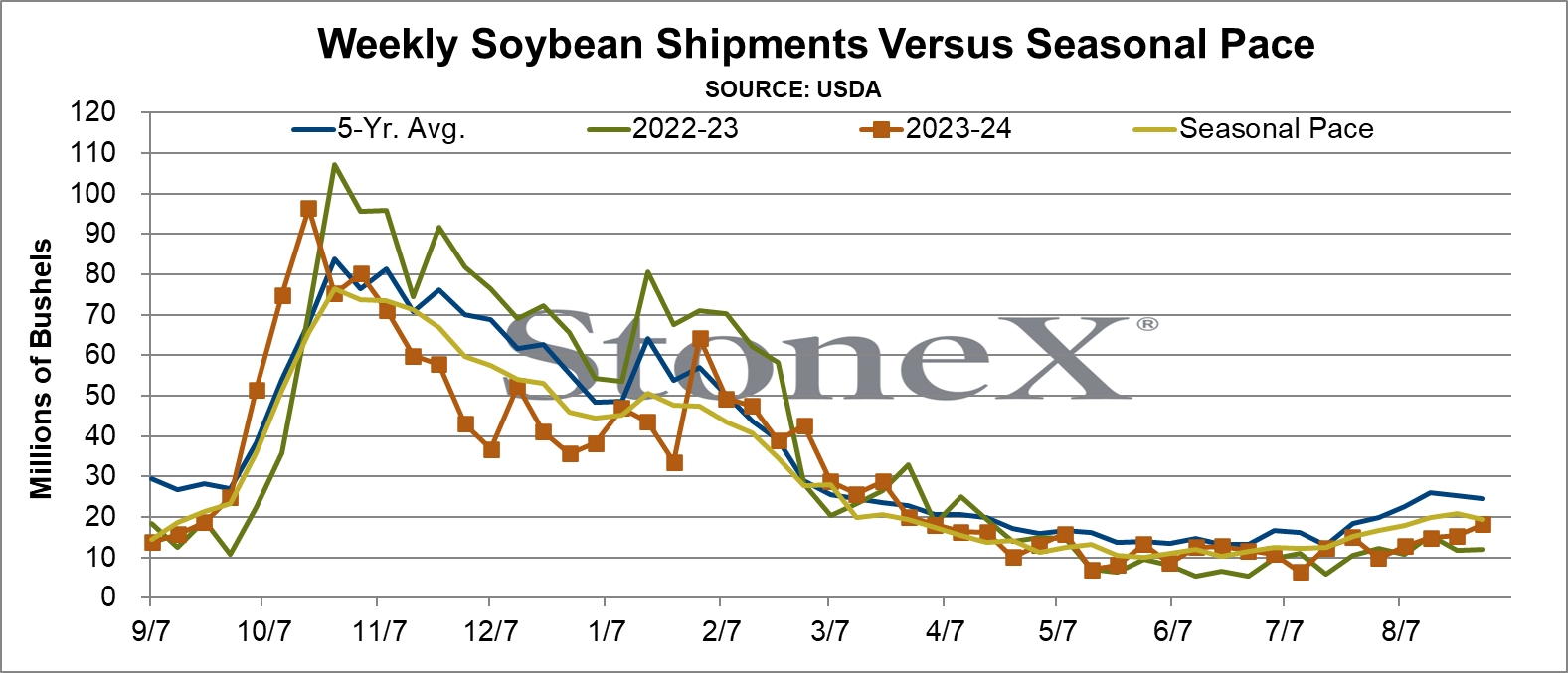
USDA inspected 38 million bushels of corn in the week ending August 29, as shown below, along with 18.3 million bushels of soybeans, 21.2 million bushels of wheat, and 4.8 million bushels of grain sorghum. The portion of the above that was inspected specifically for shipment to China included 7.1 million bushels of soybeans, 4.8 million bushels of grain sorghum, and 0.07 million bushels each of both corn and wheat. This morning's weekly export inspection report leaves just two days of data left in the 2023-24 marketing year for corn, grain sorghum and soybeans, which will be included in next week's report.
Marketing year to date corn inspections for export total 2.048 billion bushels, which falls far short of USDA's target of 2.250 billion bushels. However, not all grain is inspected before it is exported due to trade agreements, such as the agreement that we currently have with Canada and Mexico. Export shipments that are not inspected show up in the Census data, but that data is 6 - 8 weeks delayed. Census data through June indicates that there were 192 million bushels shipped that were not inspected in the first 10 months of the marketing year. Adding that to marketing year to date inspections through August 29 would bring the total to 2.241 billion bushels. Adding on anticipated non-inspected shipments in July and August, combined with inspected shipments in the final two days of August, should put us over the top, leading to a modest increase in USDA's old-crop export target in either the September or October crop report.
Marketing year to date soybean inspections for export total 1.643 billion bushels. Export shipments that are not inspected totaled 46 million bushels in the first 10 months of the marketing year. Adding that together brings the total to 1.689 billion bushels, which is just 11 million bushels short of USDA's target for the 2023-24 marketing year of 1.700 billion bushels. Adding on anticipated non-inspected shipment in July and August, combined with inspected shipments in the final two days of August, should bring us very close to USDA's target of 1.700 billion bushels. I expect that any adjustments will be very small going forward, unless those non-inspected shipments were much larger than anticipated in July and August.