September 4 - Stocks slowly firmed into mid-morning, before turning choppy, following mixed economic data released today that fanned rate cut optimism. Factory orders rose 5.0% month-on-month in July, beating expectations of 4.6%. Factory orders ex-transportation were up 0.4% in July, while computers/electronic product orders fell 0.3%. The latter is a measure of business sentiment. Along that line, today's JOLTS report showed end of July posted job openings declined to 7.673 million, down from a downwardly revised 7.910 million the previous month, and below analyst expectations of 8.1 million. That puts posted job openings at their lowest level since January 2021. New hires changed little during the month at 5.5 million, while separations increased modestly to 5.4 million. Quits at 3.3 million and layoffs and discharges at 1.8 million also changed very little in July. The ratio of job openings to unemployed slipped to 1.07 in July, bringing the jobs market into better balance as it continues to soften. Firms aren't laying off employees, but neither are they expanding at a significant pace. As such, the numbers gave traders hope that Friday's jobs report will give the Federal Reserve the data that it needs to justify a larger rate cut.
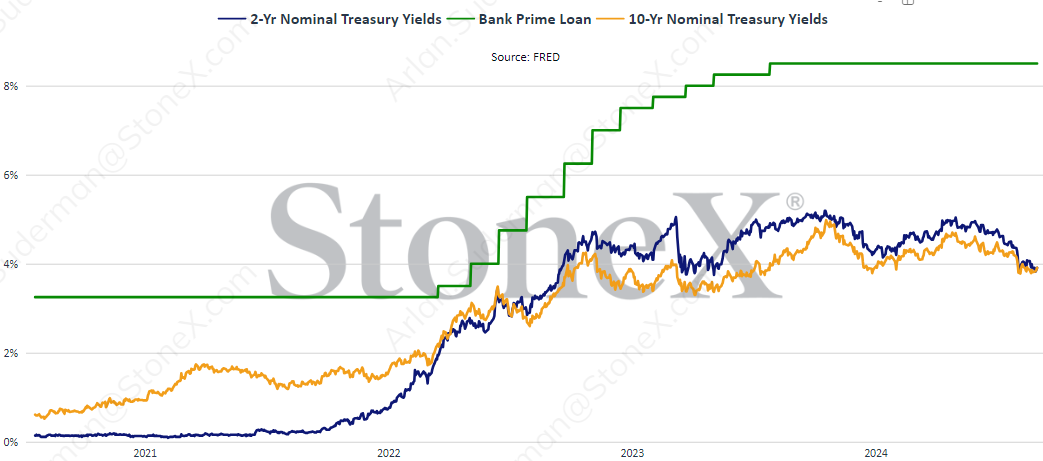
Stocks are mixed to firm at this hour, as Wall Street consolidates ahead of additional employment data later this week, following big losses on Tuesday. The VIX is trading near 20 at this hour, after opening at a 26-day high above 23 this morning, while the dollar index is notably lower near 101.4. Yields on 10-year Treasuries are trading near 3.79%, while yields on 2-year Treasuries are trading near 3.79%. The yield inversion that has been so prevalent the past couple of years went positive at times this morning. The inversion gained momentum in July 2022, raising talk on Wall Street of an imminent recession. Individual sectors of the economy slipped into recession, such as manufacturing and housing, but the economy as a whole remains resilient. Now prognosticators are telling us that the flip of the inversion back to positive means that a recession is imminent. Cyclical recessions happen on average every 6.5 years, so a recession may be coming. But I would also argue that some of these old "rules of thumb" observations are not as accurate in an economy that is heavily stimulated by fiscal spending.
Crude oil prices are modestly lower below $70 per barrel at this hour, after posting a new low for the year near $69 on recession concerns earlier in the session. Meanwhile, the grain and oilseed markets continue to have a firmer bias as speculative funds unwind massive short positions in the complex. The farmer is the big "long" in the grain and oilseed market, which is expected to cap gains without stronger fundamental supply and demand support. That includes both the Brazilian and the U.S. farmer, with both being behind in their marketing patterns this year. Drought in portions of the U.S. Southern Plains and in the Black Sea Region raise concerns for the 2025 winter wheat crop, but it's difficult to sustain a rally at this point based on Black Sea dryness when the cash market in that region remains quite weak as exporters seek customers. Corn and soybean prices have also enjoyed a nice short covering bounce, but confirming a harvest low typically requires the market to be comfortable with the size of the approaching harvest. Traders will look to the next round of production estimates from both private sources and from USDA on September 12th to get an indication of whether this year's corn and soybean crops are getting bigger or not. The first of those estimates will be the monthly StoneX customers survey results to be released this afternoon. The StoneX survey pegged the corn yield at 182.3 bushels per acre August 1, with soybeans at 52.6. A larger number this afternoon would suggest that the crops are still getting bigger, while smaller numbers would ease those fears of bigger crops.