September 5 - Federal Reserve Chair Jerome Powell stated at Jackson Hole that the central bank is now focused on sustaining the jobs market at current levels or better. He indicated that the Fed would adjust policy as necessary to do that, while also saying that we had essentially brought inflation down, with it no longer being a threat. That put Wall Street's focus squarely on employment data. This morning's data raised fears of a deteriorating jobs market, even though it was mixed in nature. That was followed by better than expected purchasing managers data, and ISM service data. The PMI composite final index came in at 54.6, suggesting notable month-on-month expansion, with the services index at 55.7. Both were above analyst expectations. The ISM services index came in at 51.5, again slightly higher on the month and above expectations. Yet, Wall Street remained focus on recession fears, creating a risk-off environment in the markets. Money flowed into the relative safety of government securities, weighing on Treasury yields.
Stocks erased early gains, although the tech sector is trying to hold onto modest positive numbers at midday. The VIX is trading near 21 at this hour, while the dollar index is weaker near 101.1. Yields on 10-year Treasuries are trading near 3.74%, while yields on 2-year Treasuries are trading near 3.75%. Crude oil prices are bouncing a bit following this week's sharp selloff, while the grain and oilseed markets are taking back a portion of their recent short-covering rally. Even the protein sector is under pressure today, with losses on Wall Street spilling over into the livestock market, with cattle leading the way lower on soft demand concerns.
OPEC+ will extend current voluntary output cuts through November, another two months longer than previously announced, according to a statement released today. OPEC+ currently has cuts of 5.86 million barrels per day in place, seeking to support crude oil prices in the economic malaise that has followed the post pandemic higher interest rate environment. OPEC+ members had already previously agreed to extend the 3.66 MMb/d mandatory cuts through 2025, but they had planned to gradually bring back the 2.2 MMb/d of voluntary cuts starting in October. However, the recent plunge in prices on poor China economic data and thoughts that Libyan production would be returning online led to OPEC+ leaders revisiting the issue. Crude oil prices found some stability today on the reports of an extension of the cuts, but healing this market still will take demand. That can be a problem if the U.S. economy turns south, on top of the problems already in China.
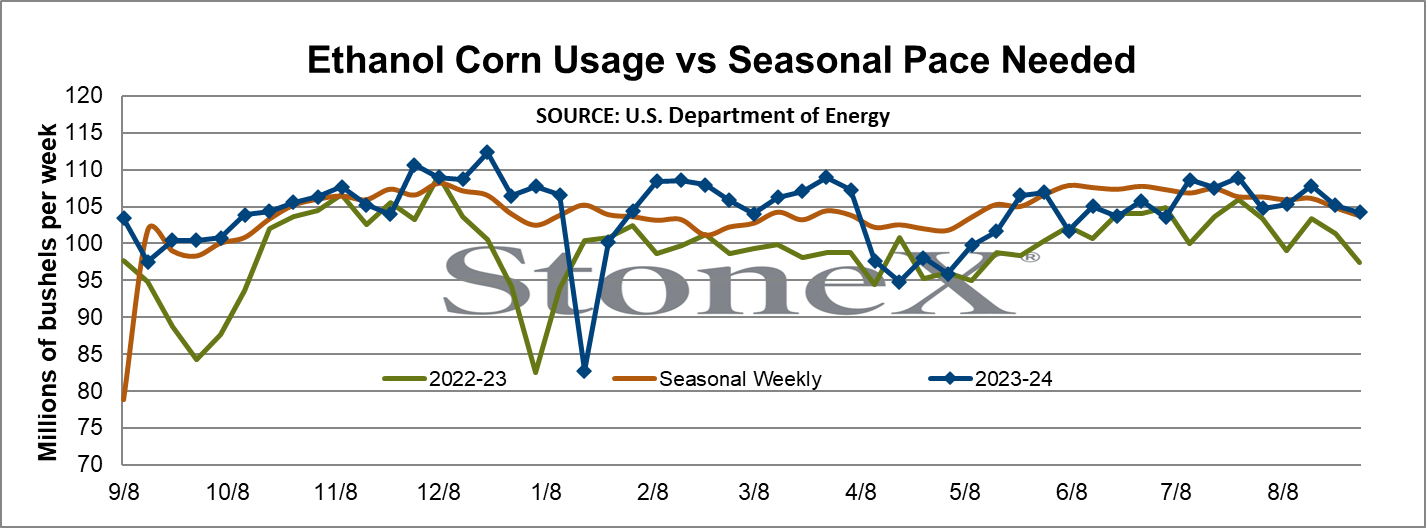
U.S. commercial crude oil stocks (excluding the Strategic Petroleum Reserve) fell by 6.9 million to 418.3 million barrels in the week ending August 30. that puts supplies roughly 5% below the five-year average for the end of August. Gasoline stocks rose by 0.8 million barrels, leaving them 2% below levels typically seen in late August. Distillate stocks dropped by 0.4 million barrels, putting them 10% levels typically seen at the end of August. Ethanol stocks slipped to 23.4 million barrels in the week ending August 30, down from 23.6 million the previous week, but up from 21.6 million barrels in the same week last year. Ethanol production slipped to 1,061K barrels per day last week, down from 1,071K bpd the previous week, but up from 1,012K bpd in the same week last year. The production of fuel ethanol utilized an estimated 104.2 million bushels of corn in the week ending August 30, as shown below, down from 105.2 million bushels the previous week, but up from 97.9 million bushels the previous year. With one day left in the marketing year, marketing year estimated corn use for fuel ethanol production totaled 5.440 billion bushels, up 248 million bushels or 4.8% from the previous year's pace. Once we get the data for the last day of the corn marketing year, we should see that marketing year total closer to 5.455 billion bushels, which would be about 5 million bushels above USDA's target for the year.