January 30 - Stocks are starting the day slightly weaker after the major indexes closed at all time highs yesterday, while the VIX rises slightly but remains relatively low near the 13.7 level. The dollar is also down slightly after yesterday's gains, hovering above 103.2 at the time of writing. Treasuries are down slightly as they trade to two-week lows, with 10-year yields at 4.05% and 2-year yields around 4.3%. Crude oil is roughly unchanged to start the day following a reverse in course yesterday that saw the nearby WTI contract push above $79/barrel before falling to close below $77. The ags are mixed, with the soy complex attempting to find some strength while most of the grains start today in the red again after yesterday's weakness.
The Federal Open Market Committee kicks off their January meeting today, reconvening with seven more weeks of U.S. economic data under their belts since their last get together. Widespread expectations are for rates to stay unchanged at this week's meeting, with the focus instead on the commentary and mindset of Fed members as traders look for any semblance of optimism for impending rate cuts. Market expectations for a rate cut at the March meeting (3/19 - 3/20) have fallen from their initial optimism to hover around a 50/50 chance, with traders waiting to digest additional inflation data as well as the results of this week's meeting. While considerable progress was made in the fight against inflation through 2023, the Fed has continued to express their position of wanting to avoid pivoting too early and risking a resurgence in inflation in 2024. We know that the last percentage point reduction to reach their 2% mandate is the hardest, and that's why their policy decisions in 2024 will carry so much weight. While we don't expect any wild surprises from this week's meeting, it will certainly bring back to center stage the debate in the market of when the long-awaited Fed pivot will arrive.
The Euro zone's economy avoided a recession to end 2023, with this morning's GDP reading for Q4 showing 0.1% year-on-year growth and no change in quarter-on-quarter terms. While this doesn't sound great on the surface, the flat Q4 did beat expectations of matching the -0.1% quarter-on-quarter decline seen in Q3, largely driven by better than expected growth in southern Europe (Portugal +0.8%, Spain +0.6%, Italy +0.2%). However, the news wasn't as positive everywhere, with manufacturing powerhouse and Europe's largest economy, Germany, showing a -0.3% decline due to the continued weakness in the global manufacturing sector. Notable declines were also seen in France and Ireland. While the individual countries' economies aren't on the scale of the U.S. or China, the Euro zone countries combine to make up the second largest economy in the world, meaning the region's economic health carries plenty of weight for the global economy. Growth in Europe has lagged that of the U.S. through the last year, and expectations are for that trend to continue, driven home by the IMF this morning downgrading their forecast for Euro zone economic growth to only 0.9% in 2024 and 1.7% in 2025.
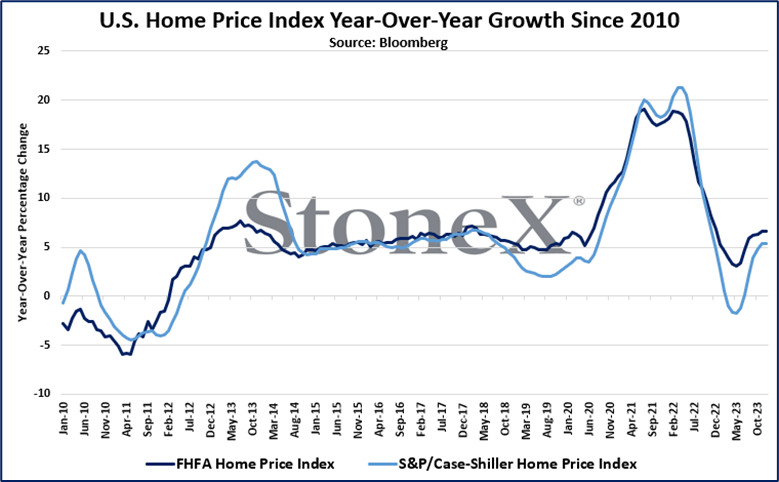
The U.S. housing market continues to show strength, with this morning's housing price indexes from both the FHFA and S&P/Case-Shiller showing an uptick in November. The FHFA's House Price Index showed a 6.6% year-on-year rise in November, slightly above expectations of 6.5% while rising from the 6.3% seen in October and marking the sixth consecutive month of gains. The S&P/Case-Shiller Home Price Index of twenty cities didn't show as aggressive growth, coming in at a 5.4% year-on-year rise in November, above the month prior's 4.9% but below market expectations of a 5.8% climb. Detroit and San Diego saw the sharpest growth, up 8.2% and 8.0%, respectively, while the only city seeing a decline was Portland at -0.7%. With housing making up such a large percentage of the average American's budget, inflation in the housing sector has a large influence on overall inflationary pressures in the U.S.