March 20 – The Fed calmed the market yesterday after holding their target rate steady at 4.25% - 4.50% as expected, with stocks rallying into yesterday’s close, but that boost may prove to be short-lived as stock futures are pointing to a lower open this morning. Perhaps it was the lack of surprises following months of rapid market moving headlines that allowed a relatively mundane FOMC meeting to be taken with optimism, with the VIX cooling into the close yesterday but rising to 20.5 at the time of writing. The Fed’s policy statement noted that “uncertainty around the outlook has increased,” while Fed Chair Jerome Powell was quoted as saying the Fed needed to “wait here for greater clarity,” with this rhetoric falling right in line with the market’s expectations. Powell also attempted to provide confidence to an anxious market by stating “our current policy stance is well-positioned to deal with the risks and uncertainties we face.”
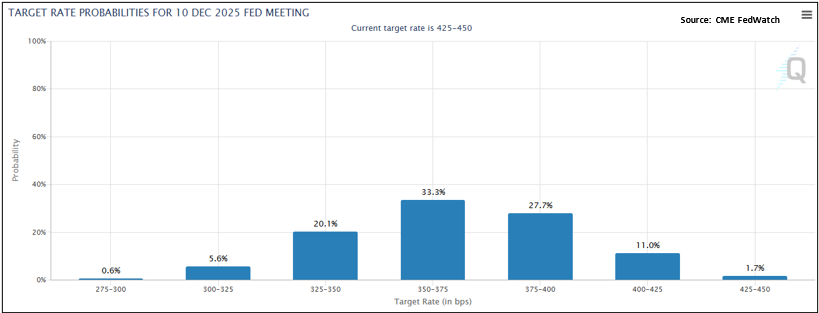
Fed policymakers expect to see two 25 basis point rate cuts by the end of 2025, steady with their previous projection and in line with market expectations going into yesterday’s meeting, though that has shifted to expectations of three cuts today, as can be seen in the below graphic from CME’s FedWatch. The Fed signaling their intentions of taking a wait-and-see approach is allowing the dollar to firm again today, pushing to new highs for the week near 104 to start the day. Meanwhile, treasuries look to start the day on a sharply weaker note, with 10-year yields near 4.18% and 2-year yields near 3.93%. Crude oil looks to get off to a quiet start, with May WTI hovering just below the $67 mark. The ags are mixed to start the day, with corn looking to cling to small gains while most of the other grain and oilseeds fall, and the cattle complex continuing its push upward as feeder cattle futures again carve out fresh highs.
Perhaps the most noteworthy takeaways from yesterday’s FOMC meeting were the changes made to the Fed’s economic outlook. To start, inflation expectations for 2025 were raised to 2.7% from the 2.5% previously anticipated in December, with expectations beyond 2025 kept steady and inflation seen returning to the Fed’s 2.0% mandate by the end of 2027. The outlook for 2025 U.S. economic growth was revised downward from 2.1% to 1.7%, with 2026 and 2027 both pegged at only 1.8%. Unemployment expectations were raised from 4.1% to 4.4% in 2025, while 2026 and 2027 were projected at 4.3%. Additionally, the Fed yesterday announced their intentions to slow the pace of quantitative tightening starting next month, also meeting general expectations of the market going into the meeting, though some expected a full pause.
Initial jobless claims rose slightly week-on-week to 223K, a hair below analyst expectations of a larger rise to 225k, while the week prior was revised up from 220K to 221K. Continuing jobless claims rose at a slightly higher clip, coming in at 1.892M and representing a 1.8% week-on-week increase from the downwardly revised 1.859M in the week prior. Four-week average jobless claims continue trending higher, rising to their highest level since early November at 227K.
The Philadelphia Fed’s Manufacturing Index fell to 12.5 in March, the lowest since December but still beating estimates of a sharper dip to an 8.5 reading. Notable declines were seen in new orders and shipments, but there was a silver lining for the labor market with the employment subindex unexpectedly climbing to 19.7, the highest level seen since October 2022. On a more negative note, the business conditions subindex tanked to only 5.6, the worst reading since January 2024 and continuing the downtrend seen since peaking back in November. Keeping with the theme of rising inflation expectations from the Fed, the prices paid subindex continued its sharp climb to start 2025, reaching 48.3, the highest level seen since July 2022. While February inflation data largely came in better than expected, readings like this can act as leading indicators of inflationary pressures to come.