October 16 – The tech sector is looking to rebound from yesterday’s sharp losses driven by disappointing results and forward guidance from Dutch chip giant ASML. With the AI craze being one of the largest drivers pushing stocks to all time highs in 2024, the fear is yesterday’s results could be a sign of the hype in the chip sector being overblown, but the hope is that this was just a one-off and that upcoming earnings will allow us to put it behind us. Meanwhile, the VIX is hovering near the 20.7 level. The dollar is starting the day slightly in the red after losing steam yesterday, though it remains near the roughly two-and-a-half month high put in on Monday around the 103 level. Treasuries are also starting off narrowly in the red, with 10-year yields trading at 4.02% and 2-year yields trading at 3.93%. Crude oil is looking to stem the bleeding from the early week selloff that has seen the nearby WTI contract lose ~6.5% over two trading days on a combination of Chinese economic concerns and a cooling of geopolitical tensions with news of Israel potentially focusing their retaliation on Iranian military targets rather than energy. The ags are starting the day mixed, with the soy complex leading the way higher while the wheat and livestock complexes push lower.
China’s State Council Information Office will hold a press conference tomorrow to discuss measures targeting the country’s long-struggling property sector. One of the biggest disappointments in the wake of the recent stimulus measures announced by the Chinese government has been the lack of details given, bringing skepticism that has allowed Chinese stocks to slide from their initial bounce in response to the stimulus. China’s housing sector has finally seen its first optimistic readings in recent memory this month, but it’s clear that a true sustained recovery will be a long, involved process. It will be interesting to see what details are announced tomorrow, and whether or not the trade believes said details can actually move things in the right direction.
NOPA soybean crush set a new record for the month of September at 177.3 million bushels, according to yesterday’s report, a full 7 million above the average trade guess and coming in above the top-end estimate of 177.0 million. This gets the new marketing year off to a strong start, coming in 7.1% above the same month last year, with USDA calling for a 6.0% year-over-year increase. Soybean oil stocks of 1,066 million pounds were slightly below the average trade guess of 1,083 million, implying 2,186 million pounds of domestic usage in September, also a record for the month. Soy oil futures rallied in response yesterday despite the selloff in crude and is starting today off in the green again.
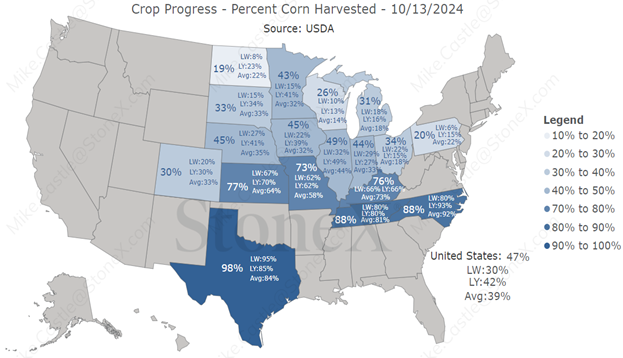
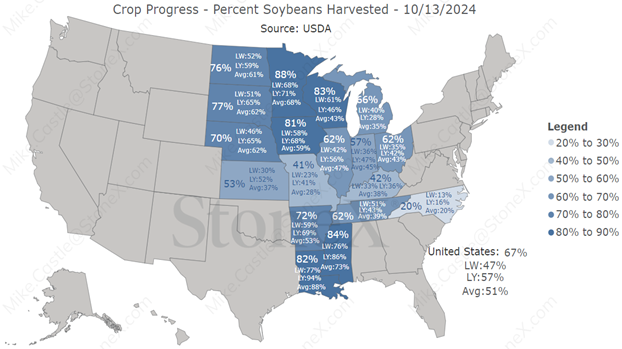
Fall harvest in the U.S. continues ahead of schedule, with corn and soybean harvest advancing 17% and 20% week-on-week, respectively, according to yesterday afternoon’s holiday-delayed USDA Crop Progress report. Soybean harvest now sits at 67% complete, a massive 16% ahead of the previous 5-year average pace, with corn harvest at 47% complete, 8% ahead of the average pace. These were both ahead of market expectations, with the dry weather throughout almost the entire country in the last week helping speed things along. Forecasts remain dry through the remainder of this week as well, meaning we should see another big jump on next Monday’s report. The rapid harvest pace, combined with record yields for many, is certainly continuing to push the limits of storage capacity in the Midwest on the front-end.
Winter wheat planting made less progress than expected, however, advancing 13% week-on-week to reach 64% complete. That trails last year’s pace at this time by 1% and the 5-year average pace by 2%, with Oklahoma the most noteworthy laggard due to ongoing drought at 17% behind their average pace. Winter wheat emergence was pegged at 35%, also trailing last year by 1% but trailing the 5-year average by 3%. Forecasts do call for relatively heavy rainfall totals to make their way across much of the Southern Plains in the 6-10 day window, though eastern portions may miss out. It will be important to see how these forecasts verify, especially given the issues the global wheat crop is experiencing elsewhere around the globe.