October 18 – Stock futures are pointing to a mixed open to start Friday’s trade, with the Dow Jones in the red while the S&P 500 and Nasdaq look to add to yesterday's gains. The VIX is starting the day around where it ended yesterday around the 19.1 level. The dollar has had a strong week with the European and Chinese economies in question but is starting the day on a weaker note as it hovers above 103.3 at the time of writing. Treasuries are weaker this morning as well, with 10-year yields back below 4.08% and 2-year yields around 3.95%. Crude oil is down slightly this morning though remaining in the tight range seen the last few days as the nearby WTI contract hangs slightly below the $70 level, while the ags are mixed after this morning’s export sales report.
U.S. housing starts declined 0.5% month-on-month in September to a seasonally adjusted annualized rate of 1.354 million, in line with market expectations, while August was revised down slightly to 7.8% growth and an annualized rate of 1.356 million from the original 1.361 million print. Single-family housing starts actually rose by 2.7% month-on-month, though the headline reading was dragged down by a 4.5% month-on-month decline in starts of housing with five or more units. Building permits in the U.S. fell by 2.9% month-on-month to a seasonally adjusted annualized rate of 1.428 million, down from 1.47 million in August and below market expectations of a smaller decline to 1.46 million. The main weakness was again seen in housing with five or more units, falling a sharp 10.8% month-on-month, while single family units saw a 0.3% month-on-month climb. The biggest decreases in permits were seen in the Northeastern U.S., down 13.1% month-on-month, followed by a 6.1% decline in the South, 2.9% decline in the Midwest, but a sharp 10.9% jump in the West.
Israeli military leadership and Hamas have now both confirmed the death of Hamas leader Yahya Sinwar. Leaders of Israeli allies have raised the prospect of a ceasefire being achievable now, with U.S. Defense Secretary Lloyd Austin saying “Sinwar’s death also provides an extraordinary opportunity to achieve a lasting ceasefire,” though he also noted that the U.S. and Middle East are still ready to provide defense support to Israel. However, Lebanon’s Iranian-aligned Hezbollah vowed a “new escalating phase” against Israel following the news, while Iranian leadership taking a similar tone by saying “the spirit of resistance will be strengthened.” The crude oil market has taken a fair amount of risk premium this week after a strong start to October following Iran’s attack on Israel on the first, but fresh escalations in the already-broadened conflict could certainly change that. This morning’s price action is looking similar to yesterday’s as we’ve traded both sides of unchanged but now look to start the day slightly weaker. With the potential for more near-term escalations, it will be interesting to watch how traders handle today’s session heading into the weekend.
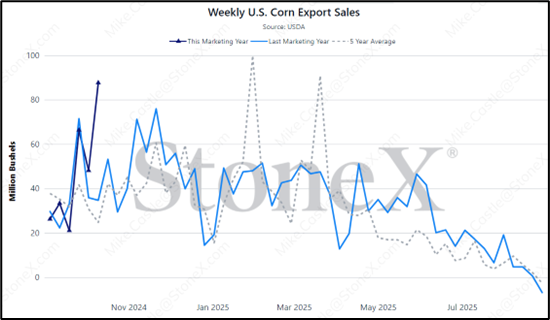
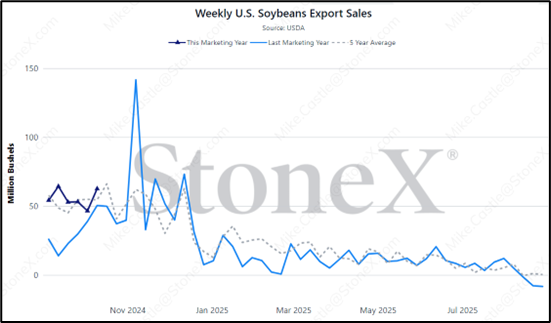
This morning’s export sales report from USDA showed massive corn sales of 87.6 million bushels in the week ending October 10th, above the top-end estimate of 86.6 million and marking the largest weekly sales seen since April 2023. More big corn flash sales were reported this week, most notably Wednesday’s huge chunk to Mexico but more smaller totals to Mexico and unknown destinations added up as well. This morning’s report pulls the U.S. ahead of the sales pace needed to meet USDA’s 2.325 billion bushel estimate by 0.7%. Soybean sales were strong as well at 62.6 million bushels, above the average trade estimate but within the range, marking the largest weekly sales since the week ending September 12th. Perhaps more noteworthy in the soy complex, however, was the 251,400 MT of soybean meal sales that marked a three-month high.
All wheat export sales came in at 18.5 million bushels, toward the high end of the estimated range (highest was 20.2M) and coming in as the largest wheat sales since late August. U.S. wheat export sales had trailed off a bit last month after a strong start the 2024/25 marketing year but have rebounded in October to keep us ahead of schedule to meet USDA’s 825-million-bushel export target. Hard red spring wheat was the leader at 7.7 million bushels, followed by white wheat at 5.5 million, hard red winter at 2.8 million, soft red winter at 1.4 million, and finally durum at 1.1 million. This follows the trend seen thus far in the marketing year, with hard red spring and white wheat both well ahead of their paces needed to meet USDA’s by class export targets, while hard red winter continues to lag.