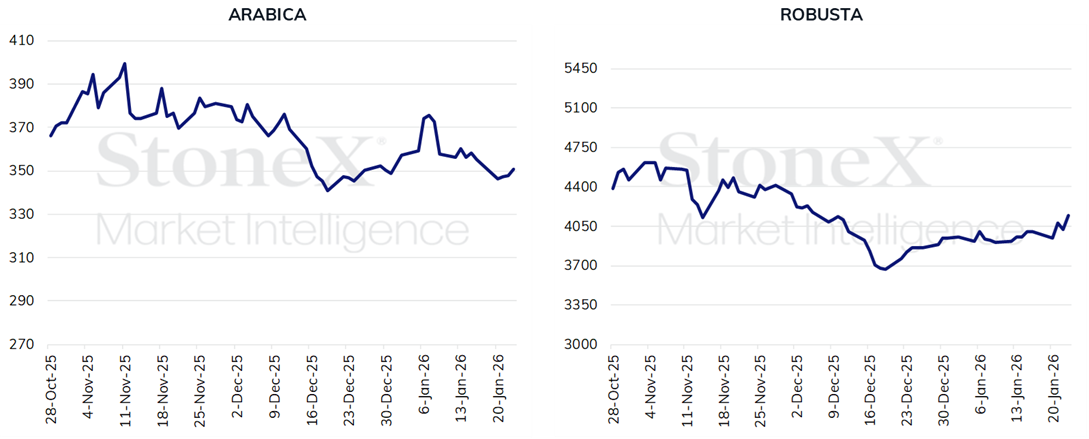
This Monday (26), international prices started higher, with the nearest Arabica coffee contract rising to US¢ 354.5/lb (+1.0%), while Robusta coffee increased to USD 4,050/t (+0.10%).
Exchange rate impacts on coffee prices and weekly outlook
Last week, international coffee prices were significantly influenced by the appreciation of the Brazilian real, which rose about 1.6% against the dollar during the period.
- In recent weeks, currency behavior has been dominated by a global weakening of the dollar, which has lost value against most international currencies.
Why this matters: The appreciation of the Brazilian real directly affects the dynamics of international coffee prices through two main channels: price formation in the exchange market and Brazilian producers’ export decisions.
- As Brazil is the largest coffee producer and exporter globally, coffee traded on international exchanges largely originates from costs denominated in reais. Thus, when the real appreciates against the dollar, Brazilian coffee becomes more expensive in dollar terms, directly increasing reference prices in futures markets.
- Apart from this pricing effect, a stronger real tends to reduce the attractiveness of exports from the producer's perspective. External revenues, when converted to the local currency, yield less, leading many players to slow external sales, postpone shipments, direct production to the domestic market, or hold inventories while waiting for a more favorable exchange rate.
Why has the Brazilian real appreciated?: The real’s good performance since early 2025 is more associated with the dollar's weakening than any specific improvement in Brazilian economic fundamentals.
- A global portfolio diversification trend has been observed, with reduced exposure to US-based assets amid heightened uncertainty in US trade and foreign policy.
- This context has simultaneously favored assets that typically do not move in the same direction, such as safe-haven instruments like gold, currencies from developed countries, and risk-sensitive assets such as commodities, stocks, and emerging market currencies, including the real.
- Last week, specifically, new threats from US President Donald Trump regarding imposing additional tariffs on countries opposing the annexation of Greenland contributed to intensified capital outflows from US assets, boosting the real and defensive assets further.
Expectations for the exchange rate this week: The week holds significant events for the foreign exchange market, notably monetary policy decisions in Brazil and the US, both scheduled for next Wednesday (28), as well as the release of inflation indicators in Brazil and economic activity data for both economies.
- Additionally, the market will closely monitor developments in the global geopolitical landscape, with tensions still present between the US, its trade partners, and strategic rivals.
Arabica coffee (KCc1) vs. USDBRL
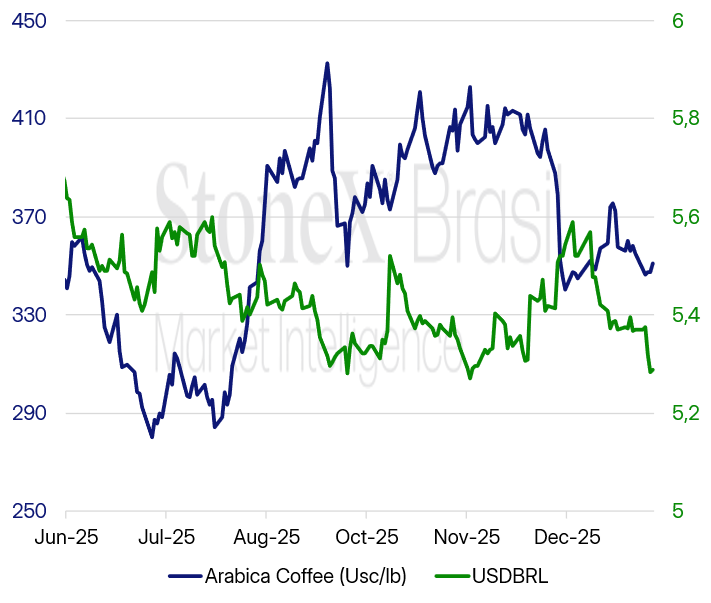
Source: StoneX CmdtyView. Prepared by: StoneX.
Robusta coffee (LRCc1) vs. USDBRL
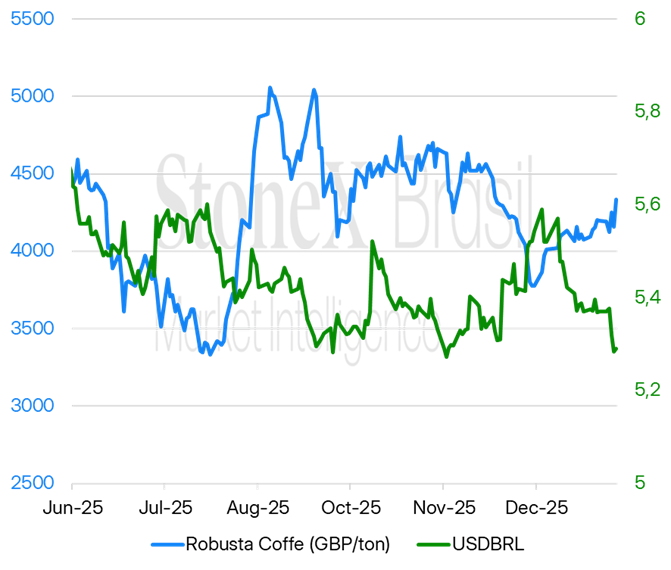
Source: StoneX CmdtyView. Prepared by: StoneX.
Climate outlook in Brazil
Short-term:
Short-term forecasts remain positive for much of Brazil’s coffee belt, especially for Arabica coffee areas, with rainfall anomalies indicating above-average precipitation across most producing regions, particularly in Cerrado and Southern Minas areas.
Why this matters: With fruit expansion completed, the current period is one of bean filling. Good rainfall ensures proper development, leading to high yields during the harvest. Sustained favorable weather conditions are likely to support the record crop outlook estimated by StoneX in November, which may exert bearish pressure on prices in the coming weeks.
Next few months:
The latest Weekly Weather and Climate Bulletin provided an in-depth analysis of Brazil’s prospects for the coming months. February and March will be critical for ensuring adequate soil water reserves needed for the final coffee crop development ahead of the dry season, while volumes are expected to decline starting in April.
Key concerns: Certain regions require attention, such as Matas de Minas, Southern Espírito Santo, and parts of Cerrado, as they are at the highest risk of experiencing below-average rainfall between February and May.
This information is highlighted by the hydroclimatic class indicator, which combines absolute rainfall volume and precipitation anomaly for the next four months.
Hydroclimatic class indicator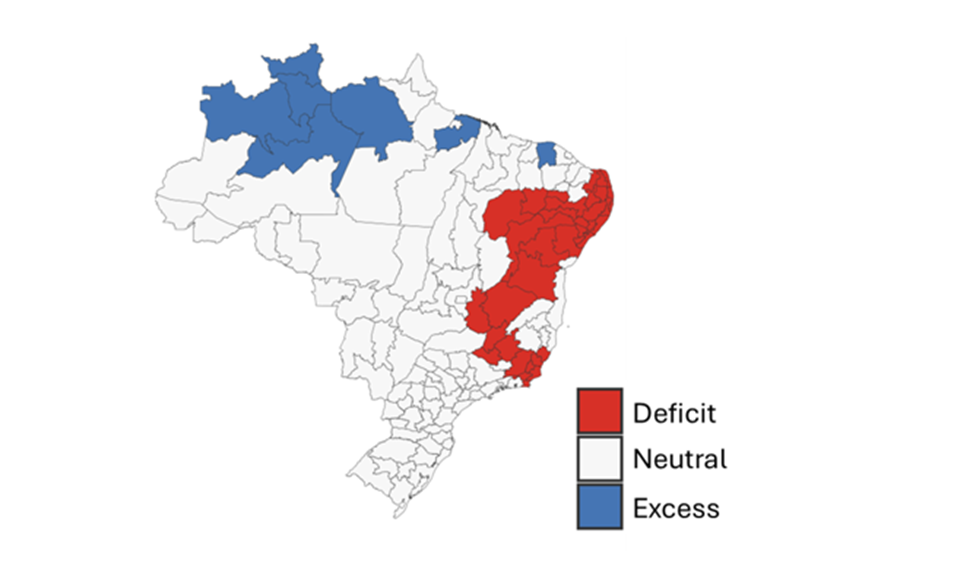
Source: StoneX. Prepared by: StoneX.
The indicator classification follows:
- Potential water deficit: significant negative anomaly + below-average accumulated rainfall, with higher risk of water stress.
- Potential water surplus: significant positive anomaly + high accumulated rainfall.
- Neutral: weak or offset signals between volume and anomaly.
Nevertheless, overall conditions in the country remain positive, with cited coffee regions requiring the most attention, especially if expected rainfall does not materialize.
For this week
Brazil: From a fundamentals perspective, market participants should closely monitor signals from Brazilian production this week, emphasizing weather conditions during the grain development period for the 2026/27 crop. This stage is particularly crucial for defining production potential, keeping weather as one of the main risk drivers for price formation.
- As the harvest approaches, market agents increasingly perceive a significant recovery in Brazilian production, a trend supported by recent crop estimate reports.
- According to StoneX projections released in November 2025, Brazilian production could register a near 13.5% increase, reaching approximately 70.7 million bags in the 2026/27 crop, reinforcing expectations of higher global availability.
Vietnam: Another key point concerns news of a slowdown in Vietnam’s trading pace last week, a factor that, as discussed earlier, contributes to sustaining Robusta prices. However, given expectations for a stronger crop in the country, the prevailing view is that this slowdown in sales is likely temporary, with more significant volumes potentially returning soon.
- Additionally, it’s worth noting the historical pattern of intensified Vietnamese sales typically occurring before the country’s main holiday, scheduled for February 14.
- This seasonal movement tends to increase short-term supply and could exert downward pressure on international Robusta prices.
- Initial signs of this dynamic may start materializing over the coming weeks, keeping the market sensitive to any indications of a stronger resumption of shipments.
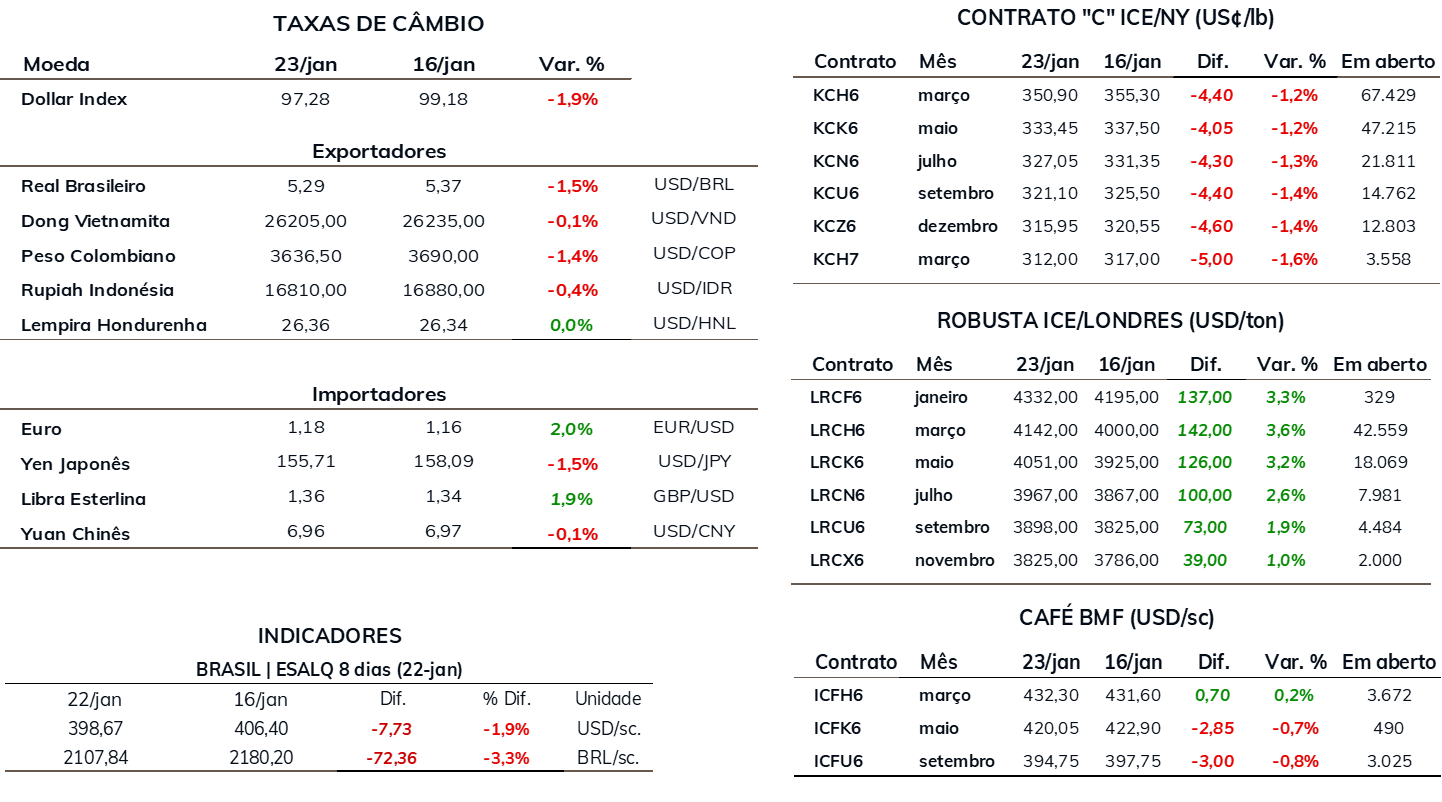
INDICATOR TABLE
Sources: ICE/NY; ICE/EU; B3; Commodity Network Trader’s Pro.