Coffee Reacts to Fundamentals and Declines During the Week
- Bullish
- Oil continues to pressure the broader commodity complex;
- Logistical disruption risks in vessel flows through the Red Sea;
- Smaller crop and sales restrictions strengthen Brazil's arabica coffee differentials in the short term.
- Bearish
- Record crop projections in Brazil;
- Positive crop development and stable weather conditions in Brazil;
- Upbeat projections for Vietnam and Indonesia's volumes in 2025/26;
- Survey reinforces market consensus for surplus and lower prices in 2026.
Monday Extends Downward Movement
Last week was marked by corrections in coffee futures prices. After gaining some traction amid rising oil prices and the broader commodity complex, as well as uncertainties stemming from the Middle East conflict, coffee futures returned to react to more favorable supply prospects as weather conditions remain positive in key producing regions of Brazil and Vietnam.
Arabica: The May contract ended the week priced at US¢ 304.7/lb on the New York exchange, down 2.6%. Following oil corrections earlier in the week, which allowed the market to refocus on its own fundamentals, coffee prices started to correct part of the gains recorded in the previous two weeks.
The latest CFTC report showed an increase in funds' net long positions, rising from 10,601 to 15,941 lots as of October 24 — the highest level since the end of January — opening room for profit-taking by speculative investors. Additionally, last Friday, Cooxupé, Brazil's largest coffee cooperative, announced it expects a 12% increase in supply from its members this year compared to last, reinforcing the outlook for greater availability in the coming months.
Robusta: The equivalent contract posted a weekly decline of 1.9%, closing at $3,593/t. Robusta prices also underwent technical corrections following the advances observed in the previous two weeks. While reports of Vietnamese farmers holding back sales persist, importers have increasingly turned to sourcing from Indonesia and Brazil to meet part of their needs, contributing to downward pressure on prices.
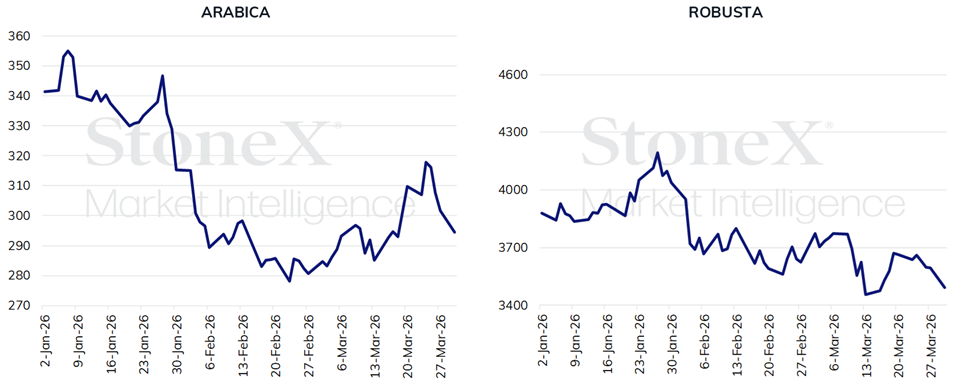
Source: CmdtyView. Analysis: StoneX.
Physical Market: The Cepea arabica coffee indicator closed the week at R$ 1,947.9/sack, a weekly decline of 0.8%. Meanwhile, the robusta coffee indicator recorded a slight uptick of 0.3%, closing at R$ 1,016.6/t.
On Monday: The market opened the session with another sharp drop in both exchanges, showing declines of 2.9% for arabica coffee and 4.8% for robusta coffee. In the absence of significant news, the positive supply outlook continues to weigh on prices. On the other hand, it’s worth noting that risks of conflict escalation in the Middle East — and potential new disruptions in vessel flows through the Red Sea following the entry of Yemen's Houthi paramilitary group into the conflict — still appear to be underpriced by market participants.
Survey Points to Consensus on More Comfortable Balance and Lower Prices in 2026
Reuters released a survey with coffee market participants, gathering key expectations for production, balance, and prices in 2026.
Details: The survey presents the median projections of consulted analysts, offering a general market consensus:
- Arabica: The median points to prices ending the year at US¢ 225/lb, approximately 35% lower than 2025's closing and 25% below last Friday's levels.
- Robusta: Projected at $2,500/t, representing a 36% drop compared to the end of 2025 and 30% lower than last week’s closing.
- Brazil: The median estimate for the Brazilian crop is 74 million sacks, a 10-million-sack increase compared to the previous season. It’s worth noting that StoneX estimates production at 75.3 million sacks, reflecting a 13-million-sack growth versus the prior crop.
- Vietnam: The survey points to 31 million sacks for the current season, a stable figure compared to the previous cycle.
- Global Balance: The median indicates a surplus of 8.7 million sacks in 2026/27, following a surplus of 1 million sacks in the previous season.
Why This Matters: The survey reinforces the consensus that, with higher global production in 2026, coffee prices are likely to decline by year-end. Unless this outlook is challenged by harvest or export data in the coming months, the market is expected to operate with a more bearish bias, especially compared to average prices observed in 2025.
Finally, it’s worth noting that StoneX will release its global coffee balance report for 2026 in the first half of April, presenting an updated view on key variables that may impact the global market, including production, demand, and overall balance estimates for the year.
Houthi Group’s Entry into Middle East Conflict Revives Memories of Logistics Crisis in Coffee Market
As highlighted in StoneX’s Weekly Oil Summary published this Monday (30th), over the weekend, Yemen's Houthi group resumed missile launches against Israel, with the Israeli government confirming interception by its air defense systems. However, the Houthis' actions have reignited broader concerns about the possibility of renewed attacks on vessels transiting the Red Sea — a scenario reminiscent of November 2023.
Why This Matters: While the Strait of Hormuz is a strategic gateway for global oil and gas shipments — especially to Asian powers — the Bab el-Mandeb Strait is critical for commodity flows, primarily between Asia and Europe. In this context, it’s worth recalling some key developments related to the Houthis’ involvement in the Israel-Hamas conflict and their impacts, particularly on the coffee market:
- November/2023: The Houthis, supporting Hamas, begin attacks on Israel and vessels transiting the Red Sea.
- December/2023: Major shipping companies start canceling shipments through the Red Sea. Insurance costs surge, and some vessels face challenges obtaining coverage altogether.
- Route Extension: Ships are forced to bypass the Cape of Good Hope in Africa, adding over 6,000 km to the journey compared to the traditional route through the Red Sea.
- Longer Transit Times: The additional route represents, on average, an extra two weeks for cargo transport, worsening conditions for buyers with lower inventory levels.
- Higher Costs: The significantly longer journey caused shipping costs between Asia and Europe to skyrocket. For instance, freight rates on the Shanghai–Rotterdam route increased sevenfold between November 2023 and July 2024.
-
Impact on Coffee Prices: During the period from November 2023 to April 2024, arabica coffee prices surged 31.9%, rising from US¢ 167.3/lb to US¢ 220/lb. Robusta coffee — which was more directly affected due to disruptions in shipments from Vietnam and Indonesia to the West — saw a 69.9% increase, climbing from $2,366/t to $4,021/t.
Arbitrage: Following this trend, the price arbitrage between the London and New York exchanges narrowed significantly throughout most of 2024, indicating that robusta coffee traded relatively higher than arabica coffee compared to historical norms.
Arabica and Robusta Coffee Prices Between 2023 and 2024 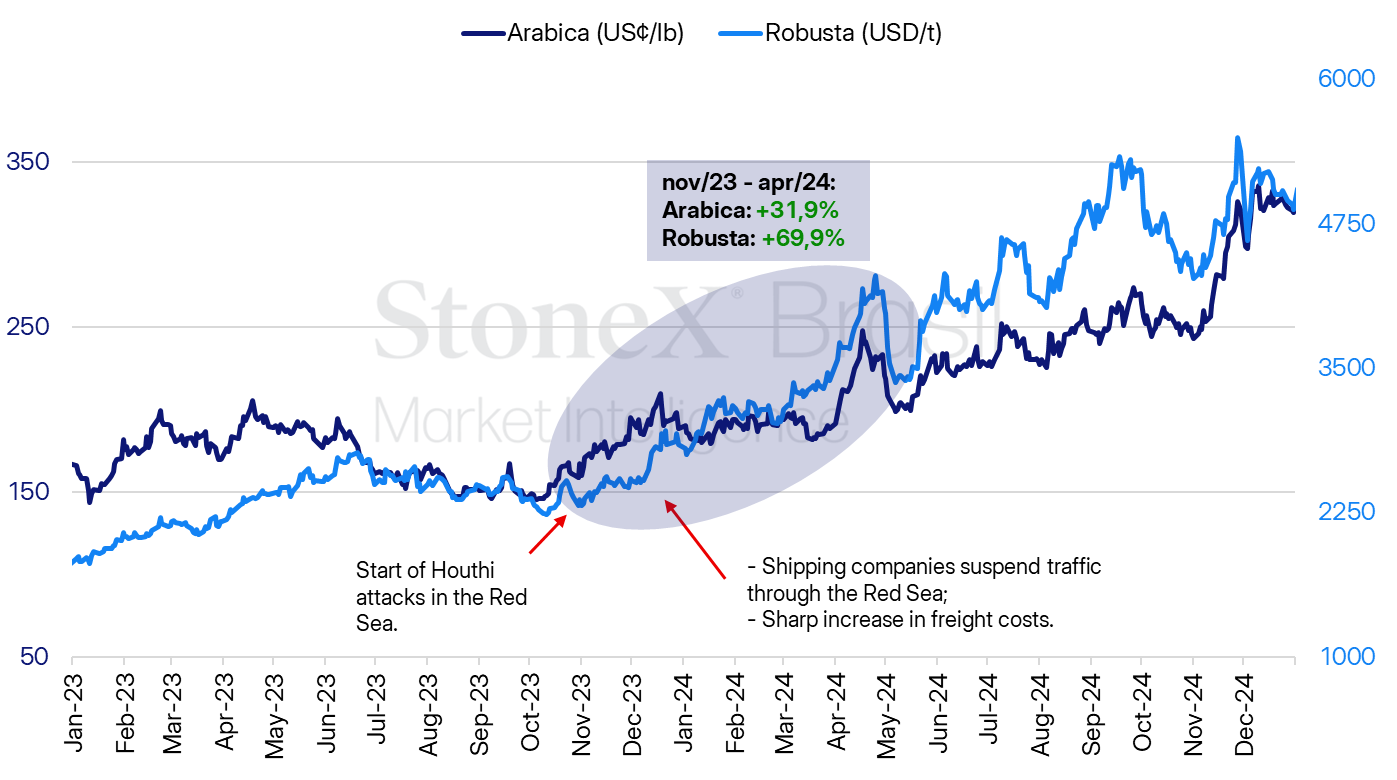
Source: ICE. Analysis: StoneX.
What to Expect: In the case of robusta coffee, besides being more intensely impacted by logistical disruptions, the market also faced a weaker crop in Vietnam, adding further support to prices. Nevertheless, much of the observed price surge was directly tied to the interruption of flows through the Red Sea.
As such, the market is likely to continue closely monitoring developments in the region. Should the conflict escalate and effectively disrupt the Red Sea route, participants may initially price in a higher risk premium. If this scenario persists — similar to what occurred around two years ago — elevated freight costs could once again impact the coffee market.
INDICATOR TABLE
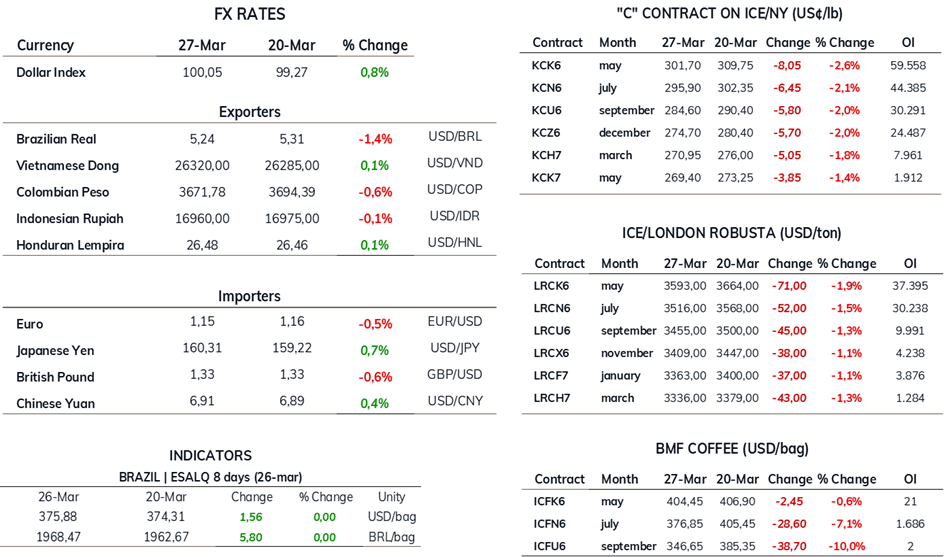
Sources: ICE/NY; ICE/EU; B3; Commodity Network Trader’s Pro.