Coffee futures contracts remain under pressure as a record Brazilian harvest approaches
- Bullish
- Smaller current crop and sales restrictions are strengthening Brazilian arabica differentials in the short term;
- NOAA reaffirms El Niño projections for early Q3;
- Despite robust export volumes, Vietnamese producers continue to limit new sales.
- Bearish
- Global surplus expected in 2026 balance;
- Record crop projections in Brazil;
- Brazil’s harvest season is approaching;
- Stronger dollar against the real puts pressure on exchange-traded coffee prices.
Declining certified stocks and El Niño risks may offer some support
Last week was marked by a challenging macroeconomic environment for agricultural commodities. The US dollar regained strength globally, with the Dollar Index advancing and putting pressure on emerging market currencies — the Brazilian real ended the week at BRL 5.08/USD (+3.5%), its weakest level in recent weeks, a factor that contributed to pressure on prices, particularly for arabica coffee.
On the fundamentals side, the prospect of an accelerated record harvest in Brazil continued to be the main bearish driver. The market also monitored updates to Brazil’s April export figures and new USDA estimates, which partially support expectations of higher global production this year. On the other hand, low certified stock levels and updates to El Niño projections still inspire caution among market participants, potentially offering some price support.
Arabica: July arabica futures closed the week at USc 266.9/lb on the New York exchange, down 2.9% for the week and hitting a new low not seen in roughly a year and a half. The week started on a positive note, with prices rising 2.7% to USc 282.3/lb on Monday (May 11), but lost momentum as predominantly bearish fundamentals prevailed in the short to medium term.
The initial progress of the harvest, estimated by Cepea to cover 3-5% of the area, is already beginning to stimulate some physical market sales, with the sharp rise in the dollar further pressuring exchange-traded prices.
The latest CFTC report confirmed the fund liquidation trend previously noted in last week’s report. For the week ending May 12, speculative funds’ net position dropped by 5,714 lots to a total of 12,558 long positions — the lowest level since mid-March. This movement indicates increased caution among speculators. Furthermore, much of this shift was driven by an increase in short positions, suggesting a heightened bearish sentiment among these participants.
Robusta: The corresponding robusta contract closed the week at USD 3,365/ton on the London exchange, down 1.4%. The movement mirrored that observed in New York, with an initial rise early in the week followed by pressure on prices in subsequent sessions.
Supply sentiment for conilon remains more favorable compared to arabica. Brazilian conilon exports in April, reported by Cecafé last week, surpassed expectations, reinforcing the perception that the global market remains well-supplied.
Additionally, Cooabriel — Brazil’s largest conilon coffee cooperative — indicated that Espírito Santo’s 2026 robusta harvest is expected to be slightly smaller than the previous one in terms of volume but of higher quality. The cooperative’s president also highlighted concerns about rising agricultural input costs due to logistical disruptions in the Strait of Hormuz.
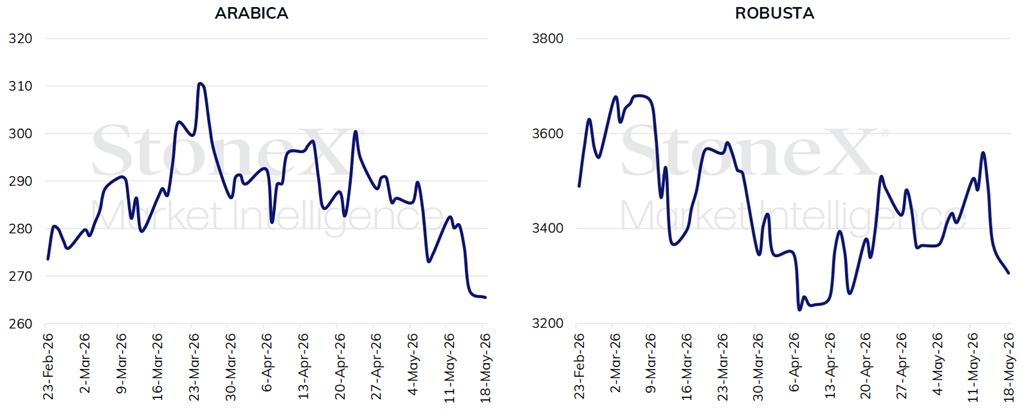
Source: CmdtyView. Prepared by: StoneX.
Physical Market: Cepea’s arabica coffee index closed the week at BRL 1,637.88/bag, down 1.9%. Meanwhile, Cepea’s robusta (conilon) index reached BRL 930.15/bag, up 1.9% for the week. The Brazilian real’s depreciation (BRL 5.08/USD) partially cushioned arabica’s decline in local currency but wasn’t enough to reverse the trend.
The arabica spot market remains sluggish, reflecting the near-total depletion of the 2025/26 crop available for sale. Additionally, the dollar’s appreciation contributed to pressure on arabica differentials against the exchange, which recently dipped below USc -20/lb.
On Monday: Coffee futures began the week by extending their losses on the exchanges. In the coming days, the market will monitor the pace of Brazil’s harvest progress, potential updates to ICE-certified stocks, ENSO developments, and the BRL/USD exchange rate, which will remain one of the key drivers of producer sales momentum.
Brazilian coffee exports remain steady in April, but revenue declines
According to Cecafé data released on May 13, Brazil exported 3.122 million bags of coffee in April 2026, a volume virtually unchanged from the same month in 2025, when shipments totaled 3.105 million bags. Despite the overall stability, the breakdown by variety reveals significantly different dynamics.
- Green arabica exports fell 15.9% to 2.26 million bags, reflecting lower availability at the end of the 2025/26 crop season. Conversely, robusta shipments jumped 374% to 497,000 bags, driven by the early entry of new crop lots and increased external demand for lower-priced coffees.
- Even so, foreign exchange revenue dropped 17.7% to USD 1.109 billion, compared to USD 1.347 billion in April 2025. This data illustrates that robusta’s growth helped sustain volumes but did not fully offset the decline in arabica, which continues to hold a larger share of the export portfolio and higher average value.
- From January to April, Brazil exported 11.619 million bags, down 16.1% compared to the same period in 2025. Thus, April’s result improves the short-term outlook but does not yet alter the picture of reduced exportable availability at the end of the crop season.
Monthly Brazilian arabica coffee exports (millions of bags)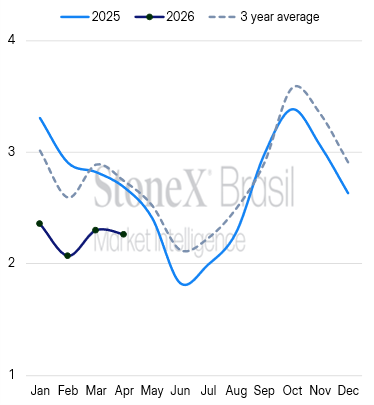
Source: Cecafé. Prepared by: StoneX.
Monthly Brazilian robusta coffee exports (millions of bags)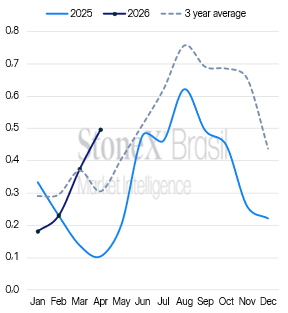
Why this matters: The stability in total shipments also highlights a significant shift in Brazilian coffee export composition. Arabica loses momentum at the end of its crop season, while robusta increasingly supports the export flow.
- This trend helps explain the drop in revenue, where stable volumes coupled with a larger share of lower-priced coffees, along with arabica’s decline, limited exported value growth. As the new harvest enters the market, shipments are expected to normalize, though revenue recovery may lag behind.
In detail: Among destinations, Germany maintained its lead year-to-date with 1.563 million bags, accounting for 13.4% of the total, despite a 12.8% year-on-year decline. The US followed with 1.390 million bags, down 41.5%, while Italy increased by 3.2% to 1.182 million bags.
- The decline in shipments to the US warrants attention, given the impacts of 2025/26 tariff and trade changes on logistics and purchasing decisions.
- However, it’s worth noting that the 451,000 bags shipped to the US in April represented the highest monthly volume in 11 months, signaling potential normalization of flows.
What to watch: With the progress of the 2026/27 harvest, especially robusta in Espírito Santo, export volumes are expected to gradually normalize from May and June.
- Nonetheless, revenue is likely to remain under pressure due to lower average prices compared to a year earlier.
- Additionally, forward sales of the 2026/27 crop account for only 16% of expected volume, indicating producer caution.
- This behavior could slow the pace of new supply entering the market, especially if prices remain unattractive.
Lower differentials reinforce the competitiveness of Brazilian robusta: The sustained growth in Brazilian robusta exports occurs in the context of reduced price differentials against other origins. As the new crop enters and domestic availability improves, the drop in these differentials largely reflects more competitive Brazilian product prices internationally.
- Lower differentials, when combined with lower absolute prices, tend to enhance the attractiveness of Brazilian robusta over competitors, boosting external demand and encouraging export growth.
Robusta coffee price differentials by region (USD/bag) 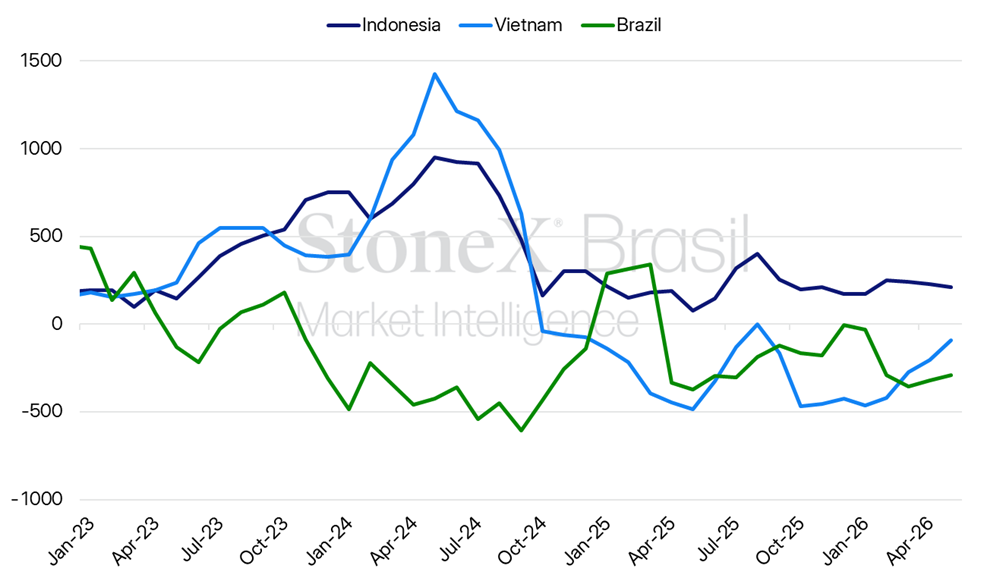
Source: StoneX CmdtyView. Prepared by: StoneX.
ENSO Transition: 82% Probability of El Niño by July
The ENSO update released by NOAA on May 14, complemented by StoneX’s internal monitoring, raised the climate alert for the coffee market. The probability of El Niño forming during the May-June-July 2026 period stands at 82%. NOAA has officially issued an 'El Niño Watch,' indicating that oceanic conditions are already developing, although the atmospheric response remains incomplete.
In detail: The equatorial Pacific Ocean is already exhibiting surface warming near the threshold for characterizing the phenomenon.
- For the April-May-June quarter, neutral conditions are still predominant (84%), with only a 16% chance of El Niño during this short-term window.
- The most likely transition occurs between June and July. According to the IRI, there is a roughly 70% probability that sea surface temperatures will exceed the characterization threshold during the AMJ quarter (Apr-May-Jun).
- From June-July-August onward, both NOAA and IRI indicate a greater than 90% probability that the Pacific will remain in conditions consistent with El Niño through early 2027 — with a 96% chance of persistence during the boreal winter (Dec/26-Feb/27).
Projection of El Niño/La Niña probability and intensity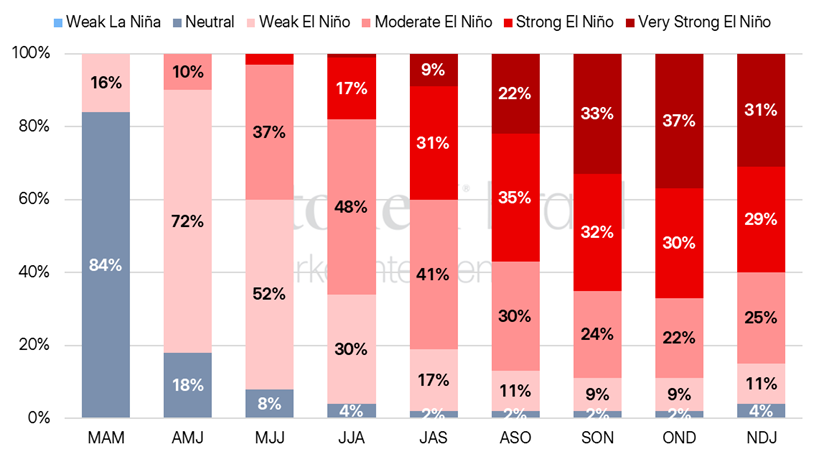
Source: NOAA. Prepared by: StoneX.
Why this matters: El Niño tends to asymmetrically impact key coffee-producing countries.
- In Brazil, the phenomenon is historically associated with above-average rainfall in the south/southeast during the summer, which could affect the next crop’s flowering.
- For Vietnam and Indonesia, El Niño typically brings drought, negatively impacting robusta production.
- The uniqueness of this window lies in the event potentially intensifying precisely during Brazil’s critical flowering period (September-October) and Vietnam’s harvest season (October-December).
- A stronger-than-anticipated El Niño could therefore act as a latent bullish driver that the market has only partially priced in.
It’s important to note that despite the high likelihood of occurrence, there is significant uncertainty regarding the event’s intensity: no single intensity category (weak, moderate, strong) exceeds 37% probability independently. A weak El Niño would have limited climatic impacts on agricultural production, whereas a moderate to strong event could reintroduce risk premiums to prices — especially for robusta, which is more vulnerable to drought in both Brazil and Southeast Asia.
What to watch: In the coming months, the market is expected to progressively factor in El Niño risks into price formation, particularly for robusta. StoneX is actively monitoring climatic developments and will update production projections as forecasting models converge on a clearer intensity estimate.
USDA Estimates for 2026/27: Mexico Stable, India Under Climate Pressure
On May 14, the USDA released production estimates for two key coffee-exporting countries for the 2026/27 crop year via its Foreign Agricultural Service (FAS).
Mexico
Mexican production maintains a trajectory of moderate growth, with significant structural changes in production profiles and domestic demand.
- Production is estimated at 4.1 million bags, representing a 1% increase over the previous crop year, primarily driven by productivity gains and adjustments in variety composition.
- A significant portion of this growth is linked to the expansion of robusta production, signaling a diversification strategy, alongside the adoption of better management practices that are enhancing field efficiency.
- Domestic consumption is also expected to rise by approximately 1% to 3.17 million bags, fueled by the growth of out-of-home consumption, particularly in the ready-to-drink segment, and increased penetration of specialty coffees.
- The United States remains the primary destination for Mexican exports, underscoring the country’s importance in North America’s supply dynamics.
Why this matters:
- Mexico plays a strategic role as a complementary supplier of washed arabica to the US, especially in a context of greater origin segmentation.
- In scenarios involving trade flow redirection due to tariffs or restrictions on other origins, Mexico’s stable supply helps mitigate pressures on North American supply.
- The expansion of robusta suggests a gradual structural shift in the global coffee market, with robusta increasingly accounting for a larger share of global production.
India
Indian production shows stability in aggregate volume but faces significant qualitative risks, particularly for arabica, due to adverse weather conditions.
- The USDA projects production at 6.14 million bags, maintaining India as a key global exporter but reflecting an annual decline of 4.5%.
- The climatic scenario raises important concerns: excessive rainfall early in the year (Jan-Feb) hampered initial crop development.
- This was followed by a prolonged drought during the critical flowering and fruiting stages, particularly impacting arabica yields.
Demand and trade:
- Domestic consumption is estimated at 1.58 million bags, with slight growth driven by strong demand for soluble coffee.
- Exports are projected at 6.2 million bags (+3.2% YoY), supported by:
- Higher exportable availability
- Recent free trade agreements increasing market access
- Expansion of higher-value-added products, particularly in the soluble segment
What to watch:
- India remains a niche exporter with growing relevance in specialty coffee and industrialized markets.
- In the short term, the expectation of higher exports (6.2 million bags) is likely to act as a marginal bearish driver, especially on the arbitrage between Indian and Vietnamese robusta.
- The observed weather pattern — a combination of excessive rains followed by drought — reinforces production uncertainty and mirrors, on a smaller scale, risks associated with ENSO (El Niño) for other Asian producers.
Harvest monitoring
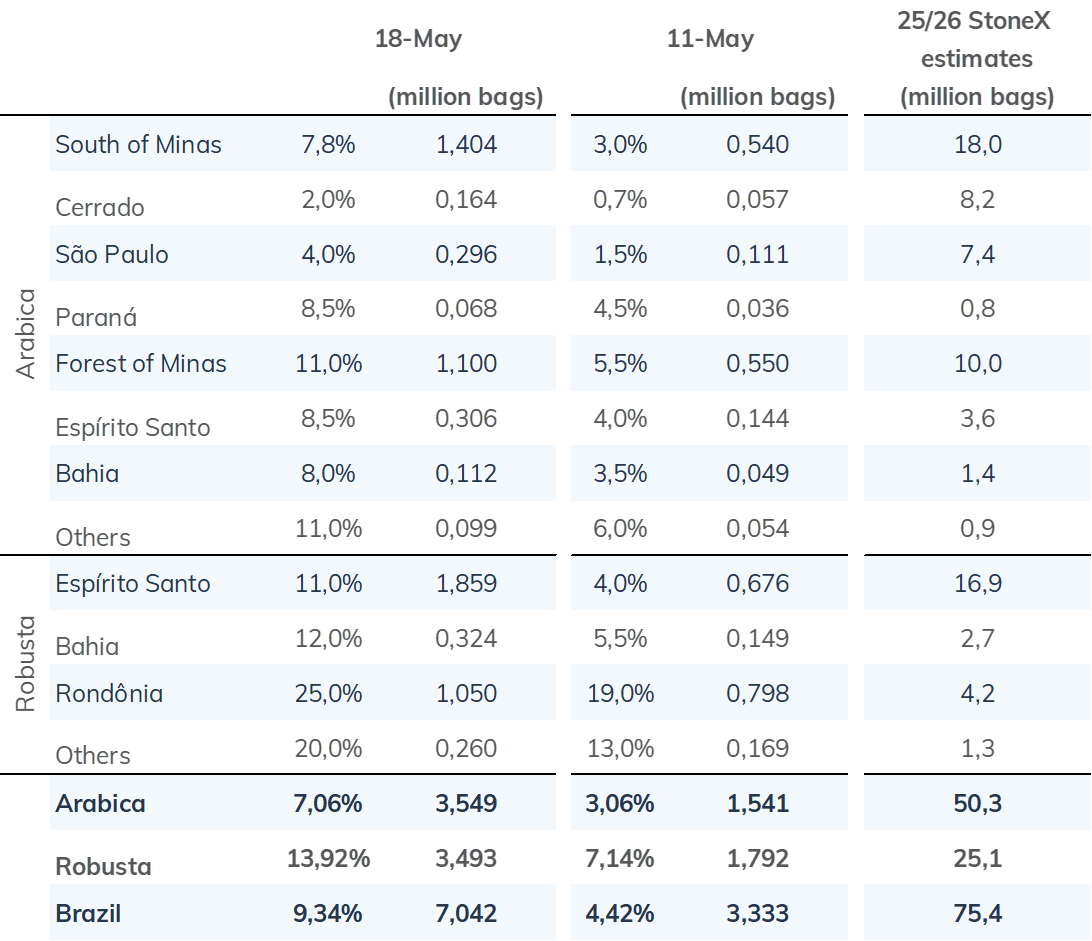
Fonte: StoneX.
INDICATOR TABLE
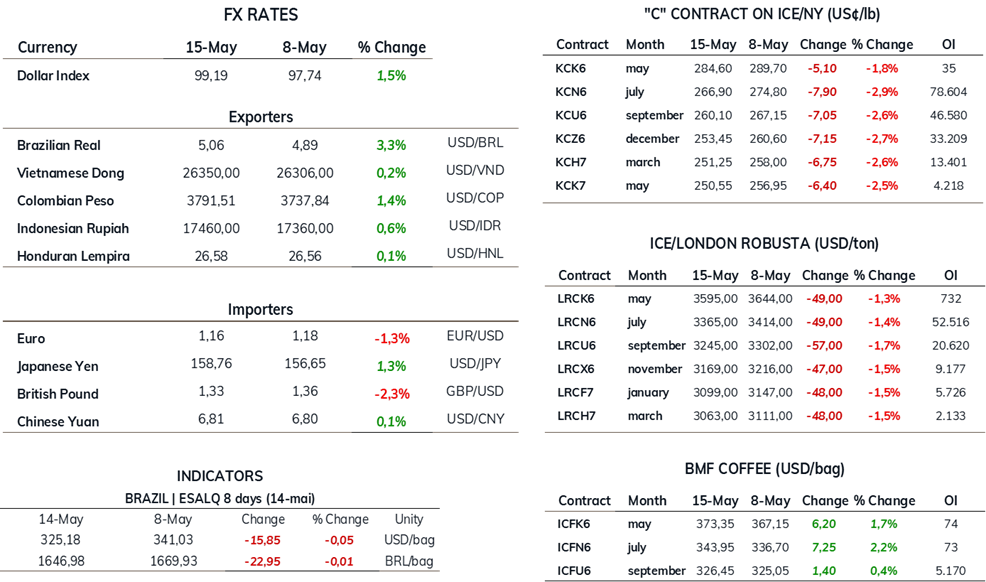
Sources: ICE/NY; ICE/EU; B3; Commodity Network Trader’s Pro.