StoneX logo

September '23 Farmer Fertilizer Focus - Potash

By: Josh Linville, Vice President- Fertilizer

September '23 POTASH
 
Josh Linville
Vice President - Fertilizer
 
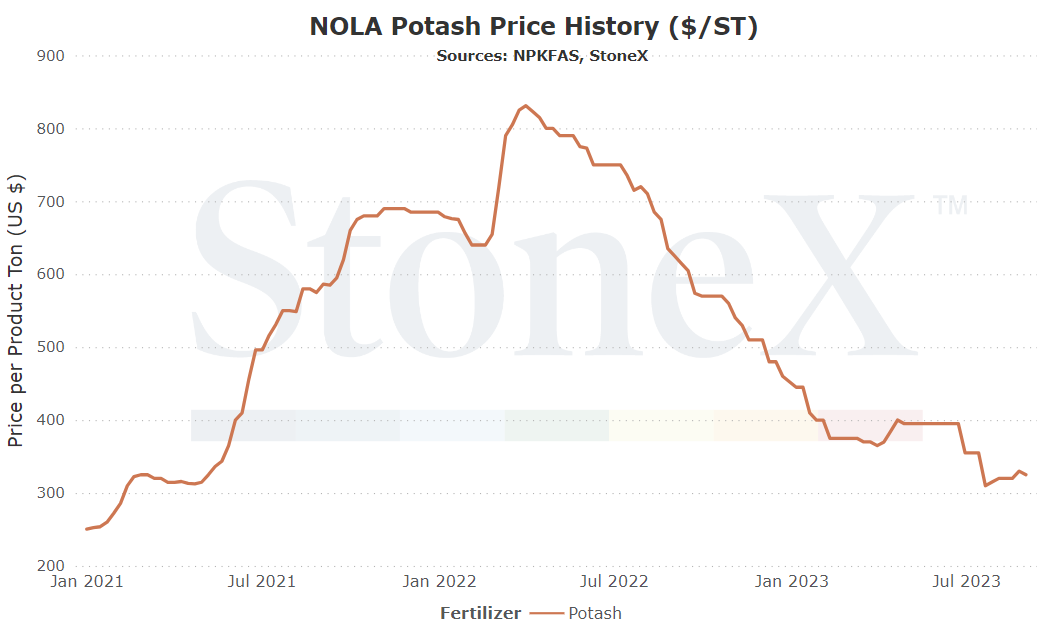
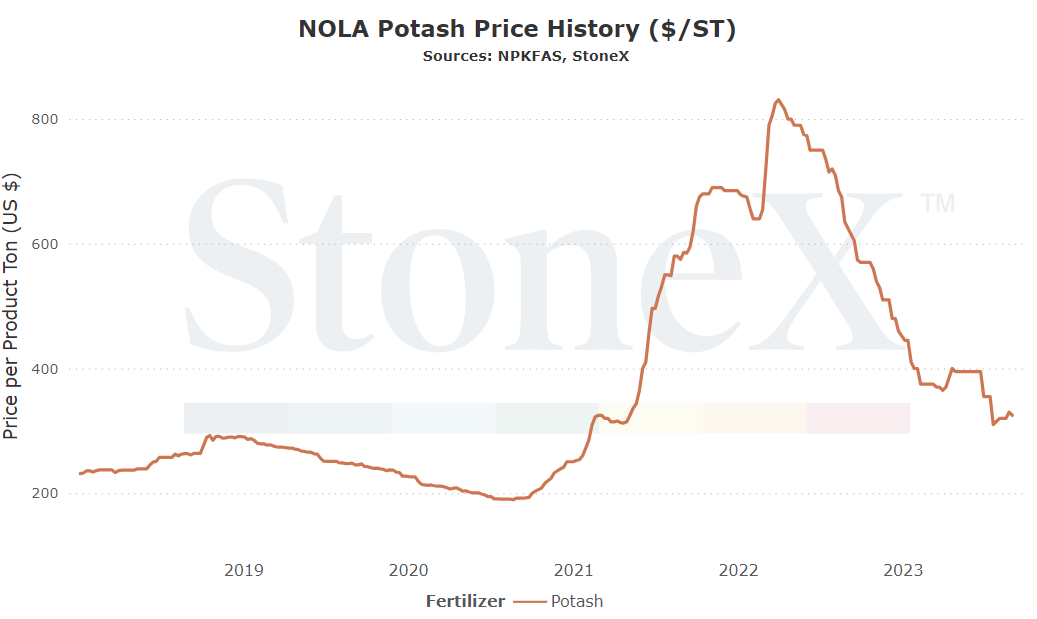
NOLA potash price graph
Please remember that this is looking at the cost of one short ton of potash sitting in a barge at NOLA (New Orleans, Louisiana).  Your cost is not going to be the same.  This should be looked at more in regards to the price direction rather than the actual pricing.
image 79274
What everyone wants to know first, what do we think will happen going forward
Global
Right now, it seems like manufacturers are comfortably sold and most demand is comfortably purchased...so if both sides of the isle are on good terms:
Hard to see values much more than flat in the coming weeks
The remainder of the calendar year is typically more quiet so we will need to watch and see if sellers start to feel any pressure.  If grain values can hold and the outlook remain decent, we could just stay locked in a quiet period for a bit...and I'm ok with that after the last couple years!
North America
North America is a bit different than the world today in that fall application demand is just around the corner.  Hard to believe with high's in the 90's for the next several days here in NW Missouri that November is now 2 months away.
Inventories still feel snug following last spring that saw inventories drop to very low levels (lower than normal on high demand).  Resupply operations are still happening and we have faith the market will be ready.  However, demand could surprise us.  Today's potash value is good vs historical values.  Today's potash value is solid vs grain values.  Harvest should be done on-time or early.
Lot of indications that potash values will hold/push higher in the coming couple months.  The success or failure of fall will dictate winter/spring directions.
A lot of my bullishness in potash lies with current grain values.  Keep in mind that if they start to fall...potash will need to be watched.
Should you lock in potash needs today?
If the current values work for your operation/region/etc., then that is your answer.  Your local market needs to be considered as things like supply availability, demand timing and logistical issues can change the view.  Just because we see the market strong or weak going forward does not mean it will translate to where you live.  We are all a part of the world, but we live at home.
Global
If you are going to need the product in the near term (before end of 2023), probably a good idea to get those locked down.  At the very least, be having a conversation with your supplier.
Major buyers (India/China) saw fit to lock in large annual contracts at these types of values.  Hard to see how they are both wrong today.
North America
Yes.
For most of N.A., November is only 2 months away.  For those of you down south, your application comes even quicker.
To me, it is a solid value.  Much more in line with what we would consider normal.  
We are not out of the woods in terms of drawing down inventories last spring.  If you have any plans of rolling this fall, have that conversations sooner than later.
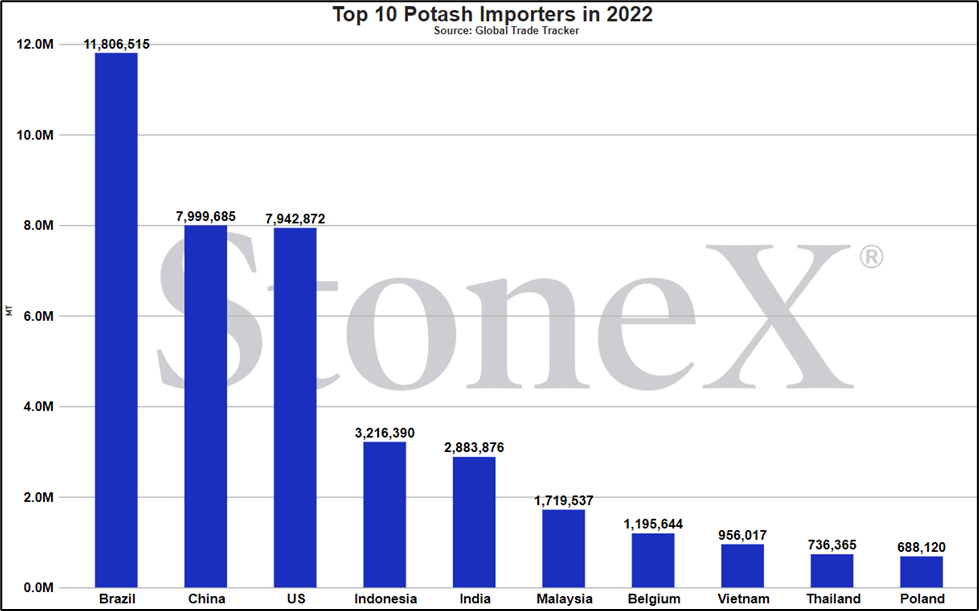
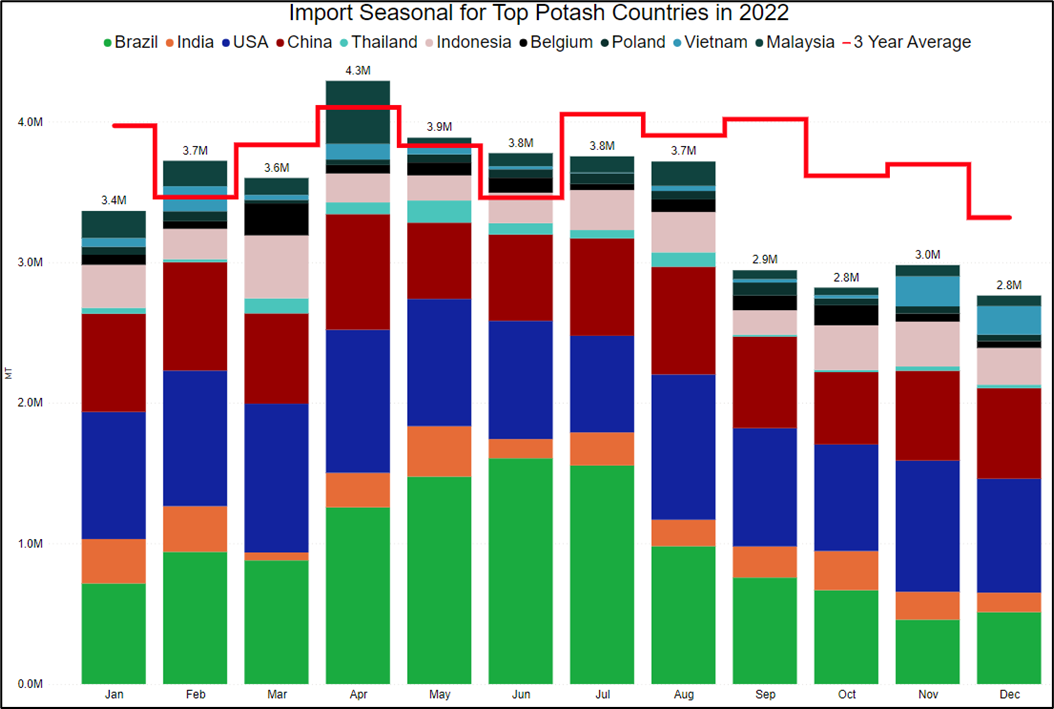
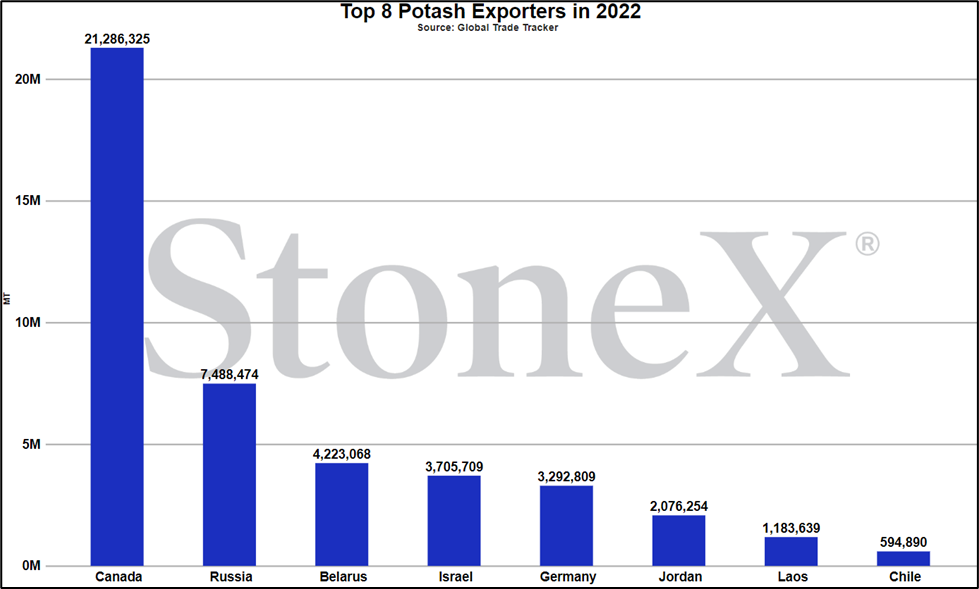
General global potash information
image 73049
image 73050
image 73051
image 73052
What has happened in the last 30 days?
Belarus exports continue to improve
As many of you know, Belarusian potash exports have suffered since Q1 '22 due to their allegiance and support of Russia, to the point where they allowed Russia to stage troops and push into Ukraine from the north due to proximity to Kyiv, and their illegal invasion of Ukraine.  For those new here, a short story:
After the start of the Russian invasion of Ukraine, Eastern European countries effectively "picked sides".  Many countries, including Lithuania, sided with the West.  Belarus, with its government much more Russian friendly than their neighbors, supported the Kremlin.
"This is potash, why are we talking about this?!"
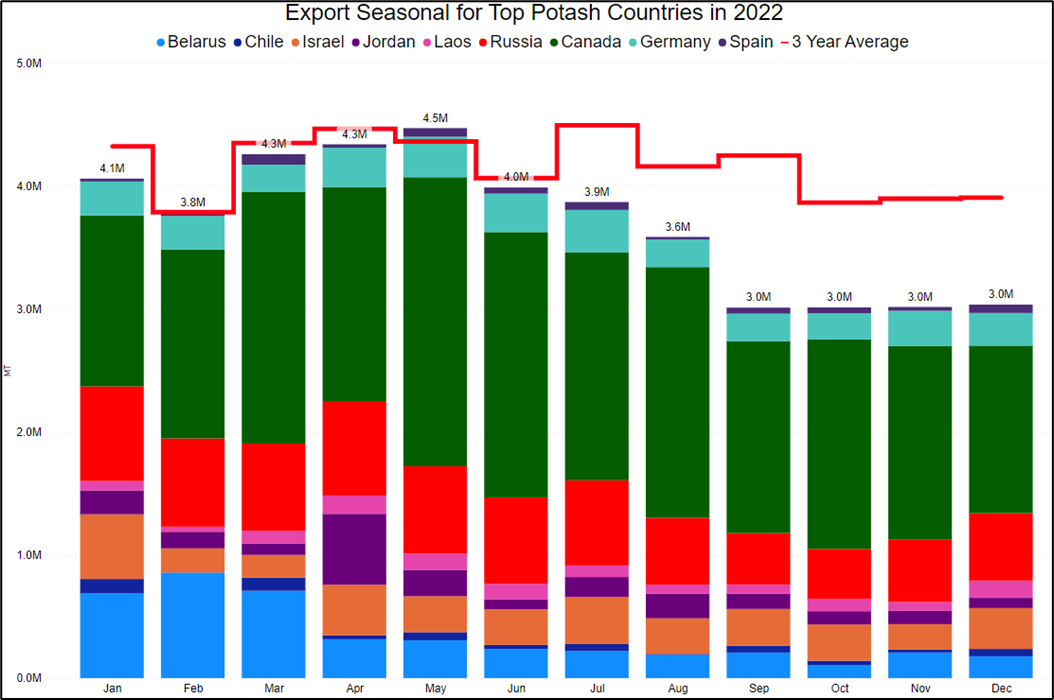
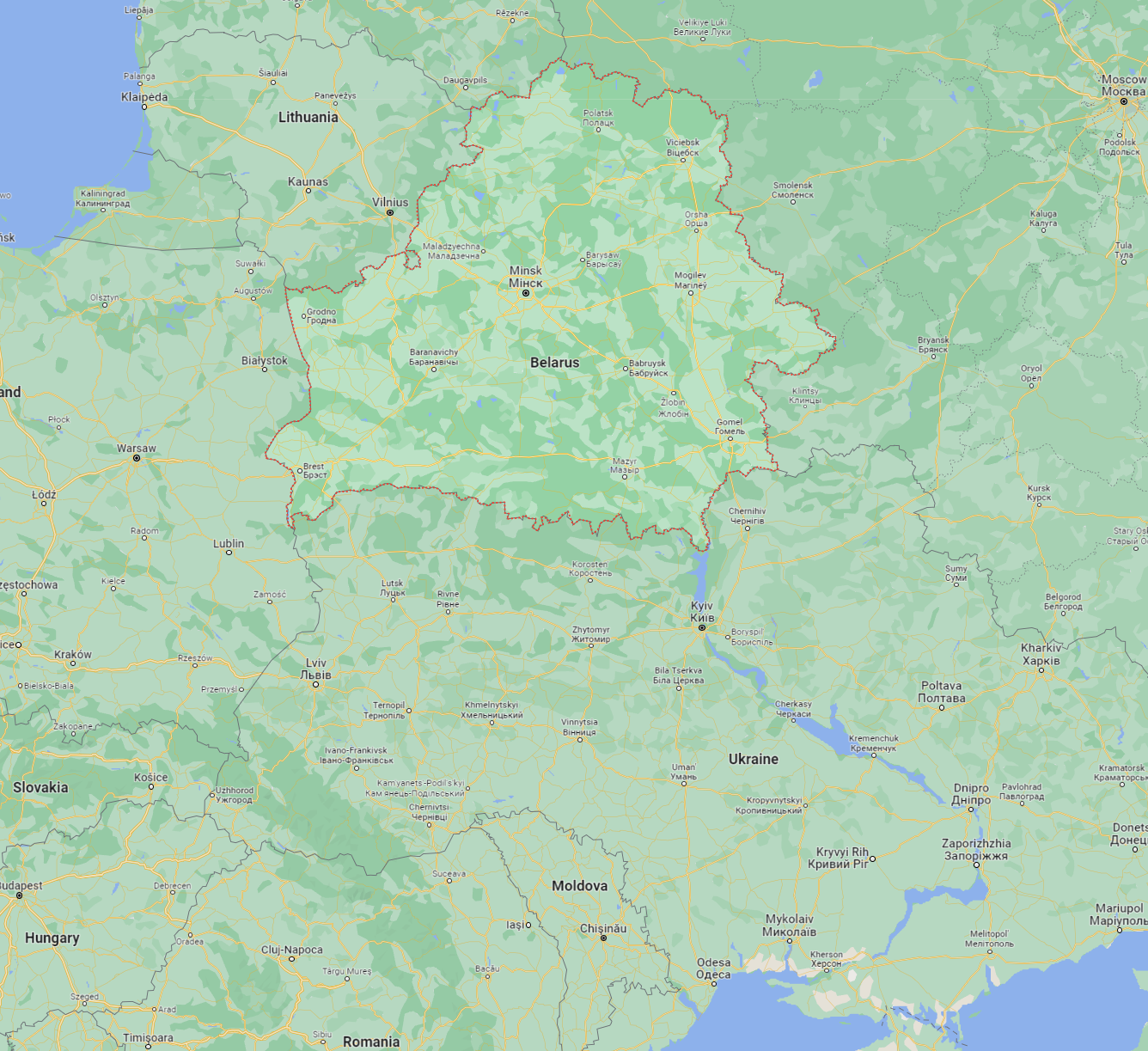
During "normal" period, Belarus is the 3rd largest export of potash in the world.  However, they have a location problem.  As the below snippet from google maps shows, Belarus is landlocked.  In the years before the Russian invasion began, this wasn't an issue due to their relationship with Lithuania (northwest of Belarus).  Their partnership allowed Belarus to produce potash, place the product on railcars, ship it thru Lithuania to deep sea ports and out to the world.  The process was barely an afterthought for the global market.
Once they decided they were going to support Russia, things go hairy.  The Lithuanian government quickly imposed penalties where Belarusian assets were seized and any normal relations that might have been were out the window.  Long comment short, Belarus shipment lanes got shut down.  After this, Belarusian exports dropped significantly.  
  • They could no longer access deep sea ports in Lithuania
  • They couldn't ship product west thru Poland, another country siding with the West
  • They couldn't ship product south...thru Ukraine.  Pretty sure they would struggle to make that happen!
  • Logistically, they couldn't ship product east into and out of Russia due to a lack of facilities
image 78710
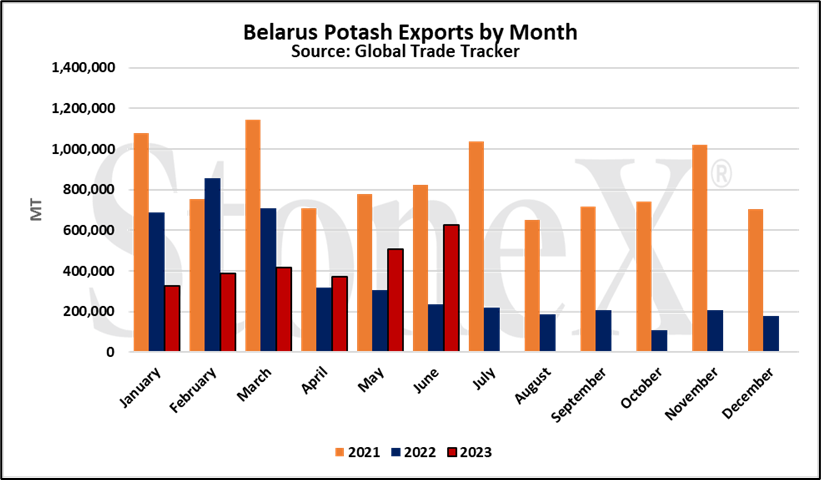
The graph below shows how quickly Belarusian potash exports suffered.  On average, they would export around 800 - 825KMT per month.  Once their primary export lanes were cut, they dropped to below 200KMT per month.  As a result, the global potash S&D saw supplies tighten significantly with the loss.  The outlook appeared bleak.
image 78709
However, improvements are continuing to be made.  In the months after the shipment ban thru Lithuania, rumors were heard that work was being made to bypass Lithuania.  Rather than rely on a Western country, logistical improvements were being made to access the world thru Russia.  While these sorts of projects do not get completed overnight, progress is progress.
Again, as the chart above shows, Belarus has been making slight but continuous export improvements.  The first bumps higher were shipments to China which could be accessed by rail shipments...really long rail shipments but shipments none the less.  Now, we are seeing more and more product arrive in countries like Brazil, meaning they are accessing deep sea ports.
The long story short is that the world appears to be gaining its 3rd largest potash exporter once again.  If demand remains steady and supplies jump, that is typically indicative of a bearish market.  This has been a reason for our belief that longer term potash markets are going to see values suffer more.  Belarus was not going to "stay away" forever.  
image-20230824074923-1
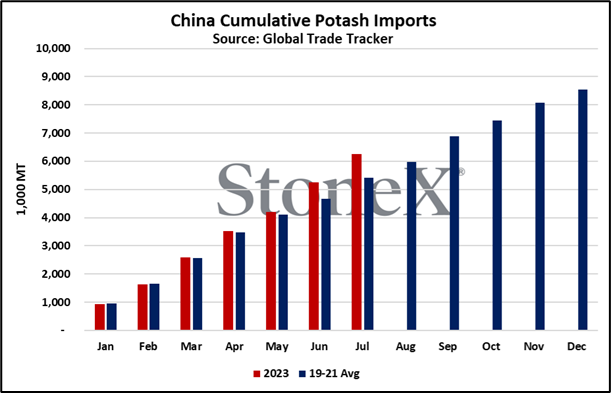
China continues to import ahead of schedule
Last year, China was the 2nd largest importer of potash, barely beating the U.S. for the spot.
Makes sense that we should track their import rate, or lack of, for signs going forward.
That said, China has had a hot hand since June in terms of import flow which has helped remove a little extra excess product from the globe.
In terms of the world, China importing an extra million tons thru July is not a huge deal.  Brazil / U.S. / China all combine to import approximately 28M tons per year and that is only the top 3 importers of the world.  However, this higher import pace can help buoy price ideas on the short term.  It can also mean that China fills their warehouses earlier than normal and their 2nd half 2023 purchases/imports could suffer, leaving the world wanting for demand.
image 78708
Canadian strikes/export issues seem to subside, improving export capabilities
Unlike the last couple years where when Black Swan events popped up, they had staying power and disrupted the marketplace, Canadian export issues occurred and then were relatively quickly resolved.
Over the last couple months, Canadian potash manufacturer export ports had issues with equipment breakages that slowed their ability to load vessels.  While disruptive at the time, crews were heard to make short work of repairs and got flows underway once again.  In effect, equipment breaks after time and well trained crews step in to make them operational.  Cycle of life.
However, a scarier event popped up not long after in the form of port strikes.  Where the equipment breakage was as simple as locate the break, develop a plan to repair, make the repair and return to normal, strikes are a little more...complicated.  Attention was quickly turned to it out of fear that it could have lasting power.
Fortunately, terms were reached relatively quickly and normal operations returned.  Unfortunately, some break downs like in Portland are still in the process of being repaired so export capability is hampered somewhat.  These should serve as reminders that just because everything seems normal today, events can occur to disrupt that flow and quickly throw the market out of balance.  These issues happened in a relatively unimportant period of time for the market.  Had either or both of these occurred during a more delicate time, the market could have been left scrambling.
Expanded production plans being delayed/cancelled in face of lower priced potash market
It's always interesting to me how when market values spike, everyone in the world wants to jump in.  Higher prices typically mean higher margins and "new money" starts trying to enter the fray.  However, when that market eventually calms down, all that new money starts to find new homes.
Fertilizer is absolutely no different.  While potash didn't see as much of the new money entering the market, expanded and new production was certainly on the table.
As values spiked in early 2022, new and expanded potash production was all the rage.  Manufacturers with already operational mines were discussing investments that would help to significantly boost annual production totals.  New mines were being discussed in Russia.  Basically, with margins on production being literally hundreds of dollars for each ton produced, it was easy to justify the investment.
However, as we all know, those high prices were not going to stay around forever.  High prices eventually cures high prices and potash was no exception.
Now, with prices at much more reasonable levels, many of these plans are already being walked back.  The mines being studied/pursued in Russia are being cancelled on the grounds of an unstable outlook for Russia given the current climate (war on Ukraine).  Simply too risky to invest money in a country doing something like that.  Canadian producers who had planned large increases to their annual production are now "delaying" those plans to further investigate.
While the reasons for delaying/cancelling can be many, likely they all have the lower market price in common.
N.A. inventories still snug following huge spring that reduced inventories to very low levels
A big story toward the end of last spring was how tight several of the fertilizer products got.  A bearish market cycle thru much of winter, combined with solid spring demand, coupled to cause the market to run thru most available inventories of urea, phosphate and potash.  While the availability situation has improved since then, inventories are still much tighter than they would normally be today.
This isn't a section that is trying to scare anyone into doing anything.  Trying to scare folks into doing things is no way to do business.
However, shining a light on a potential situation is...
Potash summer fill programs have come and gone and efforts to refill storage across North America continues today.  While some nearby demand may find that inventories are not nearly as high as they normally would be, anyone focusing on the fall application season likely isn't seeing anything to worry about.  That doesn't mean there isn't.
Current potash values are actually fairly well priced when we look at them vs historical values, vs current grain values, etc.  Assuming harvest gets done on time/early (a week of triple digit temps will certainly help speed that timeline) and mother nature allows a sufficient fall application period, this fall demand should be REALLY good.
Now, I'm not going to use the term "shortage".  I've come to hate that word.  Prices can certainly rise when inventories get tight and you might have to wait longer for supply to arrive, but a capitalistic economy means you will find product.  You may not like the cost associated with it, but you will find it.
However, if the fall season is solid from a weather window and harvest gets done, inventories could be chewed up rather quickly.  I know I preach this a lot but this means having more conversations with our retailer needs to be in order.  Unlike some other fertilizers, the price risk for potash doesn't look excessive so the supply chain should be more willing to put product in place, anticipating coming demand.  However, the last year burned a lot of companies so conservatism is more likely to be used.  There are only 2 months until we get to November.  From a fertilizer logistical POV, 2 months is not a long time.  Better to have those conversations today if you intend to roll this fall than to wait and risk it.
Where are current values in relation to the past

NOLA/New Orleans Louisiana 
  • Vs 30 days ago - +2% or approximately $5 higher
  • Vs 90 days ago - -18% or approximately $70 lower
  • Vs 6 months ago - -13% or approximately $50 lower
  • Vs 1 year ago - -48% or approximately $300 lower

image 79277

U.S. Midwest Average (average of several points across the Midwest)

  • Vs 30 days ago - +4% or approximately $14 higher
  • Vs 90 days ago - -10% or approximately $44 lower
  • Vs 6 months ago - -10% or approximately $45 lower
  • Vs 1 year ago - -44% or approximately $319 lower
Bull/Bear Factors
Because no market is ever guaranteed to go higher/lower, we try to consider the factors that can sway values so that we are able to act when they occur rather than react.
Bullish Factors 
  • Grain values are holding – unfortunately, from a grain/potash ratio POV, the best opportunity is behind us.  Fortunately, today's grain/potash ratios are still SOLID vs last couple years.  As long as grain continues to hold, farmers should lean into fertilizer/potash applications to maximize yields in 2024.  
  • N.A. harvest should be on-time/early - we have been fortunate in NW Missouri in terms of rain this summer.  The crops have looked beautiful.  Heck, the yards until recently looked like it was till April.  However, even as good a shape as we were, the week of triple digit temps put a hurt on the crops.  Seems likely that harvest will start earlier as a result.  That should open the fall application window even more, allowing farmers to apply everything they want before winter sets in.
  • Continued tight N.A. supplies following last spring – we are still dealing with the conclusion of last spring which saw potash inventories dip to very low levels.  The industry is working to get everything refilled before major application demand starts in 2 months.  I have faith it will get there...but it takes a lot of work and it keeps sellers in control of the narrative.
Bearish Factors 
  • High phosphate values may indirectly hurt potash demand – this may be a stretch but hear me out.  Phosphate values are still too high vs a lot of the comparisons (grains/historical/etc.).  IF farmers see that price as too high, they may elect to delay application until winter/spring.  I do not know many farmers who would make the decision to apply potash and phosphate separately.  Who wants to pay double the application fee?!?!  If phosphate is too high, potash demand this fall could suffer as well.
  • Still a lot of belief that grain values will fall into harvest – this is a bit of grain forecasting, which I'm not good at.  What I'm good at is listening to people smarter than me and trying to repeat it in a way that makes sense.  Now, if those folks are right and grain values do drop going into harvest, it will not only hurt the farmer mentality, it will hurt the ratios/profitability/etc.  Long story short - it will hurt demand.
  • Global outlook remains "oversupplied" - the longer range forecast is that potash will be an "oversupplied" market in the coming years.  Now, this is not something to expect in the coming months.  However, that belief does have an effect on position takers in that they remain a little more cautious out of fear of holding the bag when the market falls apart.  Cautious demand can hurt nearby values.
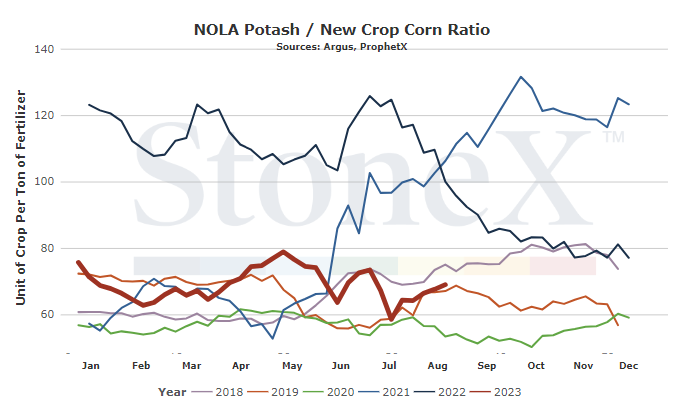
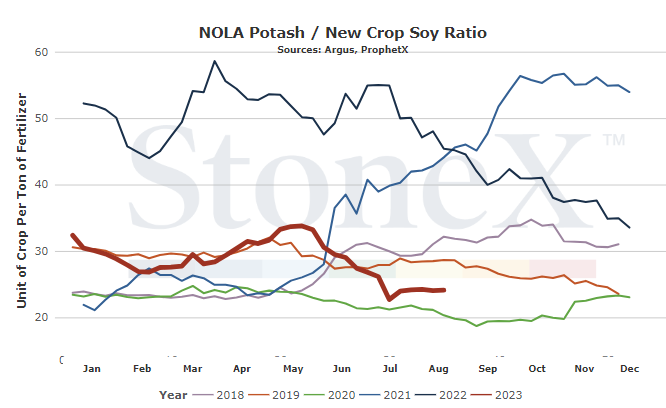
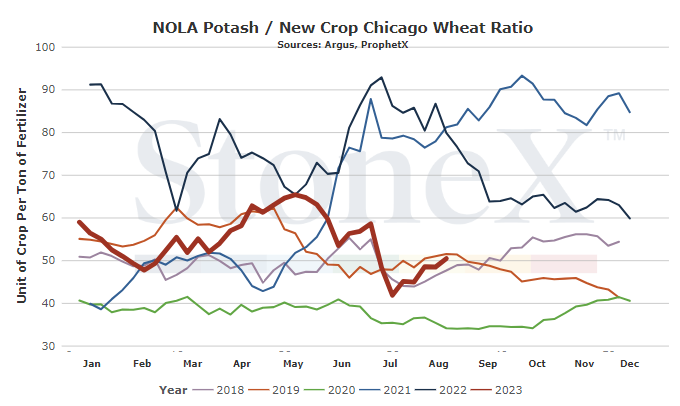
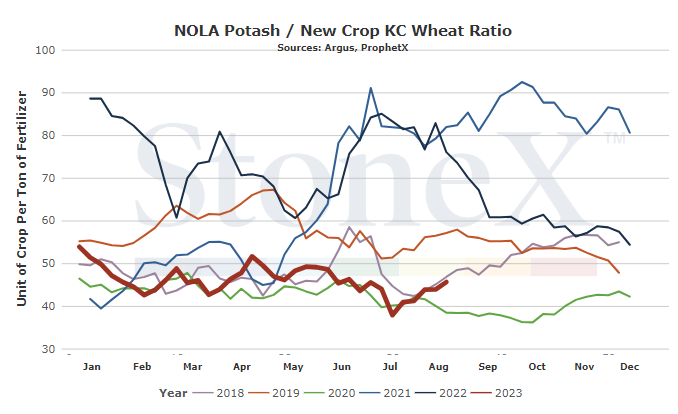
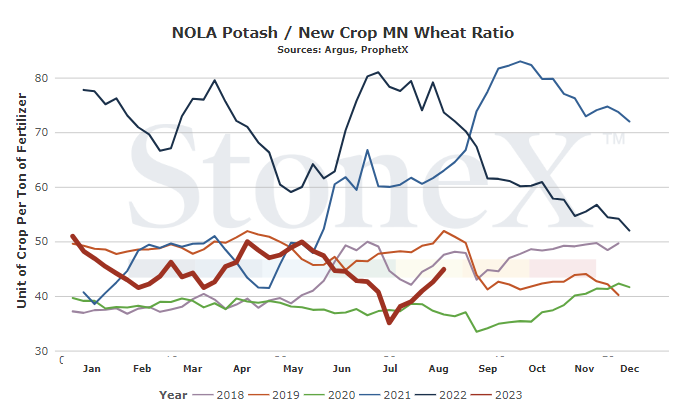
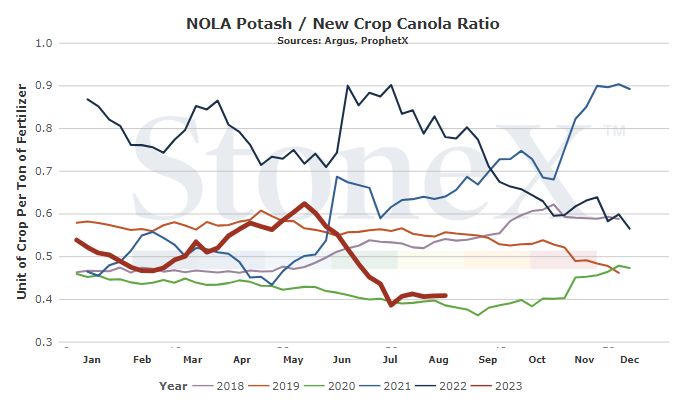
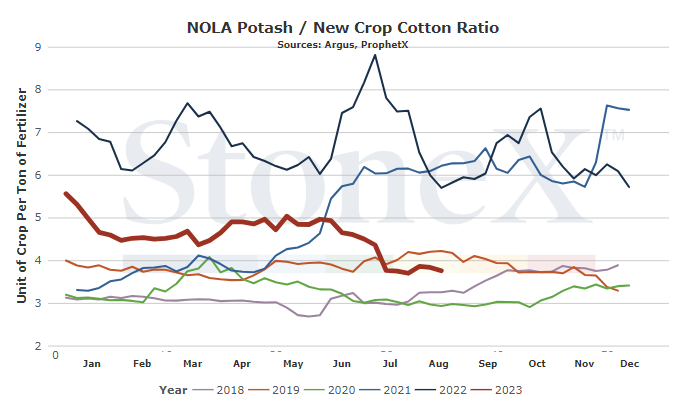
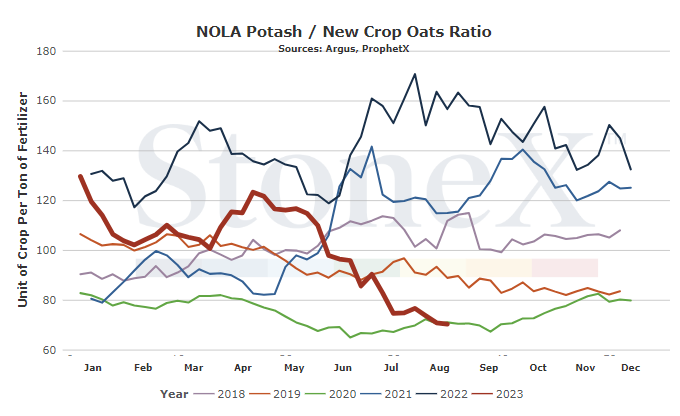
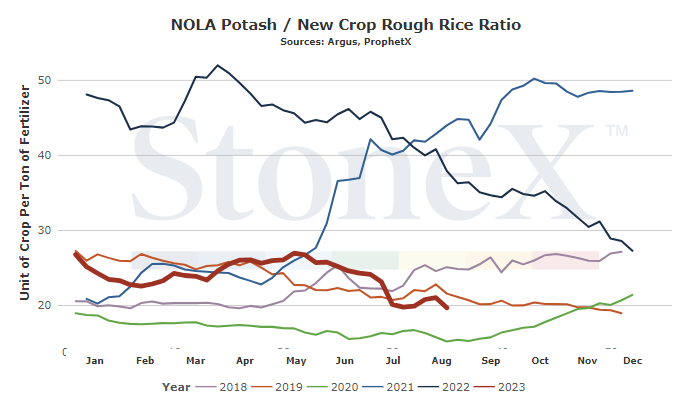
Where are the current potash/grain ratio values today?

We believe that only looking at the flat price of either grains or fertilizer can be misleading:

  • Only selling grain can hurt you if fertilizer prices rise substantially
  • Only buying fertilizer can hurt you if grain prices fall

We look at the ratio "value" to get a better indication of where we are or how many bushels of X does it take to pay for 1 ton of fertilizer.

Would you rather:

  • Spend 120 bushels to pay for 1 ton of potash
  • Spend 60 bushels to pay for 1 ton of potash

When we compare the current ratio value against recent years, we start to see if we are high or low.

YOUR VALUES WILL LOOK DIFFERENT

This graph looks at the NOLA potash price vs the flat grain price. There are no logistics on either product. Your location will look different due to fertilizer logistical costs, grain basis, etc.

image 79278
image 79279
image 79280
image 79281
image 79282
image 79283
image 79285

image 79286image 79287

Josh Linville’s focal points
  • Fall demand for N.A. - if fall application were to start right now with where all the values are, I think fall demand would be solid.  Maybe profitability overall is down for farms but it isn't due to potash.  The value is significantly better than a year ago and should lead farmers to healthy application rates.  Assuming demand is good, we will wipe out inventories and go into 2024 relatively empty...with spring not far away.
  • Logistics for N.A. - fortunately for the potash market, a lot of product is moved via rail and not by the river system which has been struggling.  However, those on rail sites will tell you that services has been slower.  We still have 2 months to get the system filled and ready to go.  Past that, we have to rely on just in time deliveries to stay ahead of demand.  If there is any major disruption in the next 3 months...watch out.
  • New/expanded production for the world - will all this new and expanded production actually happen?  That is the big question for potash.  Some very important announces were marched back as values fell.  Will they eventually press ahead and oversupply the market?  Will they back off more permanently and keep the S&D balanced?  Hard to say.

All data was sourced from StoneX unless otherwise noted.

This material should be construed as market commentary, merely observing economic, political and/or market conditions, and not intended to refer to any particular trading strategy, promotional element or quality of service provided by the FCM Division of StoneX Financial Inc. (“SFI”), StoneX Financial (Canada) Inc. (“SFFC”) or StoneX Markets LLC (“SXM”). SFI, SFFC and SXM are not responsible for any redistribution of this material by third parties, or any trading decisions taken by persons not intended to view this material. Information contained herein was obtained from sources believed to be reliable, but is not guaranteed as to its accuracy. Contact designated personnel from SFI, SFFC or SXM for specific trading advice to meet your trading preferences. These materials represent the opinions and viewpoints of the author, and do not necessarily reflect the viewpoints and trading strategies employed by SFI, SFFC or SXM. The FCM Division of StoneX Financial Inc., a subsidiary of StoneX Group Inc., is a member of the National Futures Association (“NFA”) and registered with the U.S. Commodity Futures Trading Commission (“CFTC”) as a futures commission merchant and commodity trading advisor. StoneX Financial (Canada) Inc. is currently registered as a Futures Commission Merchant or equivalent in all provinces of Canada and is a member of the Investment Industry Regulatory Organization of Canada.

 
  • Fertilizers

This material should be construed as the solicitation of an account, order, and/or services and represents the opinions and viewpoints of the individual authors or presenters. It does not constitute an individualized recommendation or take into account the particular trading objectives, financial situations, or needs of individual customers.


The views are current only through the date stated and are subject to change at any time based upon market or other conditions, and StoneX Group Inc. (“SGI”) disclaims any responsibility to update such views. Actual results, performance, or achievements may differ materially from those expressed or implied. Information is based on data gathered from what we believe are reliable sources. Past performance does not guarantee future results.


The StoneX Group Inc. group of companies provides financial services worldwide through its subsidiaries, including physical commodities, securities, exchange-traded and over-the-counter derivatives, risk management, global payments and foreign exchange products in accordance with applicable law in the jurisdictions where services are provided.


References to certain OTC products or swaps are made on behalf of StoneX Markets, LLC (SXM), a member of the National Futures Association (NFA) and provisionally registered with the U.S. Commodity Futures Trading Commission (CFTC) as a swap dealer. SXM’s products are designed only for individuals or firms who qualify under CFTC rules as an ‘Eligible Contract Participant’ and who have been accepted as customers of SXM.


StoneX Financial Inc. (SFI) is a member of FINRA/NFA/SIPC and registered with the MSRB. SFI is registered with the U.S. Securities and Exchange Commission (SEC) as a Broker-Dealer and with the CFTC as a Futures Commission Merchant and Commodity Trading Advisor. StoneX Financial (Canada) Inc. (SFCI) is registered in Canada and is a member of CIRO and CIPF. References to certain securities trading are made on behalf of the BD Division of SFI and are intended only for an audience of institutional clients as defined by FINRA Rule 4512(c). References to certain exchange-traded futures and options are made on behalf of the FCM Division of SFI. Wealth Management is offered through SA Stone Wealth Management Inc., member FINRA/SIPC, and SA Stone Investment Advisors Inc., an SEC-registered investment advisor, both wholly owned subsidiaries of SGI.

R.J. O’Brien & Associates, LLC (RJO) is registered with the CFTC as a Futures Commission Merchant and is a member of NFA.


StoneX Financial Ltd (SFL) is registered in England and Wales, company no. 5616586. SFL is authorized and regulated by the Financial Conduct Authority (FCA) (registration number FRN:446717) to provide services to professional and eligible customers including: arrangement, execution and, where required, clearing derivative transactions in exchange traded futures and options. SFL is also authorized to engage in the arrangement and execution of transactions in certain OTC products, certain securities trading, precious metals trading and payment services to eligible customers. SFL is authorized and regulated by the FCA under the Payment Services Regulations 2017 for the provision of payment services. SFL is a category 1 ring-dealing member of the London Metal Exchange. In addition SFL also engages in other physically delivered commodities business and other general business activities which are unregulated and not required to be authorized by the FCA.


This communication is issued in the European Economic Area by StoneX Financial Europe GmbH (SFEG). StoneX is the trade name used by STONEX GROUP INC. and all its associated entities and subsidiaries. StoneX Financial Europe GmbH (“SFEG”) is a securities trading firm registered in Germany under Company No. HRB 80844.


StoneX Financial Pte Ltd (Co. Reg. No 201130598R) (“SFP”) is regulated by the Monetary Authority of Singapore and is a Capital Markets Service Licence holder (for dealing in capital market products), an Exempt Financial Adviser (for advising on investment products and issuing or promulgating analyses/ reports on investment products) and a Major Payment Institution (for domestic and cross-border money transfer services).


SFP may distribute analysis/report produced by its respective foreign affiliates within the StoneX Group of companies pursuant to an arrangement under Regulation 32C of the Financial Advisers Regulations Recipients should contact SFP at (65) 6309 1000 for any matters arising from, or in connection with, this webinar.


StoneX APAC Pte. Ltd. (“SAP”) (Co. Reg. No 200616676W) is regulated as a Dealer (PS20190001002) under the Precious Stones and Precious Metals (Prevention of Money Laundering and Terrorism Financing) Act 2019 for purposes of anti-money laundering and countering the financing of terrorism.


StoneX Financial (HK) Limited (CE No.: BCQ152) (“SHK”) is regulated by the Hong Kong Securities and Futures Commission for Dealing in Securities and Dealing in Futures Contracts.


StoneX Financial Pty Ltd (ACN 141 774 727) holds an Australian Financial Service License (AFSL: 345646) for Dealing in Securities, Exchange-Traded Derivatives Contracts, OTC Derivatives Contracts and Foreign Exchange Contracts, and is regulated by the Australian Securities and Investments Commission.


StoneX Securities Co., Ltd. (“SSJ”) (Co. Reg. No 010401047199) is regulated by the Japanese Financial Services Agency as a Type-I Financial Instruments Business Operator (Kanto Local Finance Bureau (FIBO)No.291’), is a member of the Financial Futures Association of Japan for dealing and broking FX and FX Option transactions, and is a member of the Japan Securities Dealers Association for dealing and broking stock indices and option transactions.


Trading swaps and over-the-counter derivatives, exchange-traded derivatives and options and securities involves substantial risk and is not suitable for all investors. Past performance of any futures or option is not indicative of future success. Indicators are not a trading system and are not published as a specific trade recommendation. The information herein is not a recommendation to trade nor investment research or an offer to buy or sell any derivative or security. It does not take into account your particular investment objectives, financial situation or needs and does not create a binding obligation on any of the StoneX group of companies to enter into any transaction with you. You are advised to perform an independent investigation of any transaction to determine whether any transaction is suitable for you. No part of this material may be copied, photocopied or duplicated in any form by any means or redistributed without the prior written consent of StoneX Group Inc.


The report/analysis herein is not directed to, or intended for distribution to or use by, any person or entity who is a citizen or resident of or located in any locality, state, country or other jurisdiction where such distribution, publication, availability or use would be contrary to law or regulation.


© 2026 StoneX Group Inc. All Rights Reserved.

Satellite view of Earth at night showing illuminated cities across Asia and the Middle East

Discover more insights

Our subscribers have access to comprehensive market analysis from StoneX spanning commodities, equities, currencies and more.

StoneX: We open markets

Our market expertise, advanced platforms, global reach, culture of full transparency and commitment to our clients’ success all set us apart in the financial marketplace.

Reach

With access to 40+ derivatives exchanges, 180+ foreign exchange markets, nearly every global securities marketplace and numerous bi-lateral liquidity venues, StoneX’s digital network and deep relationships can take clients anywhere they want to go.

Transparency

As a publicly traded company meeting the highest standards of regulatory compliance in the markets we serve, our financials and record of accomplishment are matters of public record. StoneX’s commitment to “doing the right thing over the easy thing” sets us apart in the industry and helps us build respect, client trust and new partnerships.

Expertise

From our proprietary Market Intelligence platform, to “boots on the ground” expertise from award-winning traders and professionals, we connect our clients directly to actionable insights they can use to make more informed decisions and achieve their goals in the global markets.