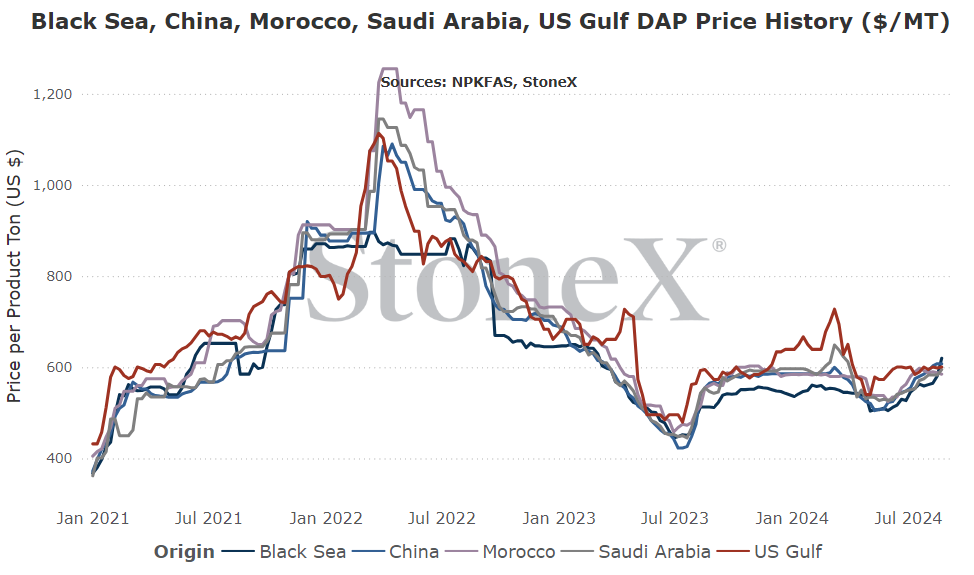
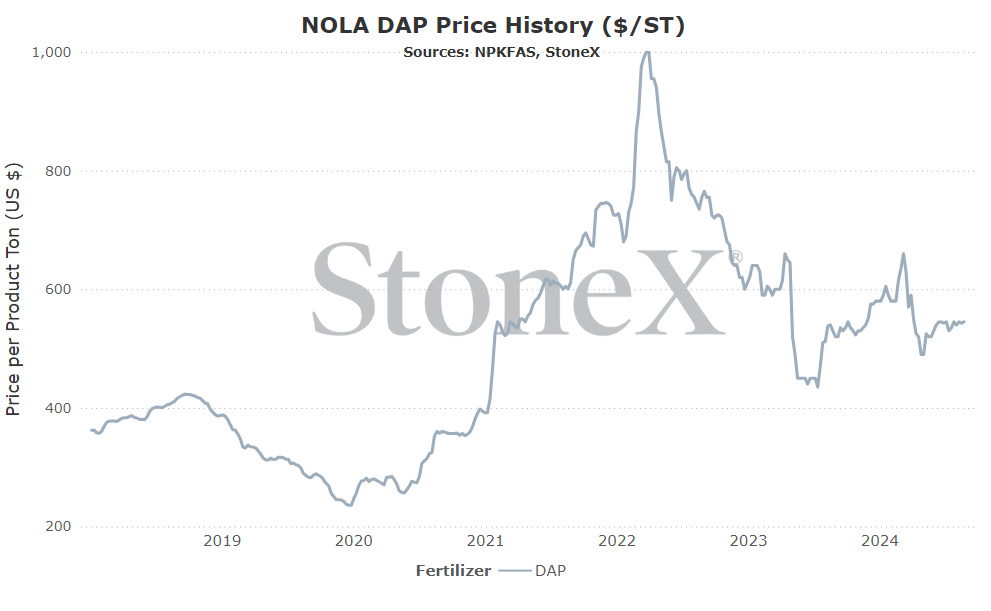
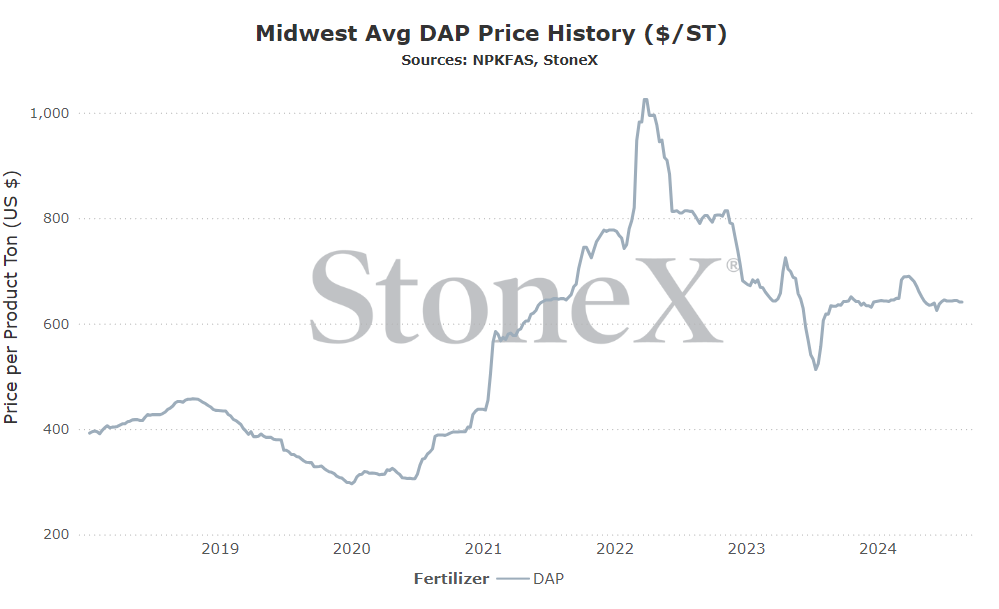
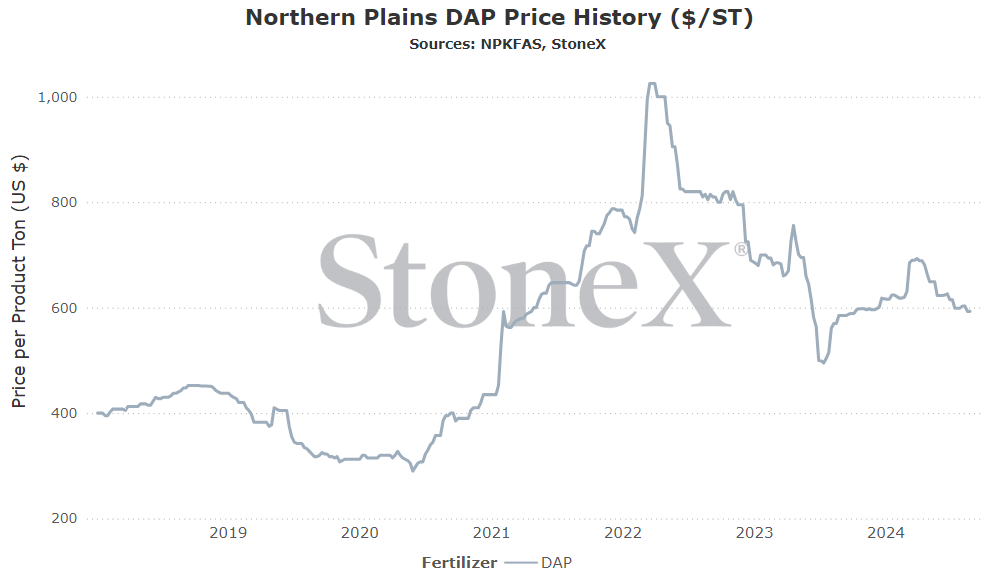
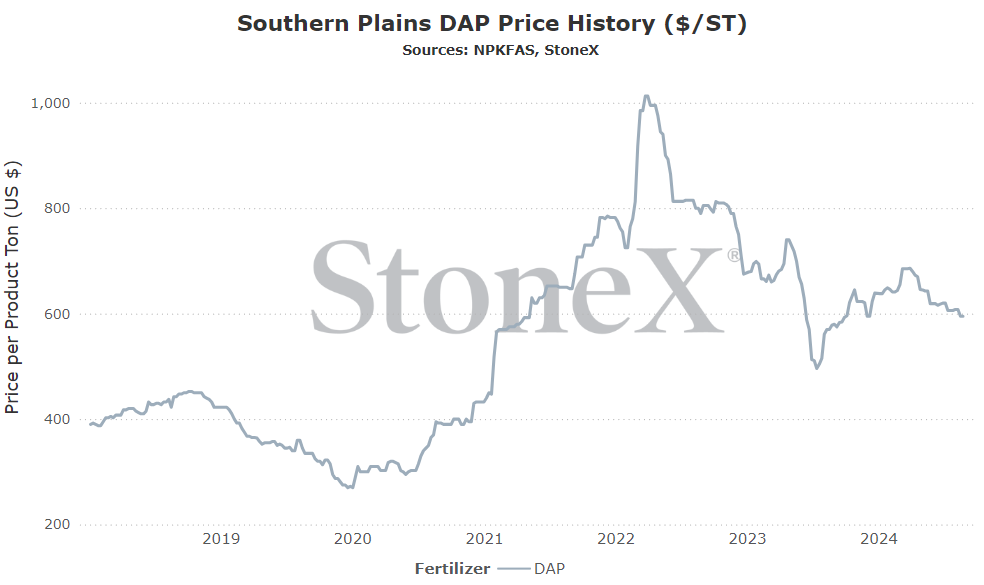
I will say this now and will say it going forward to eternity: these are the flat price graphs for each individual location. Your price where you are is going to be different. There are logistics. There is the cost of storage/interest/insurance/etc. These graphs should not be taken as "it shows the price at $700, why isn't my price $700". These graphs should be used to give an appreciation for price movements.
All values are in metric tons and USD currency.
Global
Everything about farming economics around the world is SCREAMING that phosphate values should go lower. For many, phosphate represents an input that can either be decreased or eliminated from programs. Right now, phosphate values make little to no sense vs grain values so should be near or front of the line in terms of being reduced/cut which should push prices lower.
So why isn't that the case?
Well, because right now the world's historically largest exporter (China) continues to restrict exports and the world's largest buyer (India) has a lot of catching up on stockpiles to do. So the biggest exporter is dragging behind and the biggest buyer has a lot to buy.
Bad combination.
If the above stories continue to play out, it seems like phosphate has more upside than downside potential around the world. I do not want to think this. I do not want to write this. I fully understand the bad position farmers are in...but this is one of those harsh realities. Things will improve eventually, it just doesn't look likely short term.
North America
If N.A. were left to its own devices, we would likely see prices stable to lower. Mosaic, the largest producer, continues to see operating rates suffer so inventories continue lower than they should be. However, the demand side appears ready for a massive cut. Farmers and retailers alike continue to point to lowered demand. Some farmers will reduce their application rates. Some farmers will skip. Some fall applicators will wait for spring. If this plays out (poor fall), we should go into winter with high inventories which should lean on values.
But N.A. is not an island. It is part of the world market.
What happens if the rest of the world goes higher while N.A. stays steady or goes lower? We would see exports start picking up which reduces our supplies and eventually causes our prices to climb. At the end of the day, the market will find a buyer. I know that is a cold and harsh statement but at the end of the day, the market doesn't care where they sell product as long as they make money.
I would love nothing more than for farmers everywhere to completely cut their purchases, force prices lower and get a much better opportunity in the near future...but that isn't my outlook:
I do expect to see fall demand lower. That will create an interesting environment as we go into the winter with heavier inventories which should lean on values. However, I am more convinced today that global stories of tight supplies and big demand will pull prices higher and N.A. is not immune to that. This is one of those "the world matters more than our backyard" situations.
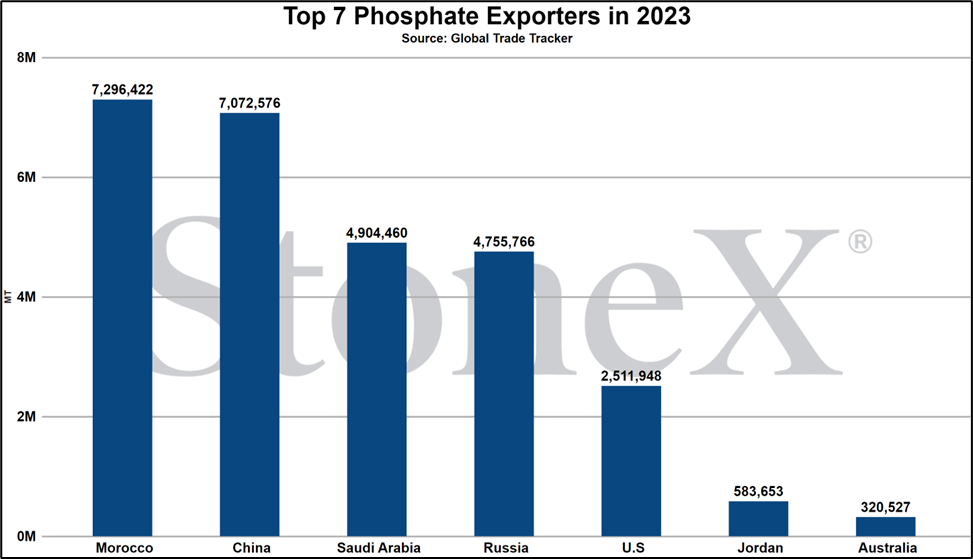
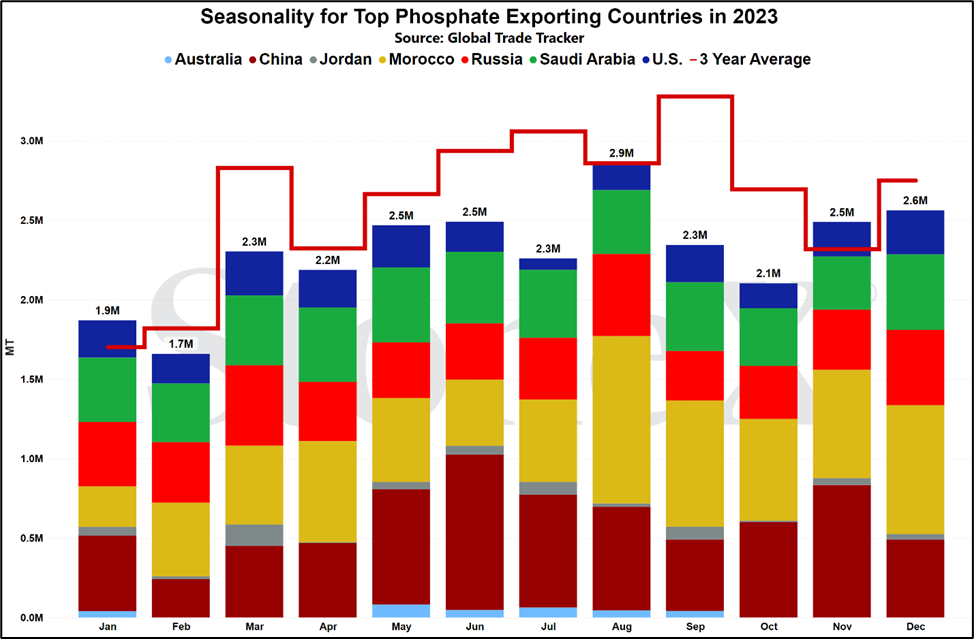
Chinese exports still lagging behind normal
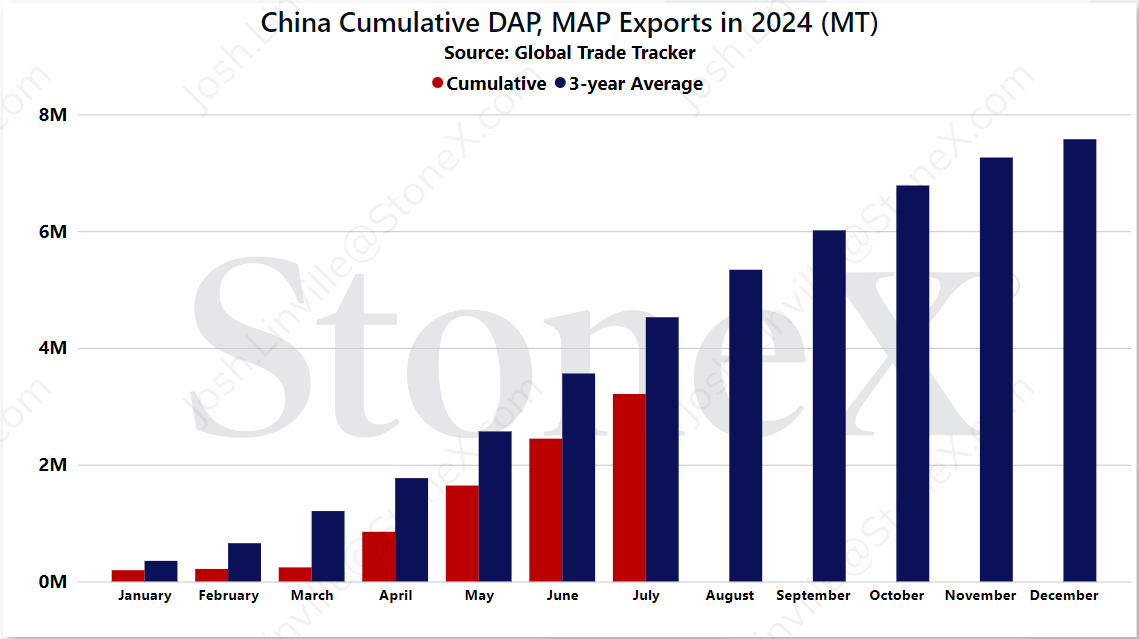
The July data has been released, and Chinese phosphate exports continue to lag behind the 3-year average which is already "low" due to recent year government export restrictions.
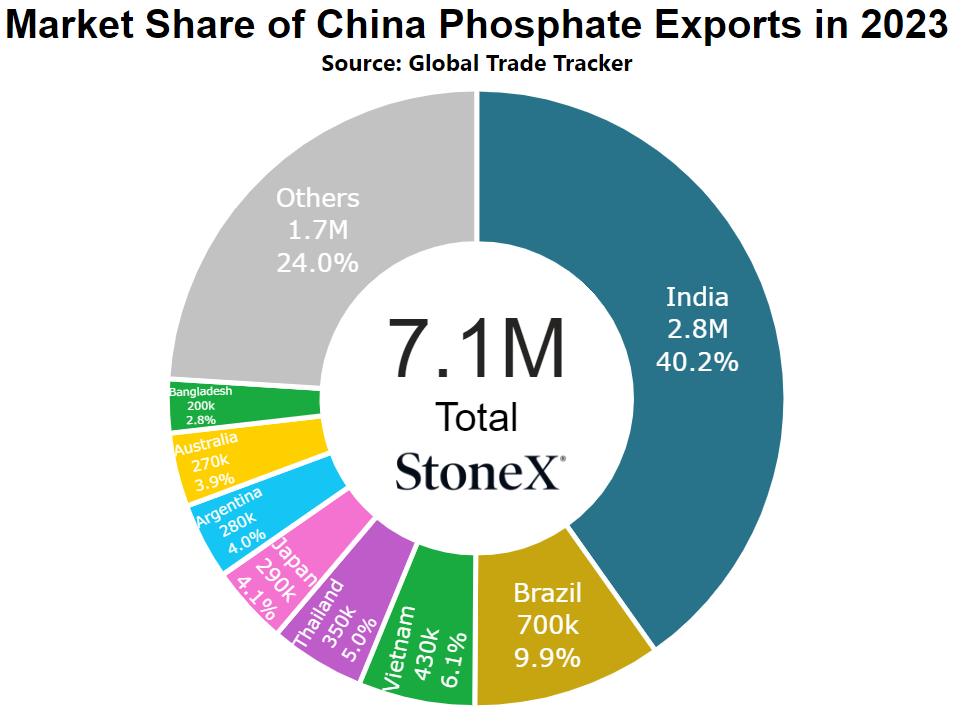
In 2021 (calendar year), China exported just over 10M tons of DAP/MAP. By July, the cumulative total was 6.77M tons. They were the largest exporter by over 3M tons from 2nd place Morocco.
In 2022, their exports fell drastically to 5.5M, pushing them into 2nd place and nearly half the year before. Global values topped out early 2022 as Russian fears, high grain prices building demand, and other factors combined to push phosphate to near record levels. As a result of the tight inventory/high price situation, the Chinese government started to restrict phosphate exports with 2 goals in mind: ensure adequate supplies and lower prices for Chinese farmers. Unfortunately for the world, the strategy appeared to work.
In 2023, exports improved to 7M tons. Significantly better than the year prior but still well short of normal. However, it was a step in the right direction and it built hope that they were returning to former glory in 2024 so prices should slip.
So far, another hope has been dashed.
January thru July has shown that only 3.2M tons have been exported. To make matters worse, reports/rumors/stories that the government is starting to restrict exports once again are making their rounds and they sound legit. While it is too early to tell, the way it is pointed right now, there is a very real possibility that they will fall short of 2022 levels...
So that is a problem that continues to play out.
What this means for farmers
When the world's largest supplier of DAP/MAP starts pulling back on this scale, it isn't good.
Global supplies have been very tight in the last couple years which is why we see phosphate being so high priced. If China does continue to proceed with putting further restrictions in place, it only makes a bad thing worse.
When I talk about how I could see prices higher, this is a major reason why I think that. However, the other piece of the pie lies with India...
India still has catching up to do
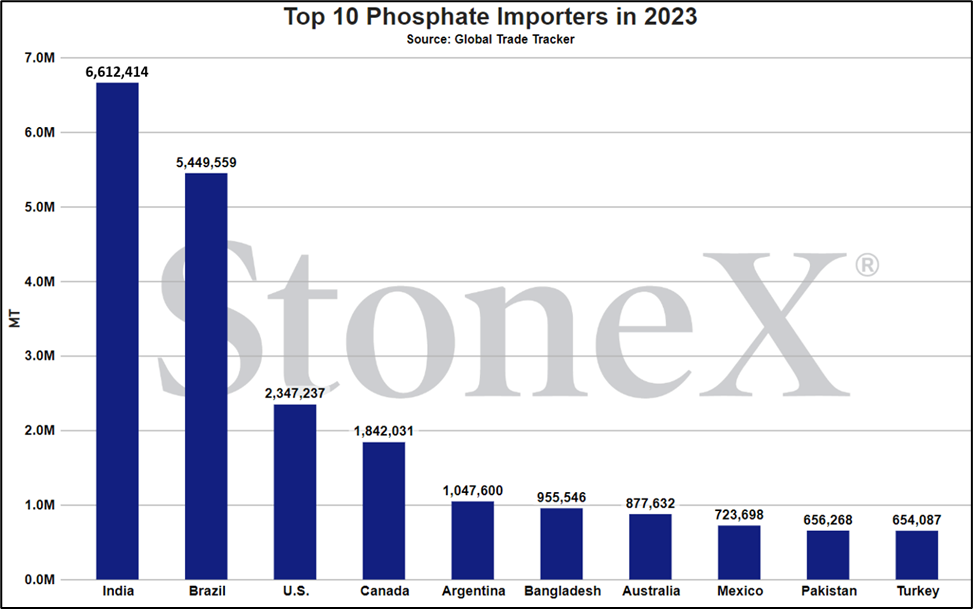
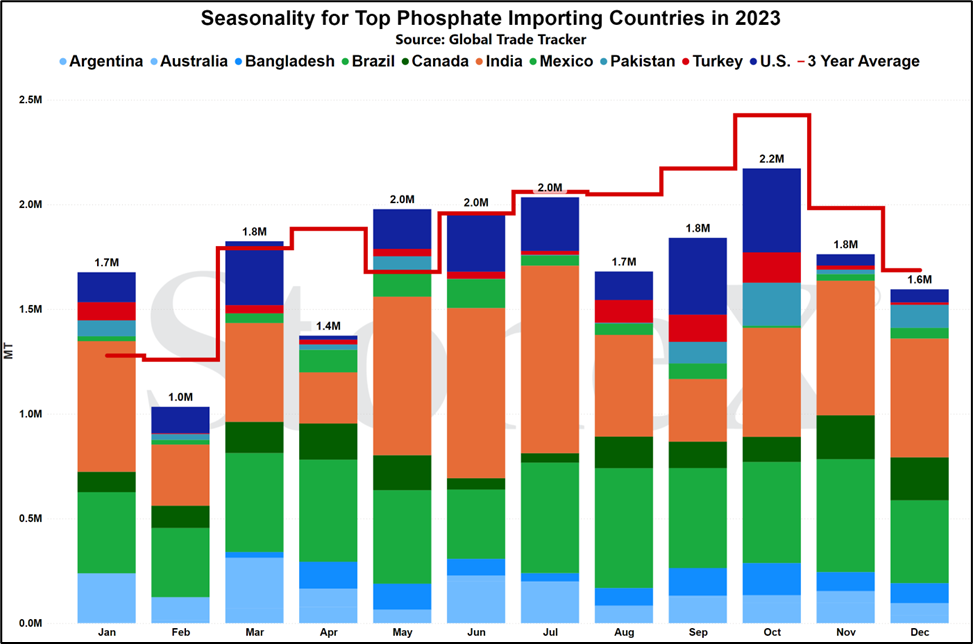
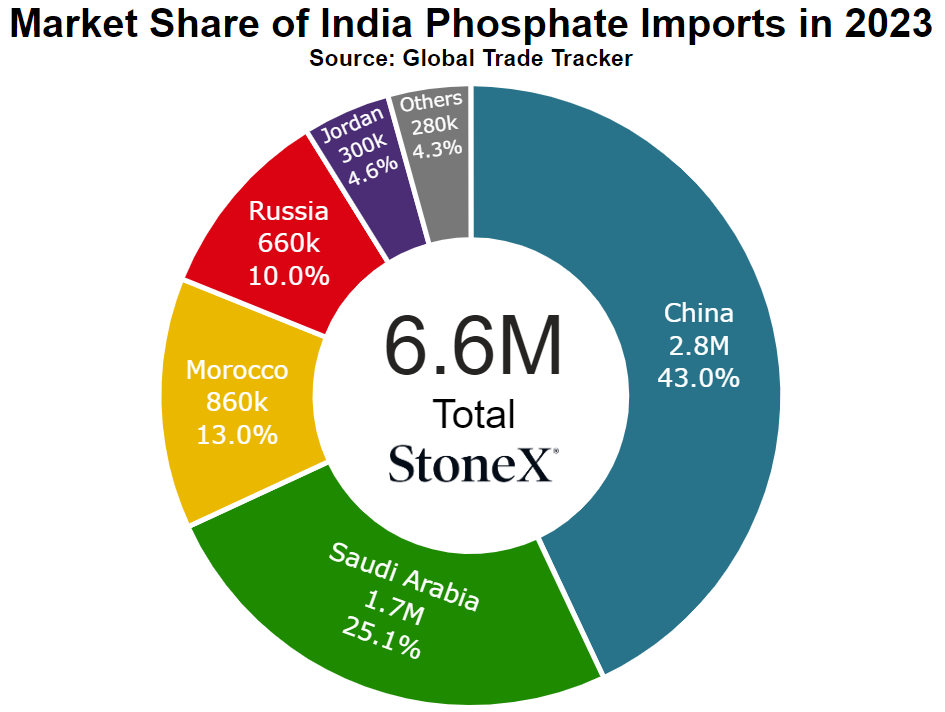
In the world of DAP/MAP buying countries, India stands alone as the largest buyer. Maybe not as the largest consumer, but they are the largest buyer.
In 2022, they imported around 7.2M tons. In 2023, 6.6M.
However, they have problems right now.
India doesn't work like a lot of the rest of the world. Rather than have their farmers be subject to moving global values, the government has a flat price that is allowed. Importers are put in a bind when global values rise. If the global price to purchase is high and the farmer sale price is low, they lose money. To keep tons flowing, the India government approves a subsidy program that helps to fill the loss gap. Normally, this is not an issue...but it has been recently.
Earlier this summer, global phosphate prices were falling as it appeared that China was returning and demand was being seen as lower with falling grain prices. The Indian government reduced their subsidy rate in hopes of forcing global values lower and as a result, saving some money. For a short time, that worked...until it didn't. Suddenly, Chinese exports started to slow and raw fears came out. Global values rose and the government has been slow to react.
Because of this, stockpiles in India are believed to be very low. Estimates range between 1.5 to 1.8M tons. Without any context, that range doesn't mean much. In later 2021, stockpiles of phosphate got low enough that farmers rioted in the streets. They ransacked retail locations. To put it bluntly, they were not happy and let the government know that they saw they as responsible. India is a democracy and like any democracy, those in power want to stay in power. They quickly fixed the situation, imports resumed and things simmered down.
Why is that relevant to today? Stockpiles during that period were only in the lower 1M ton range. There is not much of a difference from where we are today. Another comparison is that last year at this time and our 5-year average for this time puts their stockpiles around 4M.
All of this to say that India needs to catch up and catch up fast. On a positive note for Indian farmers, there was success in negotiating a contract with Morocco for around 500K ton of DAP and 200K ton of TSP. On a less positive note, they were forced to buy at market value (think that sent a message to other global manufacturers?) and they are still far short of normal for this time of year.
So my fear is this: the world's largest buyer of DAP/MAP is very low on stockpiles with season coming and will need to start buying in large waves with government subsidy money when they fix the program.
Maybe the buying will not be nearly as influential as I fear. Maybe global manufacturers will keep prices steady as to not create more demand destruction.
FYI for the younger readers, the movie is Wayne's World (source: https://www.buzzfeed.com/whitneyjefferson/waynes-world-party-time-excel…).
What this means for farmers
So we detailed that the world's largest exporter, China, has been scaling back exports in an effort to maintain high domestic stockpiles and low domestic prices. India also shows the world's largest buyer needing to play catch up.
Dangerous combination for farmers that need to buy. It doesn't guarantee prices higher. Anything can happen, but a dangerous combination.
Demand destruction popular topic...but will it matter?
Low priced grains + high priced phosphate = demand destruction as I have been told by SO many people out there!!!
All kidding aside, this is a very real story with very real implications.
I have talked to a lot of people who are seriously concerned about what fall and overall demand for phosphate looks like.
- There is concern that app rates will be reduced
- There is concern that app rates will be cut
- There is concern that fall folks will wait until spring
The biggest problem is how hard it is to sift thru the emotional feedback and the fundamental feedback.
From the emotional side, farmers are pissed and rightfully so. Many are looking at sickly 2024 income flows. The 2025 outlook doesn't appear much better. If I'm not making money then why should I buy any of this. I'll just do without.
However, on the fundamental side, we continue to forecast 91.5M acres of corn in 2025 and know that while reductions can be made in places, phosphate is needed to grow the crop. At the end of the day, most conclusions result in having to maximize yield and that is hard to do with phosphate in short supply. Some soil tests will show that less is needed for that max yield. Some may show no need for any. However, the result is likely more demand than what the emotion is saying today.
Now, I am NOT saying there is anything wrong with the emotional side. You have every right. You put your blood, sweat, and tears into your crops. You may be representing generations of farmers counting on you to continue to the family legacy or you might be the first in your line. It is frustrating beyond everything to work so hard to raise a crop that might pay the bills at best. However, emotion is a poor marketing tool.
I can tell you with the upmost confidence that I am living proof. I have made plenty of stupid, angry decisions in my life. My wife would happily regal you with stories of how horrible those played out. Be angry. Be upset. That is, until it is time to make marketing decisions. Then, it is time to let the numbers speak.
So what happens if we do see demand destruction? Normally, that would mean we move into the winter months with high inventories. With less space to fill, manufacturers get nervous and start dropping price to make sure they get to fill the remaining bins. That is normally. Unfortunately, this market is not normal. If you read the above pieces on China and India, you probably know the answer. If the world situation plays out like I fear and we end up with poor fall demand, the answer will be to export product to get back to comfortable.
This is another one of those "don't shoot the messenger".
What this means for farmers
If the India/China situation plays out like I fear, it means that even if farmers make a statement by cutting back on their phosphate needs, it may not matter in the grand scheme.
Remember, you are part of a world market whether you like it or not. The story at home can certainly be bearish but if the global market is bullish, we will get drug higher with it.
N.A. production rates continue to suffer
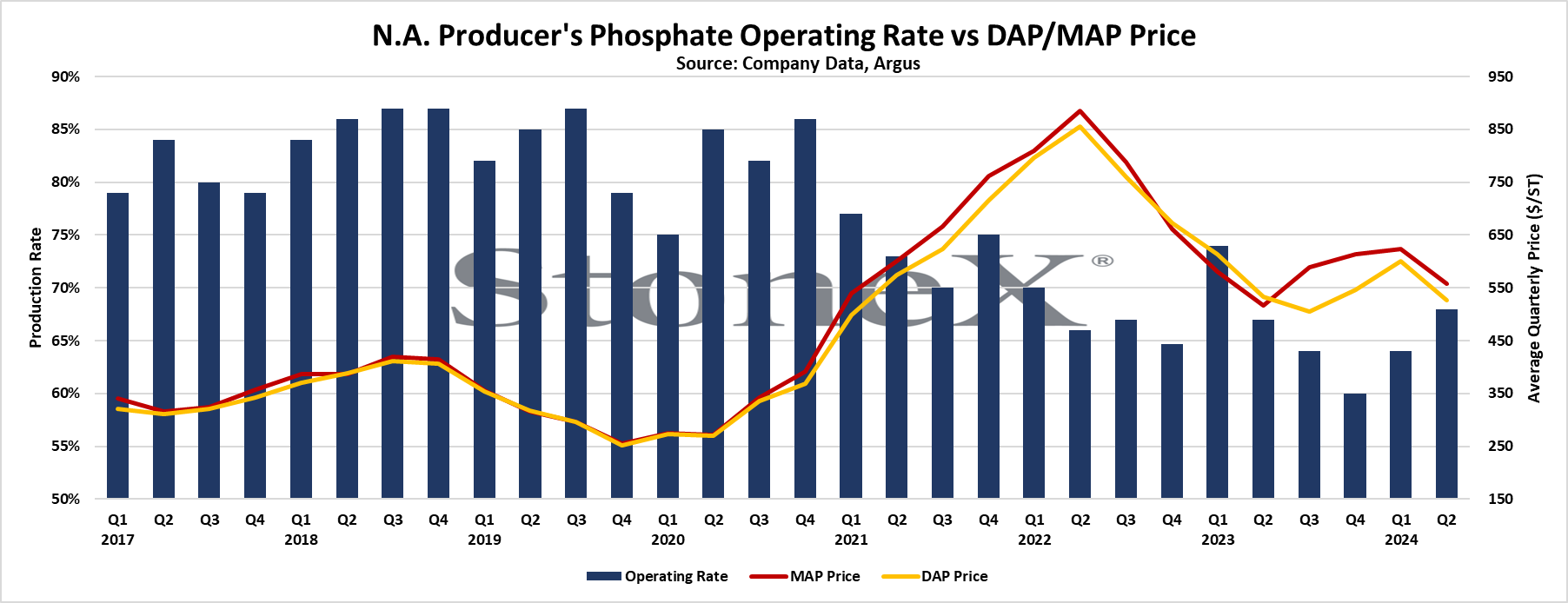
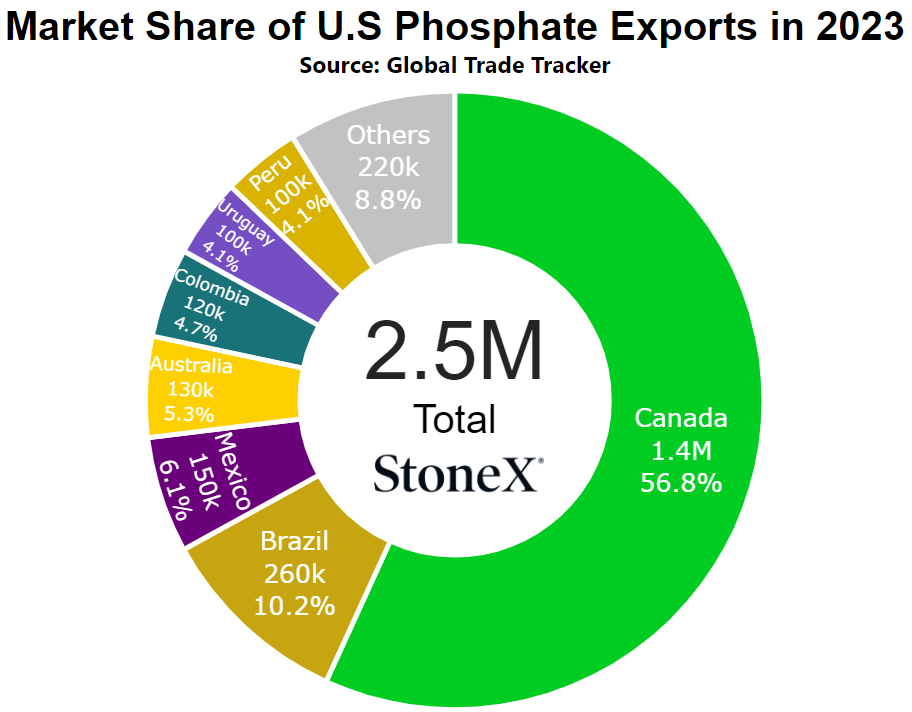
North American farmers have been suffering with tight phosphate inventories for the last couple years. The issue that is most talked about is U.S. duties on Morocco/Russia/China which has stopped imports from all 3 nations. However, not talked about as much are N.A. operating rates.
Normally, rates would be in the 80 - 85% range. Anything sub that would be seen as "odd". However, since Q1 '21, anything above 75% is the oddity.
Operating rates for phosphate have suffered significantly and when paired with 3 of the 5 largest global exporters being dutied, it makes inventory levels suffer. To be clear, from my vantage point, this is not being done purposely. Whether N.A. producers operate at 70 or 80%, it likely means very little on the global scale and with margins continuing to be solid due to high global values, it behooves them to produce everything possible. The fact that operating rates are so low during such a high margin environment leads me to believe that there have been struggles at their mines/production lines/etc.
There is hope that we will see improvement in Q3 and Q4 of this year. Earnings calls have heard statements that a return to normal is expected...though I will feel better when we actually see them. In the meantime, supplies remain tight.
What this means for farmers
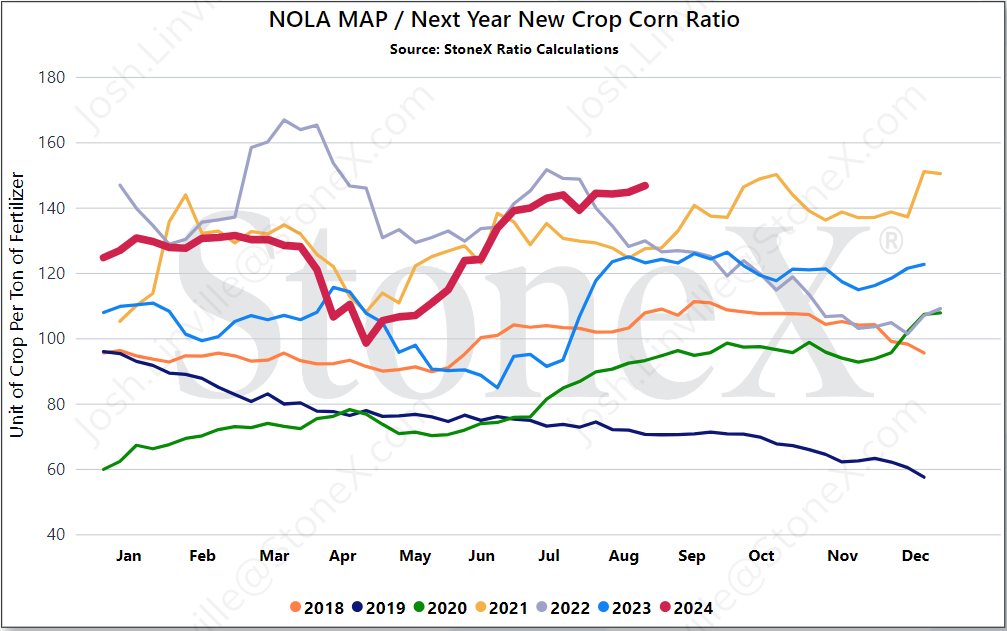
For North American farmers, it means that phosphate values will remain high. MAP is the worst of the bunch as N.A. always been dependent on big imports to fill that niche. For NOLA, MAP is historically a $20 premium over DAP. Recently, that premium is closer to the $90 - $120 range. Then, the NOLA complex has spent much more time near the top of global values when historically is has been in the middle to lower end of the range.
If operating rates and import tariffs got back to normal, it would help. A little on DAP (as it falls back to midline vs the world) and a decent chunk for MAP (as it drops back to a normal spread to DAP). However, it would not cause prices to crater. If only NOLA values fall, a huge export opportunity would open, exports start to occur in a big way, supplies get tight again and values rise. That is just a free market in action.
Prices can certainly fall but it is going to need the help of global factors.
Past opportunity missed, future opportunity to watch for
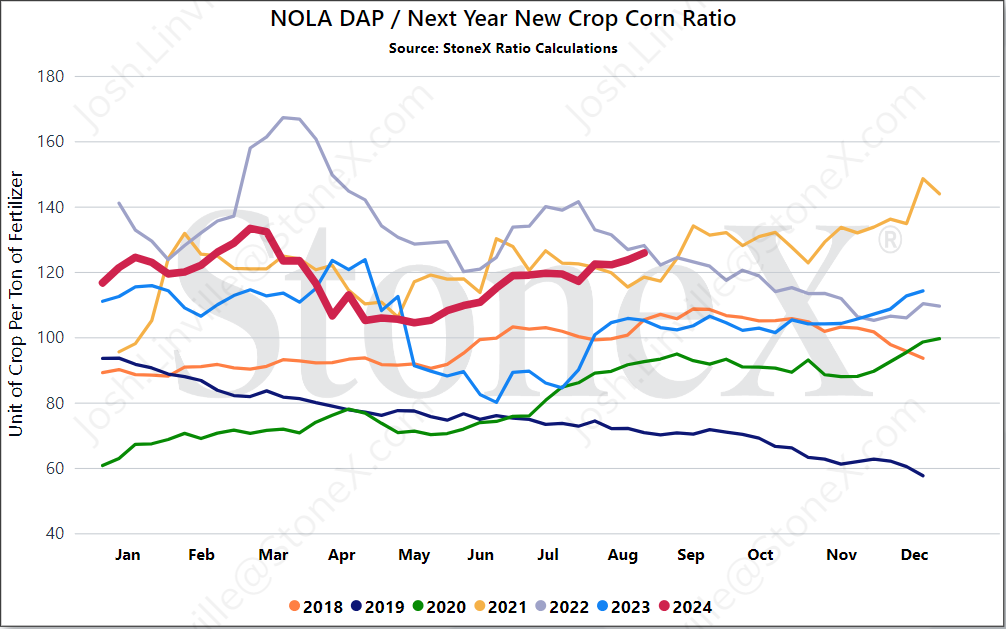
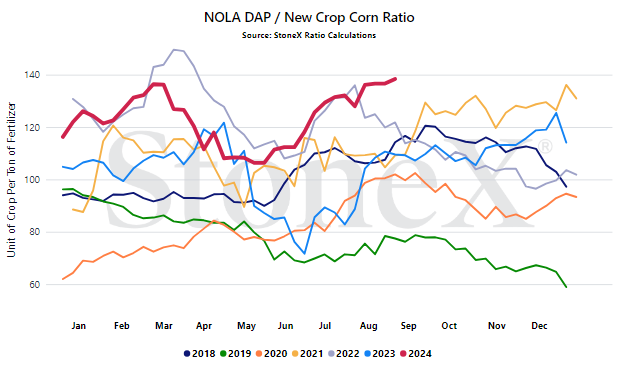
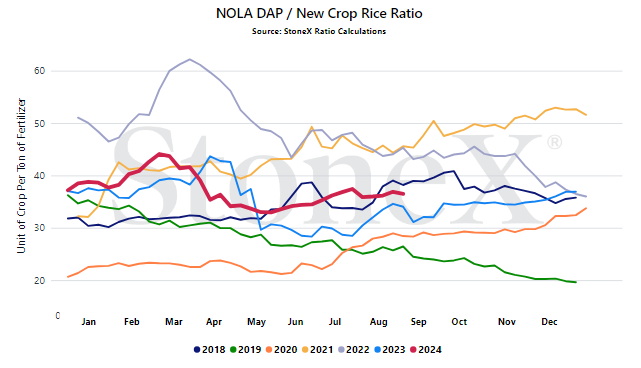
If you have read my stuff anywhere, you know all about our ratio approach. Flat prices can lie to you. $7 corn is fantastic...ok, it doesn't matter the situation. $7 corn is just fantastic!!! However, if phosphate values climb to over $1,000 like they did in early 2022, it isn't as attractive as it might seem. Rather than let those prices lie to us, I like to look at farm marketing like a manufacturer who only focuses on locking up the value. In this case, we are trying to lock up BOTH sides of the equation when the value falls. We want to spend less bushels for each ton of DAP we buy, not more. So we should look for those low value opportunities.
The case in point is last summer (2023). Being completely honest, when the ratio hit 80 (using NOLA DAP/Chicago Dec corn), I thought phosphate had more downside and corn more upside. Both markets were trending that way but I knew the value was good and we pointed that out...but should have been more vocal about it.
Playing Monday Morning Quarterback, what could we have done?
When that value dropped to 80, we could have purchased our phosphate/sold our corn to secure the ratio. In fact, if we have fields that will hold excess phosphate levels, we could have applied extra in case the markets went wacky in the future. Now, just over a year later, that same ratio sits around 125 or 45 bushels more for each ton of DAP used. If we had built soil levels, we could scale back application rates without an impact to our yield potential and pocketed the difference.
The key here is that we no longer try to call the high of grains and the low's of fertilizer. If you can do that on a consistent basis, you are in the wrong job! Rather, we should look for these opportunities when they pop up.
And if they pop up again, get ready. I'm going to have a thing or two to say...
What this means for farmers
I remember reading an article that talked about a study that looked at the difference between farmers. It looked at their returns, and then looked at their different approaches.
The percentage differential between the groups was relatively minor. The upper group did just a little better job of finding opportunities in the market than the other group.
I think this is one of those things that set a farmer apart.
Too many times, we get hung up on "this is too low, this is too high". I understand why but those farmers that are locking up all the land and keep growing are more likely to approach their marketing from a value proposition.
Just something to consider.
NOLA/New Orleans, Louisiana DAP price comparison
Number 5 global exporter in 2022
Price comparisons
Vs 30 days ago - unchanged vs last month
Vs 90 days ago - 5% or approximately $25 higher
Vs 6 months ago - -14% or approximately $90 lower
Vs 1 year ago - 3% or approximately $15 higher
U.S. Midwest Average (using multiple points across Midwest) price comparison
Vs 30 days ago - unchanged vs last month
Vs 90 days ago - 1% or approximately $6 higher
Vs 6 months ago - -1% or approximately $7 lower
Vs 1 year ago - 1% or approximately $7 higher
U.S. Northern Plains Average price comparison
Vs 30 days ago - -1% or approximately $6 lower
Vs 90 days ago - -5% or approximately $30 lower
Vs 6 months ago - -6% or approximately $39 lower
Vs 1 year ago - 1% or approximately $8 higher
U.S. Southern Plains Average price comparison
Vs 30 days ago - -2% or approximately $11 lower
Vs 90 days ago - -4% or approximately $24 lower
Vs 6 months ago - -9% or approximately $60 lower
Vs 1 year ago - 3% or approximately $18 higher
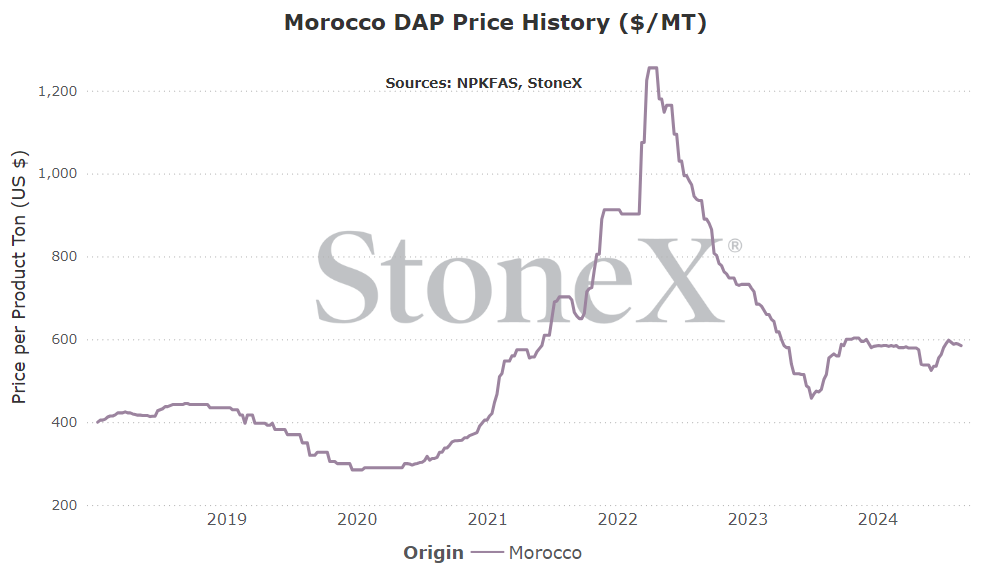
Morocco DAP price comparison
Number 1 global exporter in 2022
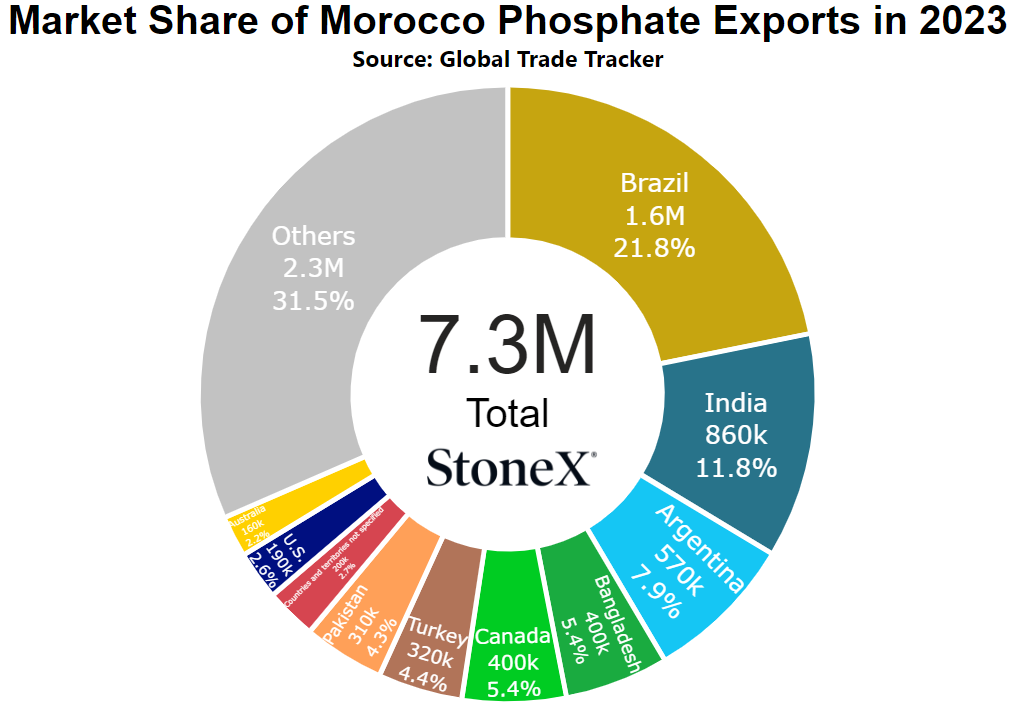
Price comparisons:
Vs 30 days ago - 1% or approximately $8 higher
Vs 90 days ago - 12% or approximately $63 higher
Vs 6 months ago - 3% or approximately $20 higher
Vs 1 year ago - 7% or approximately $40 higher
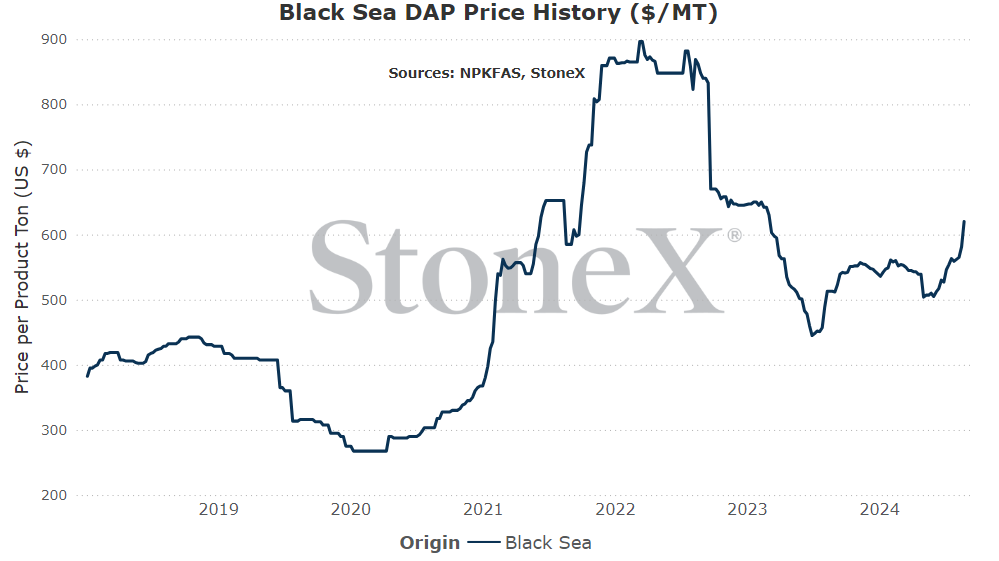
Black Sea DAP price comparison
Number 3 exporter of DAP/MAP in 2022
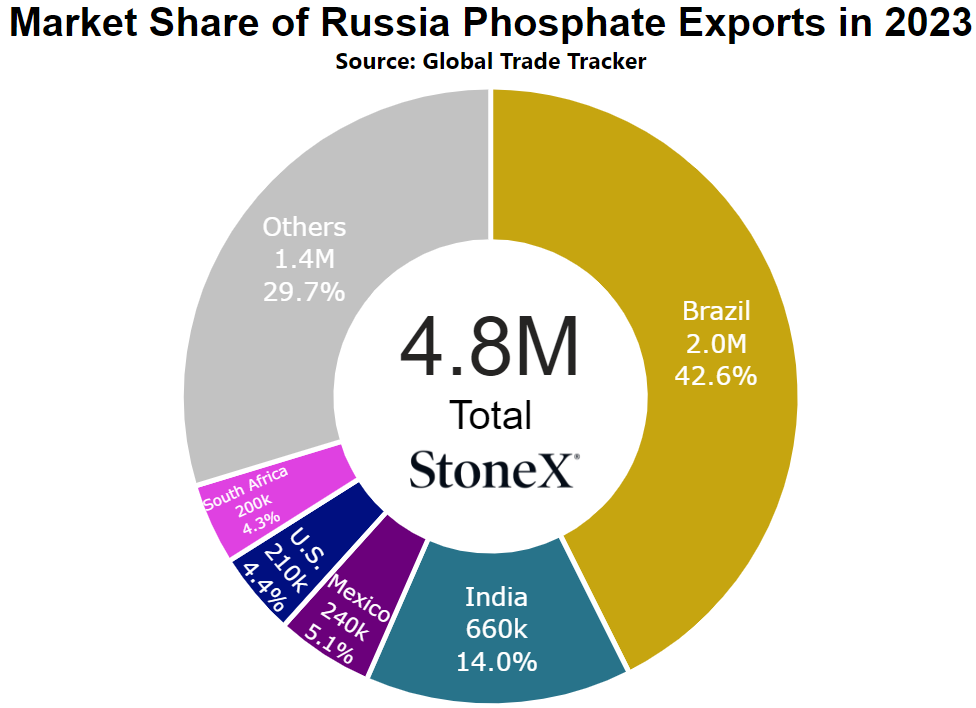
Price comparisons:
Vs 30 days ago - 5% or approximately $26 higher
Vs 90 days ago - 15% or approximately $75 higher
Vs 6 months ago - 6% or approximately $31 higher
Vs 1 year ago - 14% or approximately $72 higher
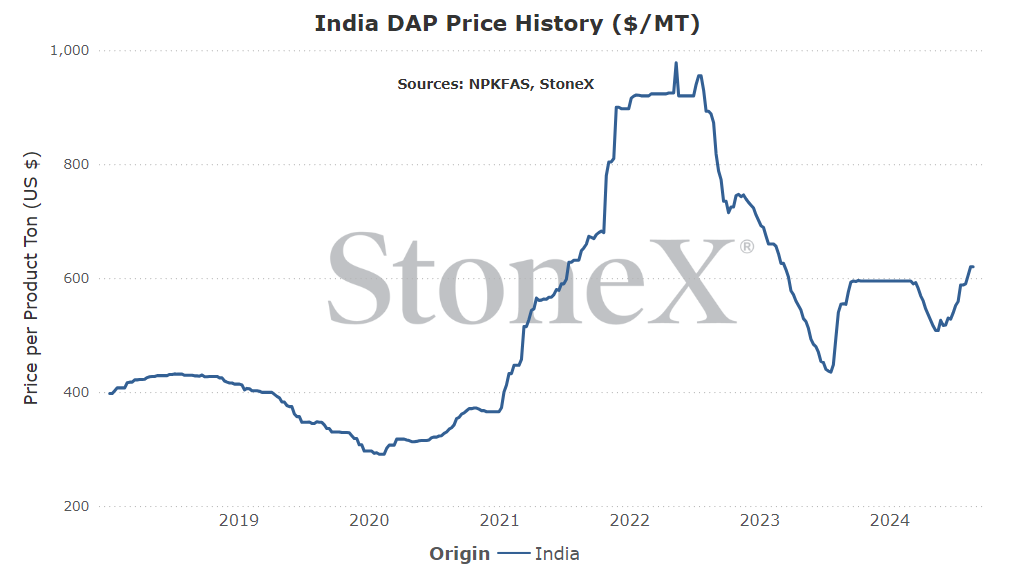
India DAP price comparison
Number 1 global importer in 2022
Price comparisons:
Vs 30 days ago - 6% or approximately $33 higher
Vs 90 days ago - 18% or approximately $94 higher
Vs 6 months ago - 4% or approximately $25 higher
Vs 1 year ago - 12% or approximately $65 higher
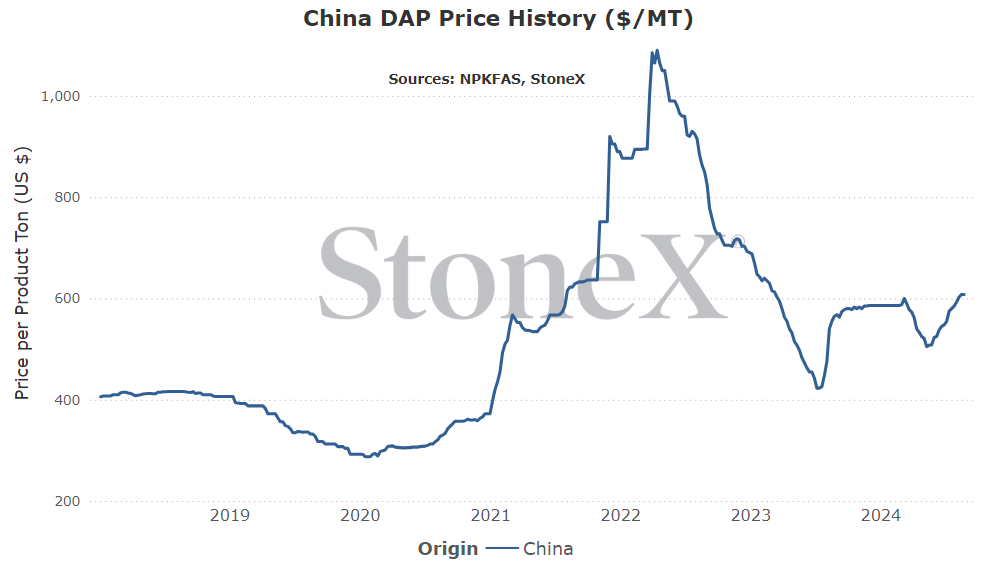
China DAP price comparison
Number 2 global exporter in 2022
Price comparisons:
Vs 30 days ago - 4% or approximately $23 higher
Vs 90 days ago - 20% or approximately $100 higher
Vs 6 months ago - 3% or approximately $20 higher
Vs 1 year ago - 8% or approximately $43 higher
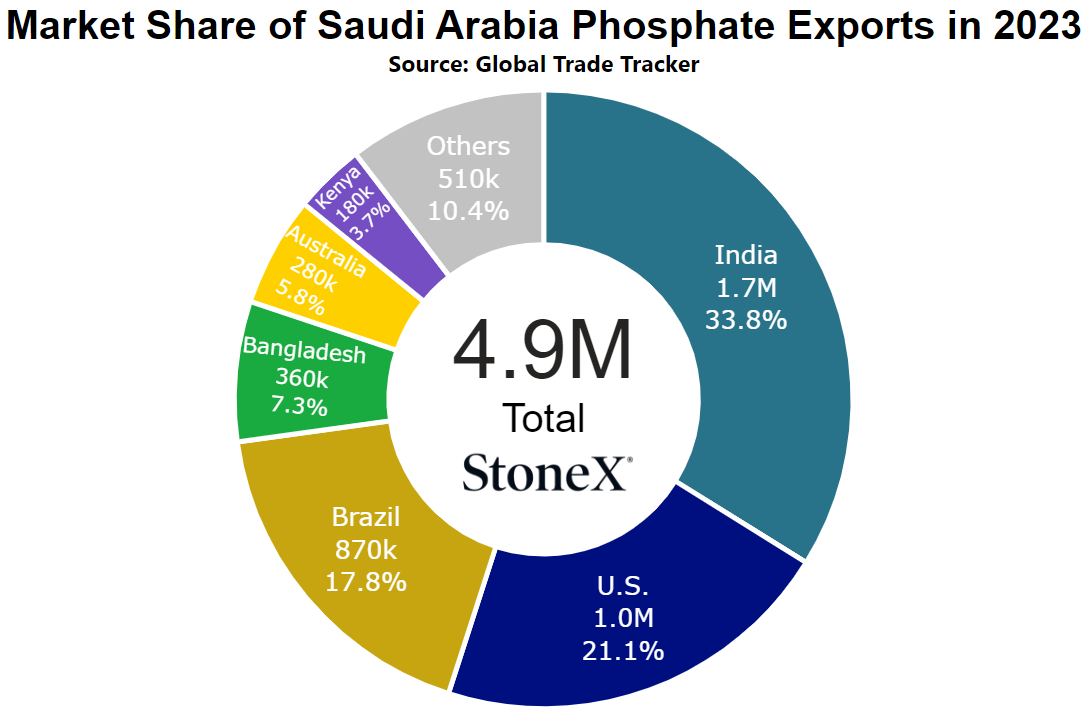
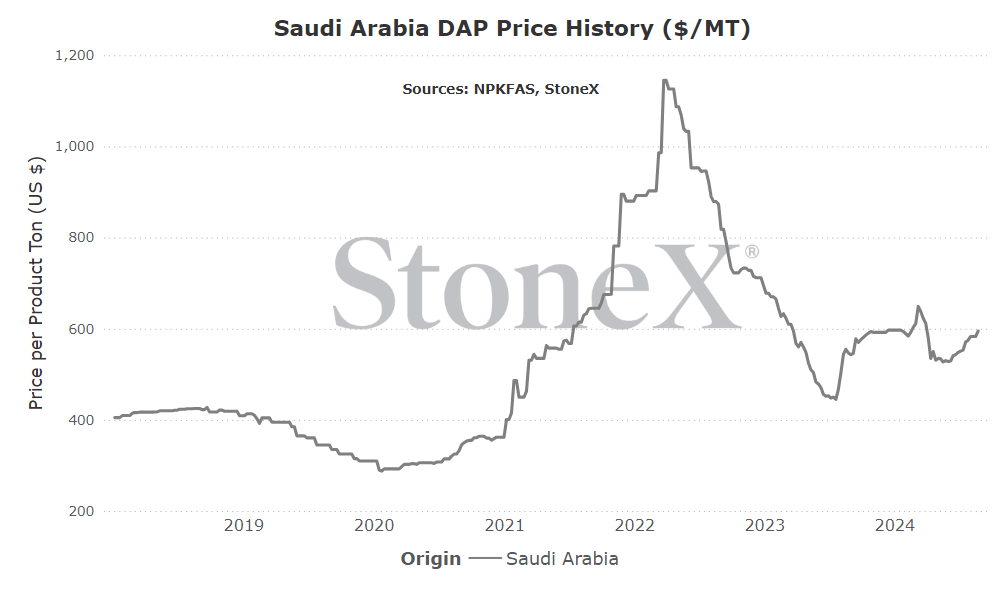
Saudi Arabia DAP price comparison
Number 4 global exporter in 2022
Price comparisons:
Vs 30 days ago - 3% or approximately $20 higher
Vs 90 days ago - 12% or approximately $65 higher
Vs 6 months ago - -3% or approximately $16 lower
Vs 1 year ago - 9% or approximately $48 higher
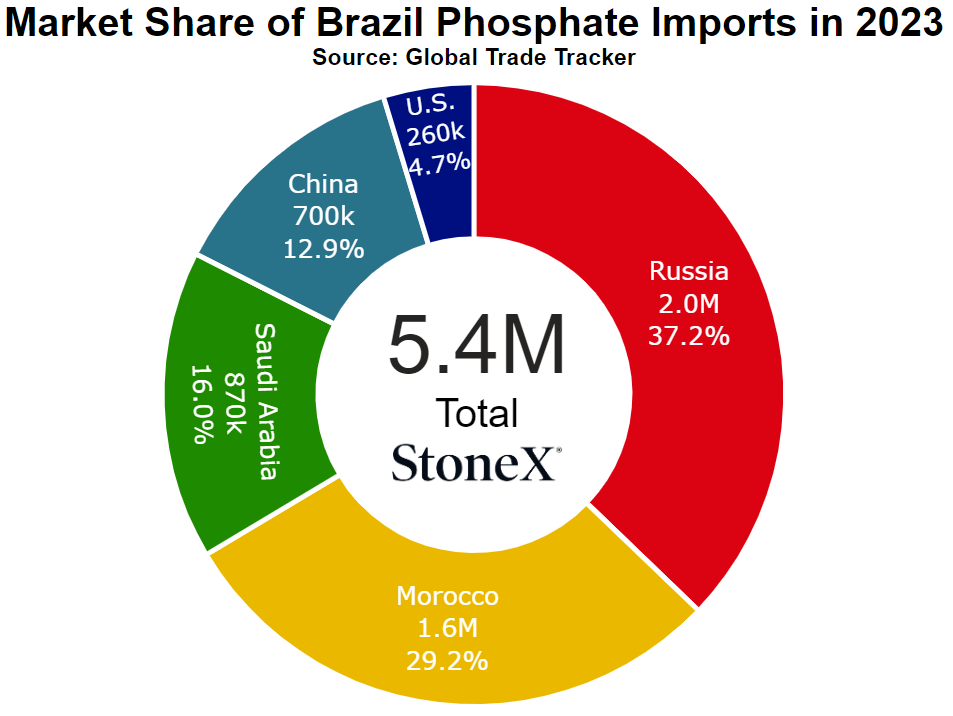
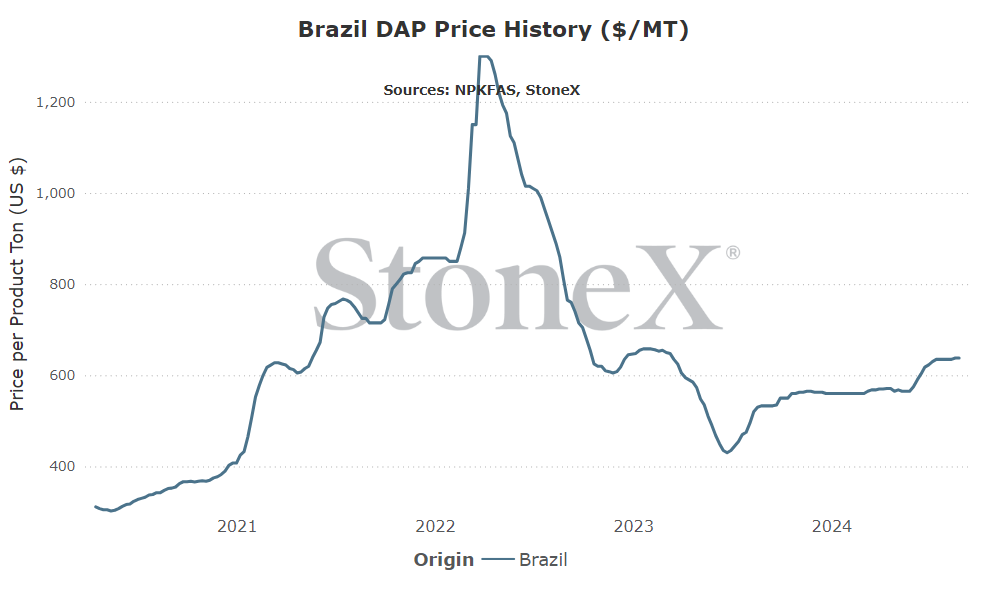
Brazil DAP price comparison
Number 2 global importer in 2022
Price comparisons
Vs 30 days ago - unchanged vs last month
Vs 90 days ago - 13% or approximately $73 higher
Vs 6 months ago - 14% or approximately $78 higher
Vs 1 year ago - 20% or approximately $105 higher
- The world's largest exporter (China) continues to fall behind – there has been a hope that the world would see Chinese exports starting to increase as some restrictions have been lowered. July data, unfortunately, did not paint that picture. Jan - July only shows 3.2 vs recent 3-year average of 4.5M and vs the more normal 2019 - '21 average of 5.4M. That is a lot of missing tons.
- The world's largest importer (India) stockpiles continue well below average – India needs to catch up in a big way even after securing 500K tons of DAP and 200K tons of TSP. Stockpiles are believed to have dropped to nearly 1.5M. For reference, in late 2021, farmer riots started when stockpiles dropped to the very low 1M ton range. For more background, last year at this time stockpiles were around 4M. The world's biggest buyer needs to fix their subsidy rate and start catching up fast.
- U.S. production rates continue below normal – while the list of reasons have been multiple, the overall story is that U.S. production rates have been below normal. On its own, this would hurt values higher as it leads to a need for more imports to replace. However, with so much of the world being blocked by tariff's (China/Russia/Morocco), this makes it that much worse.
- Farmers appear to be looking at phosphate as one of the first cuts – the extremely common conversation has surrounded farmers and retailers expecting phosphate demand to be down. Ratios are extremely high. Farmers income flows are suffering. Cuts need to be made...and it seems phosphate is standing very near or in the front of that input list.
- China can return in a big way – never count China out. Just because they are behind today does not mean they cannot start exporting heavily again. Now, there are not a lot of signs of that happening. The government is reportedly telling exporters that they are not allowed to export to India which is leading to the theory that more restrictions are coming. However, it is China. You never know.
- U.S. production rates are "expected" to return Q3/Q4 – expectations in the market is that U.S. production rates are supposed to improve during the 2nd half of 2024. While still not seen (that data will come in the near future), if/when it does it should provide an injection of much needed supply. Maybe that helps lower prices?
We believe that only looking at the flat price of either grains or fertilizer can be misleading:
-
Only selling grain can hurt you if fertilizer prices rise substantially
-
Only buying fertilizer can hurt you if grain prices fall
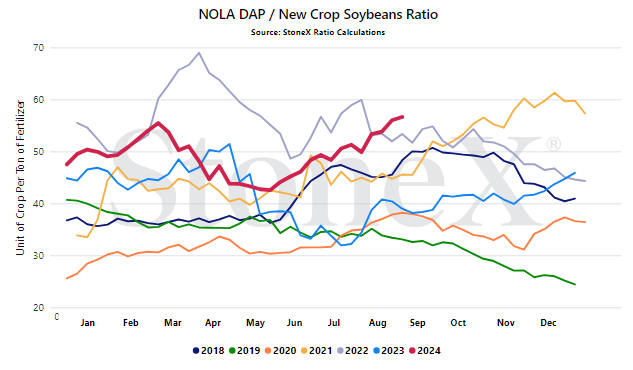
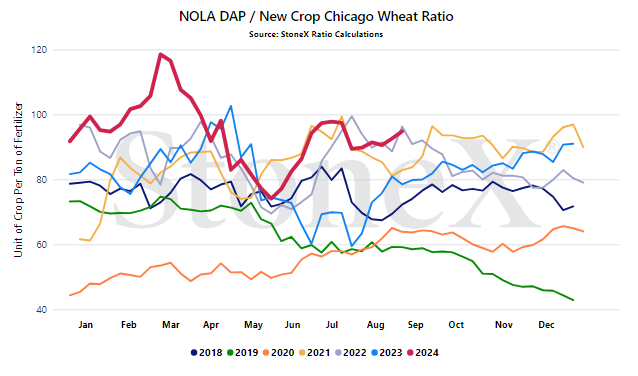
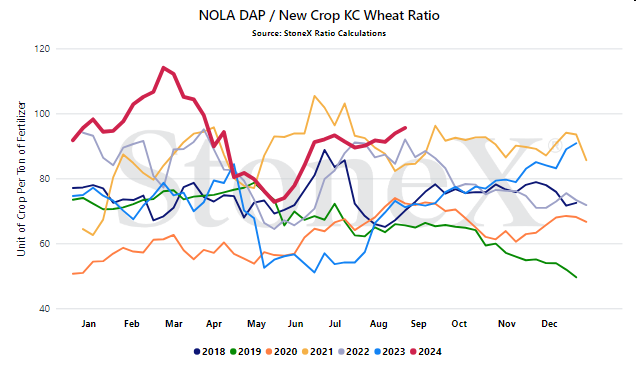
We look at the ratio "value" to get a better indication of where we are or how many bushels of X does it take to pay for 1 ton of fertilizer.
Would you rather:
-
Spend 150 bushels to pay for 1 ton of DAP
-
Spend 80 bushels to pay for 1 ton of DAP
When we compare the current ratio value against recent years, we start to see if we are high or low.
YOUR VALUES MAY LOOK DIFFERENT
This graph looks at the NOLA DAP price vs the flat grain price. There are no logistics on either product. Your location will look different due to fertilizer logistical costs, grain basis, etc.
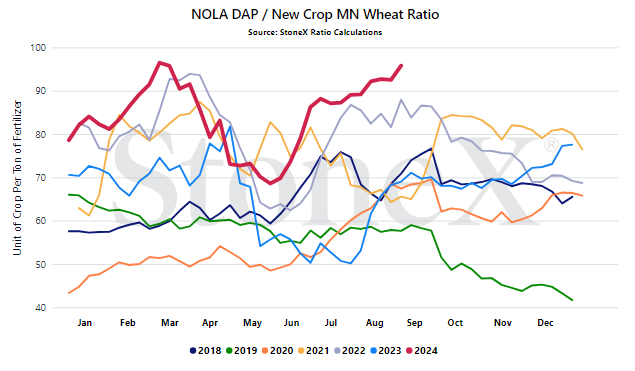
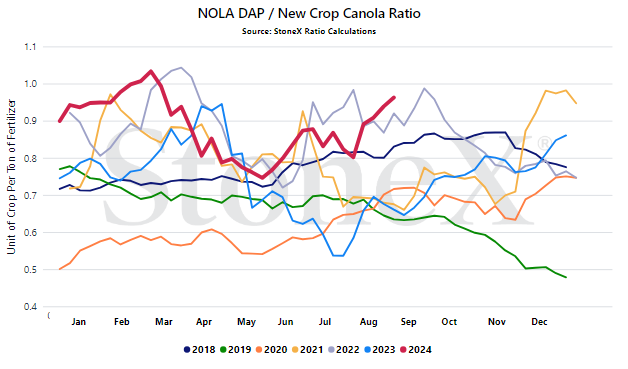
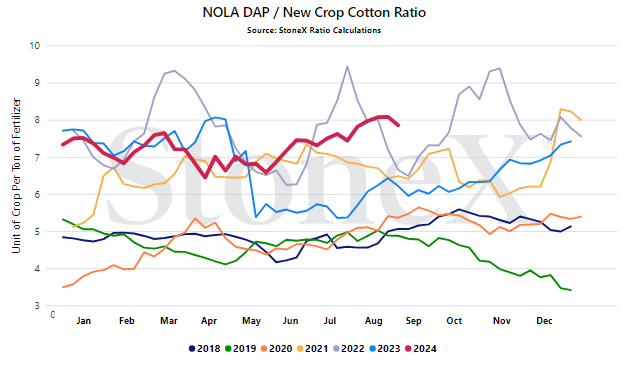
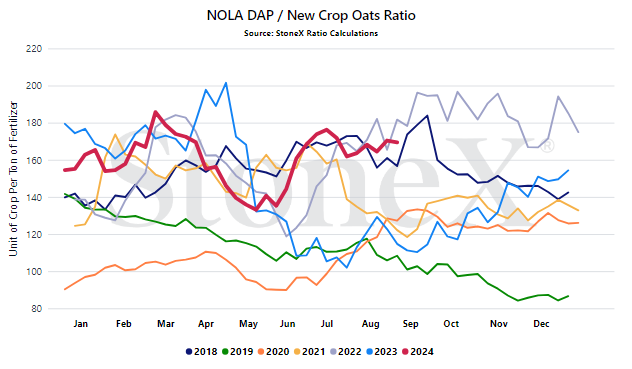
- Make smart/unemotional decisions - your grain price stinks. Your inputs costs are still high. You are not expecting to make much/any money this year and next year isn't much better. Blood pressure up yet? Has it ever come down? Listen, it is easy to be frustrating/pissed off/angry/etc. today and there is nothing wrong. I do not even farm and it gets under my skin. All I am saying is that when it comes time to make marketing decisions on either buying inputs or selling grains, set the emotion aside as best you can. I've made a lot of emotionally charged decisions in my life and my wife will be first in line to tell you none have worked out well. This is your livelihood. Your farm/family/etc. are counting on you to see it thru tough times. Treat it as such.
- Remember that even though things are calm now, they can get out of hand still - how the hell can it get worse?! I'm guessing that is the thought going thru your mind right now!!! There are still plenty of avenues to worse conditions for urea. Iran attacks Israel. Russia escalates against Ukraine. China invades Taiwan. Any/all of these possibilities have the ability to really mess up the market. It can get worse.
- Chinese exports - China is historically the world's largest exporter and they are decently behind even recent year averages with signs that it could get worse before it gets better. If they continue to restrict exports, that leaves a large void in the global supply side that is felt in every corner.
- India purchases - India is the world's largest buyer and they are way behind recent year stockpiles. In fact, current stockpiles are believed to be very near the levels that caused farmers to riot in late '21. They need to catch up and they know it. That means when the government fixes the subsidy rate, the world's largest buyer is going to be in catch up mode using government money...
- Again, make smart choices - thinking about reducing your phosphate application rate? Is that going to hurt your overall yield and/or your best profitability? Can you skip phosphate because of soil levels? Can you wait until spring in hopes that the market improves? I am not saying any answer is right or wrong. Everyone's answer can be different. All I am making a point of is that you make sure when making decisions, you are making the best financial decision for your operation and not a haste/angry decision that will hurt worse later.
StoneX Ratio Calculation
The ratio calculation is derived from Bloomberg historical grains values as well as fertilizer values from StoneX, NPKFAS, and Argus.
The calculation is simply dividing the fertilizer price by each grain price.
All data was sourced from StoneX unless otherwise noted.