Global
There really isn't much to say new about potash. The outlook remains solid.
While the Canadian rail strike story needs to be watched, so far it seems to have a minimal impact on shipments (hopefully that continues).
Russia continues to export heavily with more production coming.
Laos improvements continue to help build production levels.
Belarus could still return to former glory.
While there are certainly things that could happen to upset the apple cart, we continue to see a relatively flat potash market going forward. Supplies are very good today and look to improve in the future. A very well supplied market typically has little reason for values to move significantly outside of Black Swan events or logistical issues.
North America
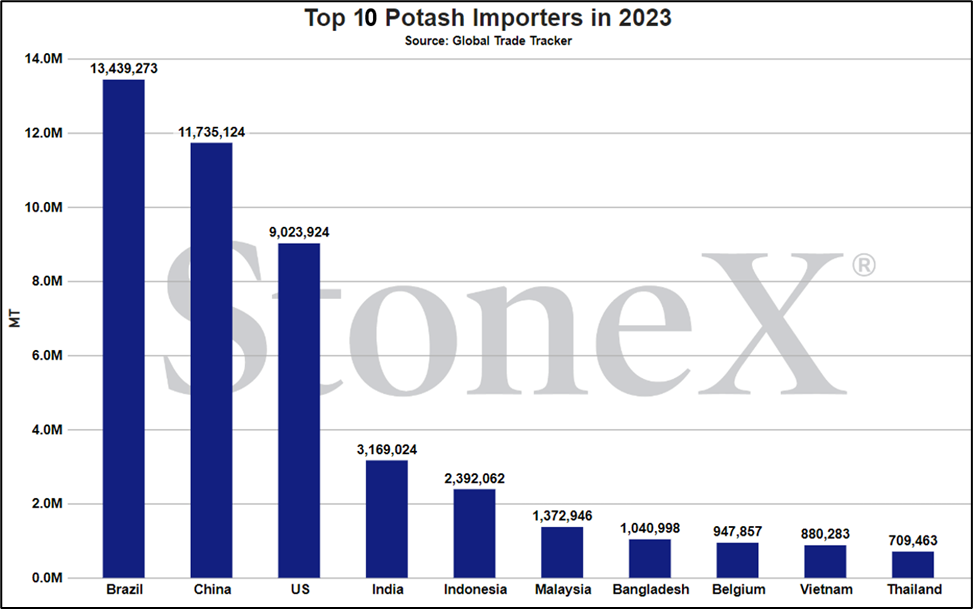
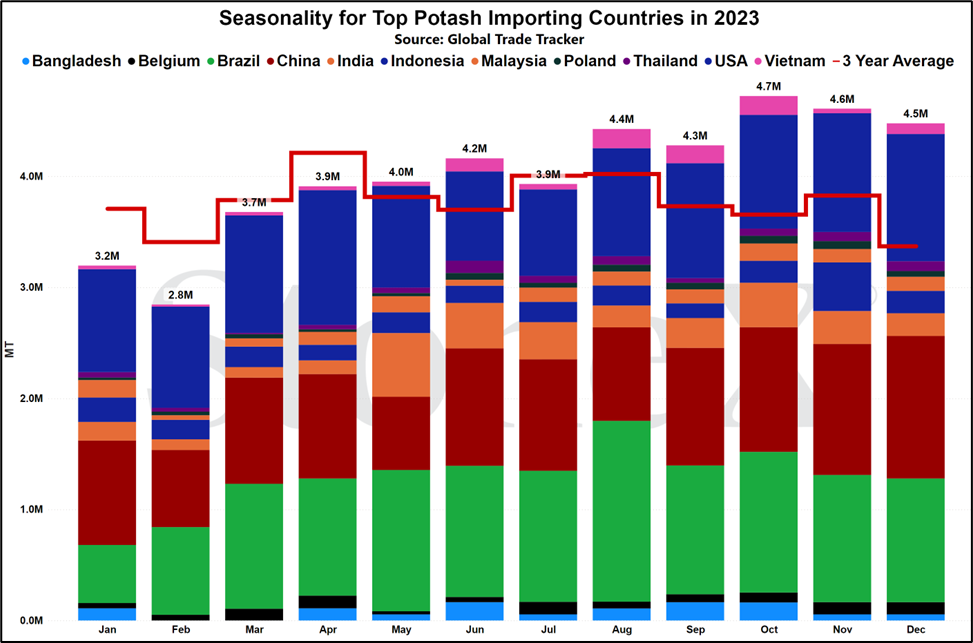
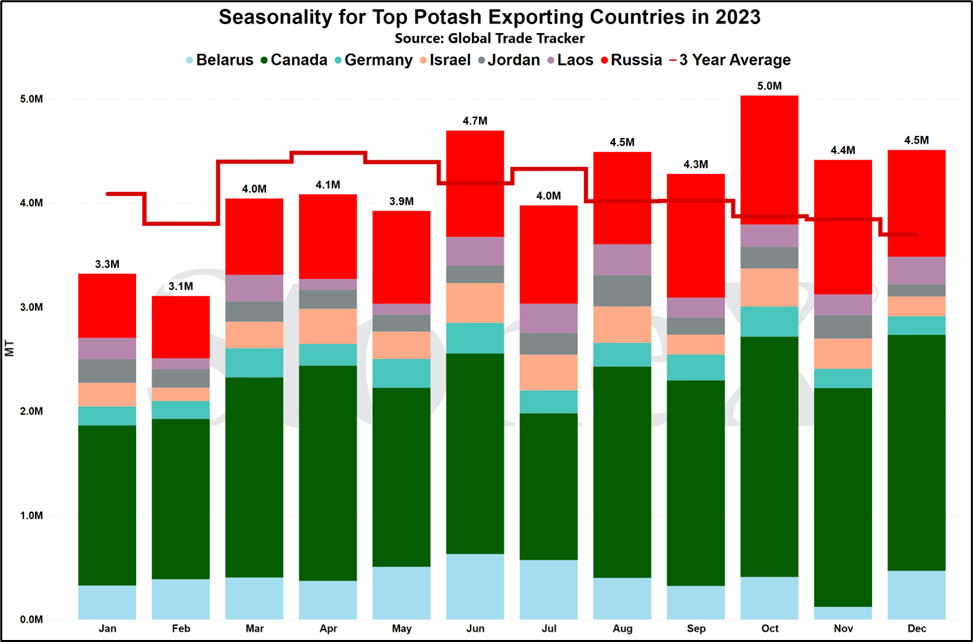
Same as above. We need to continue to watch the Canadian rail strike situation very closely. It is very hard to detail how huge an impact a rail work stoppage that lasts weeks/months would be to the Canadian government. U.S. farmers, you are not alone. 85% of the 9M tons of potash that was imported to the U.S. in 2023 came from Canada. However, today that sort of a work stoppage appears unlikely.
Aside from some bumps here and there due to logistics, potash looks flat. Suppliers appear plentiful and the 2025 crop mix points to solid demand. When looking at potash vs grain values, it is on the lower/normal end of recent years.
There just isn't a lot to get excited about today.

Canadian rail strike
Let's hit on the elephant in the room which is the Canadian rail strike.
This is a story we have been watching/talking about for longer than I like. While we have always said a work stoppage was possible, it was a very low possibility and the hope was that negotiations would be successful for both sides and normal shipments continued.
As the saying goes, hope is not a strategy.
Late last week, negotiations between the CP/CN railroads and their unions broke down. At the cutoff time, the railroads blocked workers from coming in and an official work stoppage was in place. It sounds as though a lot of the industries reliant on rail (it makes up a lot for Canada) had scaled back or stopped expecting shipments to occur which was a positive step but any slow down/stop was going to hurt.
Fortunately for the Canadian economy (not so much for unions who felt their negotiation power was impacted), the government stepped in and forced work to resume. The work stoppage period did not last very long, but the impact was there. Even worse, the story is not done. The unions are angry at the government and are threatening another strike/work stoppage. I cannot say I know if/how this process would work, but the talking points show that the story is not done.
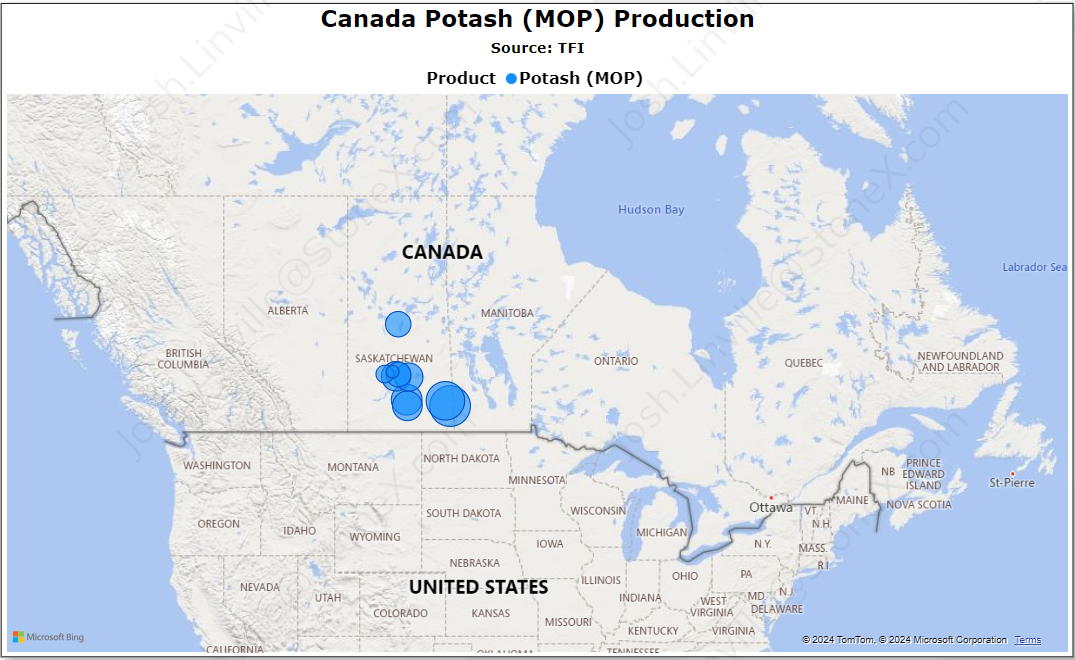
So what does this mean for potash? Take a look at the map below? All the potash production is centered in the country. That means a HIGH reliance on rail to move the product. If we see another work stoppage AND that period lasts a while, potash could have issues. In 2023, Canada exported 23M tons. In another format for those thinking truck can fill the void, a unit train typically consists of 110 cars. Now, Canada has different regulations for truckers so may be able to haul more per truck but in the U.S., 25 tons per truckload is the standard. That means it takes 4 trucks to equal a railcar. For a 110 car train, that is another 440 trucks on the road. Not only that, but we are not talking about a short 2 hour round trip.
All this to say that hopefully this will not be an issue. Hopefully, negotiations are successful, contracts are signed and we put this in our past.
Now, go back and reread the "hope is not a strategy" line.
What this means for farmers
For potash, a Canadian rail work stoppage for an extended amount of time would hurt (prices higher). Mines would likely have to curtain production without rail to move product out of the way. Exports would crawl to a stop without new inventories being put into sheds for loading. Supplies being lowered would tighten the global S&D. Logistics hurting would likely rally inland values.
It wouldn't be good.
Outlook continues to point to solid supplies globally
Aside from the Canadian rail strike story, the outlook for potash remains solid.
Canada looks like it will increase its production capacity over the next few years.
Russia is understood to be increasing its production capacity over the next few years.
Belarus is still making gains on its export capacity and is still short of what is considered normal.
China continues to invest in Laos to increase their production capacity.
Overall, it sure looks like global production/supply is going to grow at a decent clip vs demand.
What this means for farmers
This is a good thing.
A market that is very well supplied to oversupplied should see prices remain lower and much less volatile. While it doesn't mean that prices cannot rally, it certainly makes it harder.
With fertilizers always doing what they do, it is nice to have one input that looks to work in the buyers favor.
Potash price still solid vs grain values
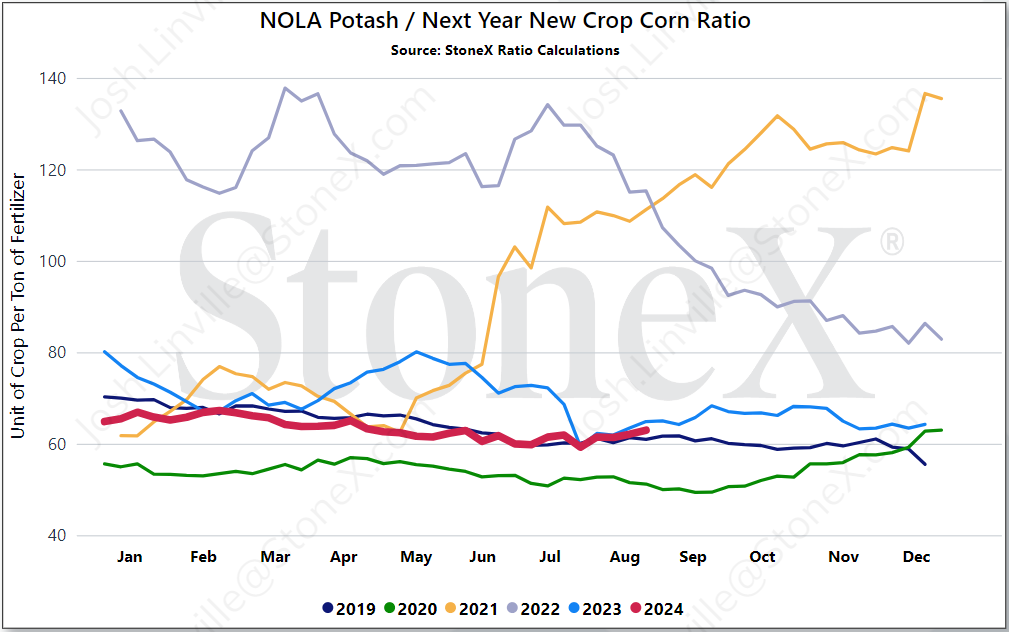
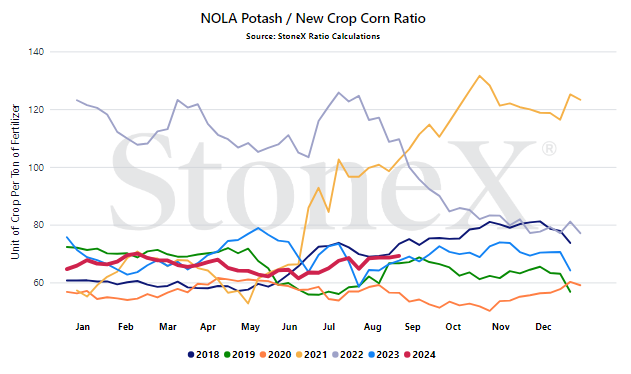
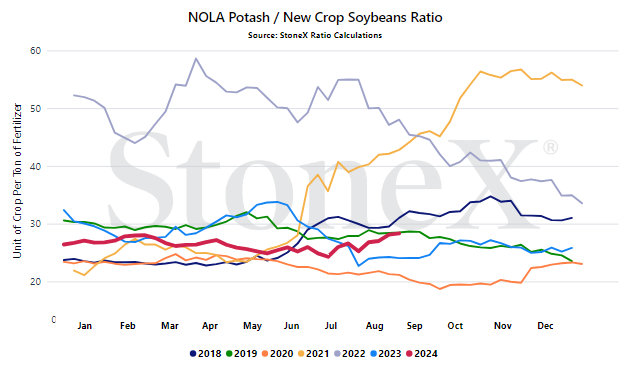
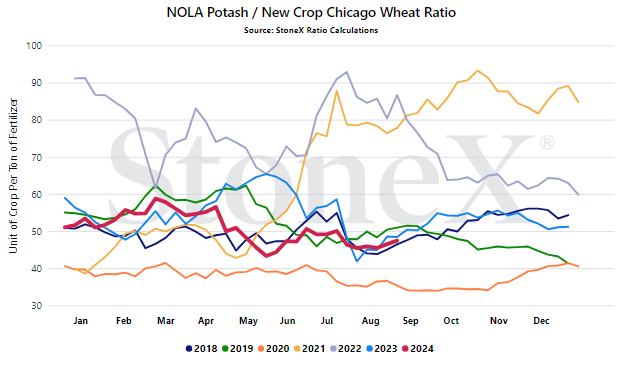
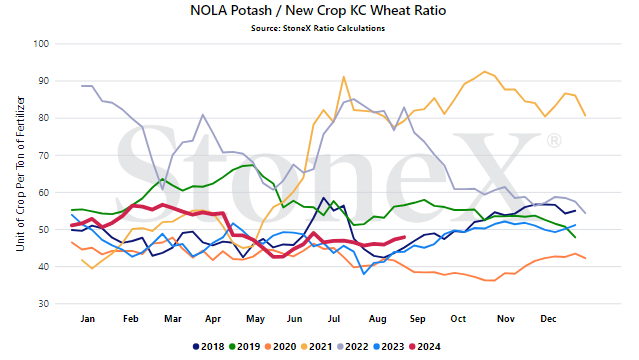
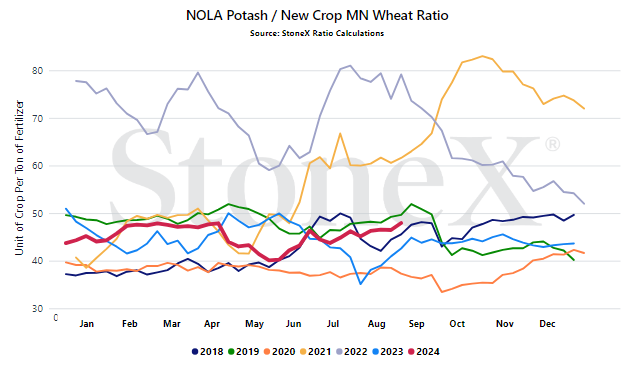
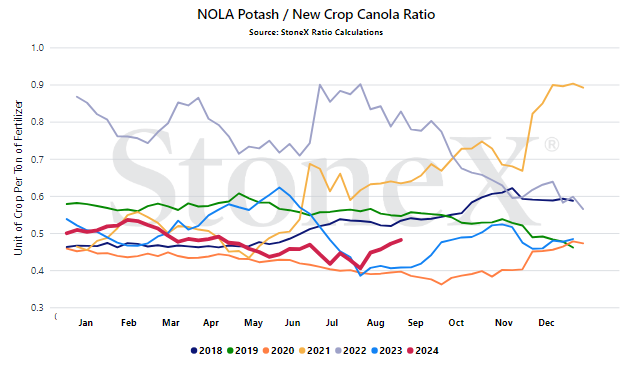
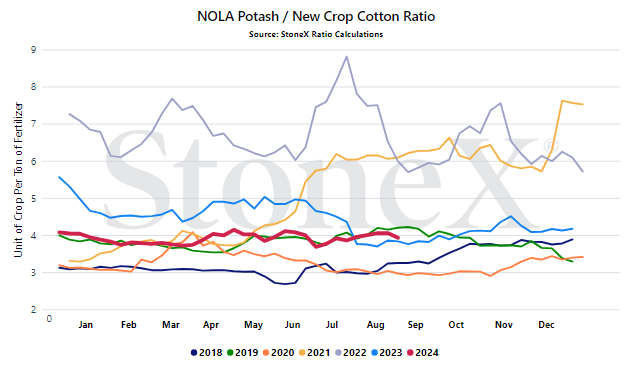
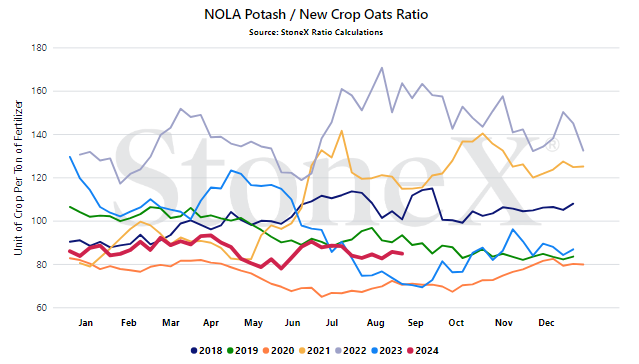
Speaking of solid supplies and hopefully continued solid pricing, let's talk about how potash looks compared to grains. As I always do, I focus on corn but take a look below at all the ratio charts vs potash.
As a quick recap for the new subscribers, I am not a fan of flat prices. Now, I like $7 corn a lot more than I like $3 corn, but that doesn't mean $7 corn is the best value when looked at vs potash. I try to approach farm marketing like manufacturers do. They do not try to call the low/high of each market, most look for when the value between them is the best. For farmers, this means looking at it as "how many bushels of corn am I spending to pay for one ton of potash".
So, if I asked you "would you rather spend 60 bushels of corn to pay for a ton of potash or 120", which would you pick? It isn't a trick question. 60 is right. That is because it is a better value to you. You are keeping more bushels to market for a profit, to hedge with, to accidently spill on the ground right in front of your deer stand....
From that narrow perspective, take a look at the graph below. Potash is pretty well priced in relation to corn. It continues to float around the low 60 bushel range which is historically pretty solid. Yes, I would love for it to crater down to 50 or below, but today isn't bad.
Now, this only works if you do both sides. If you only buy the potash, do nothing on corn and the price of corn falls, that hurts and worsens the ratio. If you only sell the corn, do nothing on potash and it rallies, same thing. It is an approach to consider.
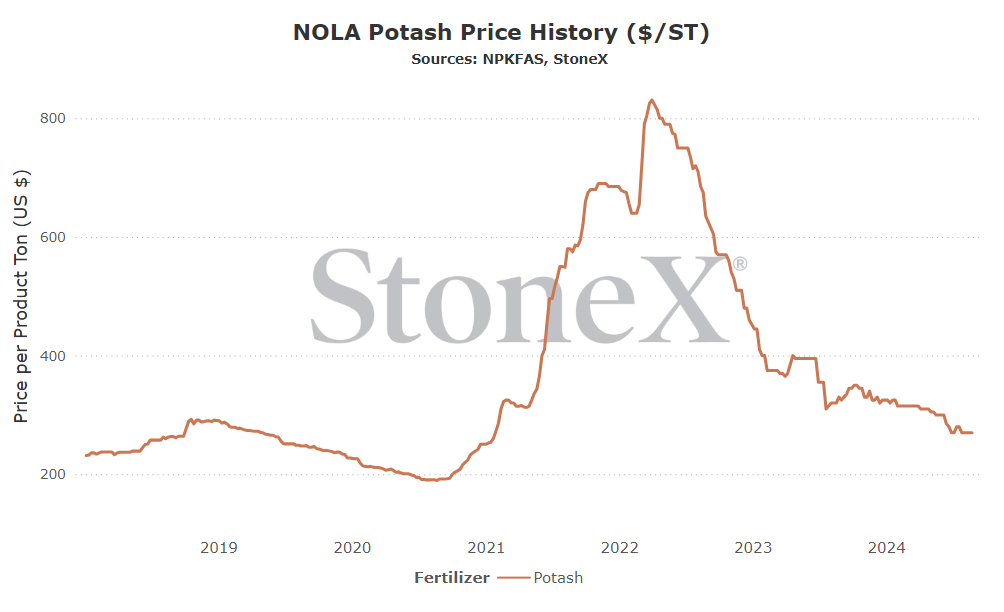
NOLA/New Orleans Louisiana
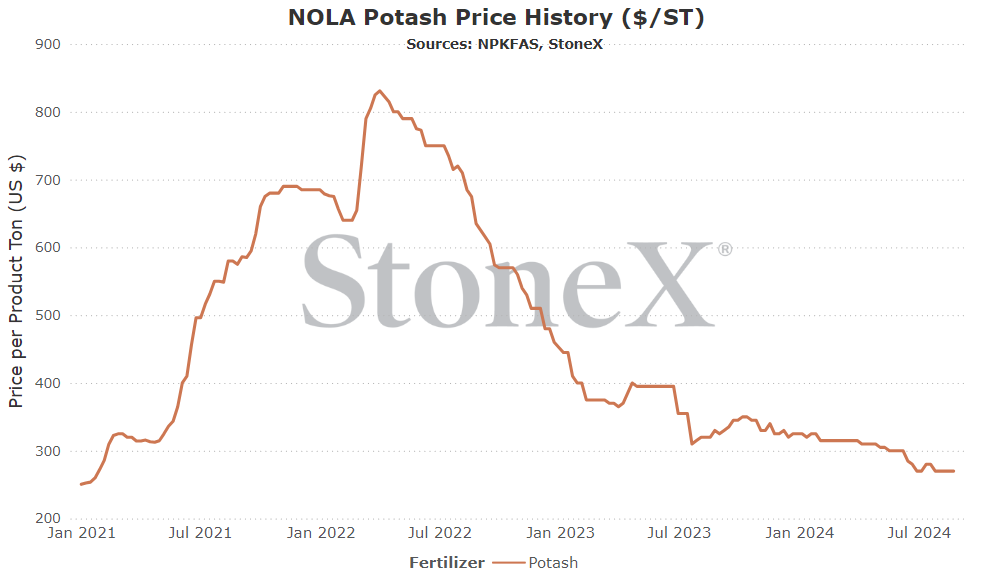
Vs 30 days ago - unchanged vs last month
Vs 90 days ago --10% or approximately $30 lower
Vs 6 months ago --14% or approximately $45 lower
Vs 1 year ago - -18% or approximately $60 lower
U.S. Midwest Average (average of several points across the Midwest)
Vs 30 days ago - unchanged vs last month
Vs 90 days ago - -5% or approximately $20 lower
Vs 6 months ago - -9% or approximately $36 lower
Vs 1 year ago - -12% or approximately $48 lower
- Canadian rail strike could result in a longer term work stoppage – today, it looks very unlikely that a long term work stoppage for the CP and CN railroads would occur. Rail is simply too important to the Canadian economy...but the chances are not zero. If workers do not get what they want, they could refuse to work, shut down shipments and sit until the others break. If, and it is a big if, that happened, potash shipments would stop...and Canada is the largest producers/exporter in the world.
- Buyers waiting until last minute could see higher logistical costs - today, farmers are struggling with high inputs and low outputs. Their economics stink...so why do anything today? We could see this mindset be prevalent in the market and cause buyers to wait until the last minute. If that happens across the market, just in time demand could meet just in time logistics...and those are not cheap.
- Solid potash values could see demand better than expected – there is a lot of talk of fall programs being skipped because of high prices/economics/etc. However, potash values are very good vs grain prices today. The market could be surprised by the amount of demand that steps forward this fall. That happens and we move into the winter empty, then we only have a few months to get refilled before spring. Tight window.
- High phosphate values could hurt potash demand – I have yet to find a farmer who has said they are willing to pay for separate phosphate and potash applications. No one wants to pay the higher app price. No one wants the compaction. The list goes on. That said, phosphate prices are terrible and if it causes enough farmers to wait until spring, potash demand could suffer as an indirect result. A poor fall would mean higher inventories headed into winter and that could cause prices to suffer.
- Supplies remain plentiful near and long term - the outlook of potash supplies is very good. Even though a lot of the expansion plans from late '21/early '22 have been abandoned, there are still some that are coming. We are already well supplied and any additional supply only helps to overburden the market and help lean on prices.
- China hasn't done an annual contract with Canada, bit of writing on the wall? - normally, China and Canpotex (Canada) ink an annual supply contract for potash. However, we still haven't seen anything this summer. China did agreements with Russia and Israel. We know their imports have been huge the last year or two. Is this a sign that Chinese demand is going to be significantly lower which could cause Canada to need to puke more product to keep the S&D stable?
Where are the current potash/grain ratio values today
We believe that only looking at the flat price of either grains or fertilizer can be misleading:
-
Only selling grain can hurt you if fertilizer prices rise substantially
-
Only buying fertilizer can hurt you if grain prices fall
We look at the ratio "value" to get a better indication of where we are or how many bushels of X does it take to pay for 1 ton of fertilizer.
Would you rather:
-
Spend 120 bushels to pay for 1 ton of potash
-
Spend 60 bushels to pay for 1 ton of potash
When we compare the current ratio value against recent years, we start to see if we are high or low.
YOUR VALUES MAY LOOK DIFFERENT
This graph looks at the NOLA potash price vs the flat grain price. There are no logistics on either product. Your location will look different due to fertilizer logistical costs, grain basis, etc.
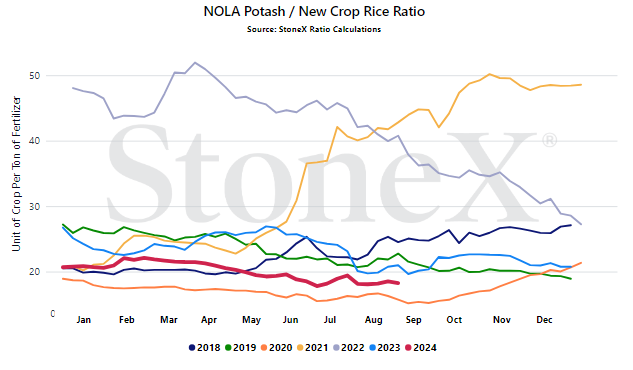
- Make smart/unemotional decisions - your grain price stinks. Your inputs costs are still high. You are not expecting to make much/any money this year and next year isn't much better. Blood pressure up yet? Has it ever come down? Listen, it is easy to be frustrating/pissed off/angry/etc. today and there is nothing wrong. I do not even farm and it gets under my skin. All I am saying is that when it comes time to make marketing decisions on either buying inputs or selling grains, set the emotion aside as best you can. I've made a lot of emotionally charged decisions in my life and my wife will be first in line to tell you none have worked out well. This is your livelihood. Your farm/family/etc. are counting on you to see it thru tough times. Treat it as such.
- Remember that even though things are calm now, they can get out of hand still - how the hell can it get worse?! I'm guessing that is the thought going thru your mind right now!!! There are still plenty of avenues to worse conditions for urea. Iran attacks Israel. Russia escalates against Ukraine. China invades Taiwan. Any/all of these possibilities have the ability to really mess up the market. It can get worse.
- Watch the Canadian rail strike - I do not care where on earth you are reading this from. Watch the Canadian rail strike. In the very low probability situation where a long term work stoppage occurs, Canada is the largest exporter by a large margin. The removal of their exports for a prolonged period of time will hurt global supplies short term.
- Keep in mind logistics - from just a straight global S&D, things are very well supplied against current demand. That should mean that values remain stable to lower. However, waiting until the last minute may mean that you have to pay just in time logistics.
StoneX Ratio Calculation
The ratio calculation is derived from Bloomberg historical grains values as well as fertilizer values from StoneX, NPKFAS, and Argus.
The calculation is simply dividing the fertilizer price by each grain price.
All data was sourced from StoneX unless otherwise noted.