September '25 NH3/Anhydrous Ammonia
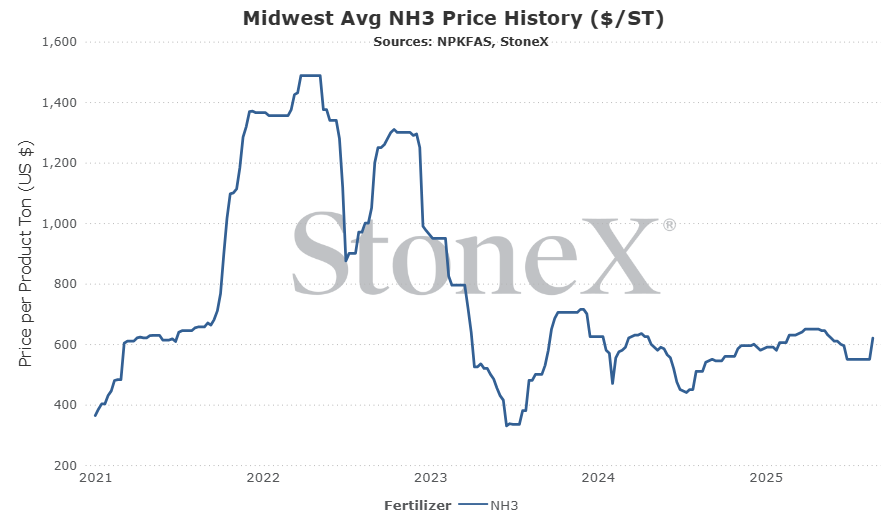
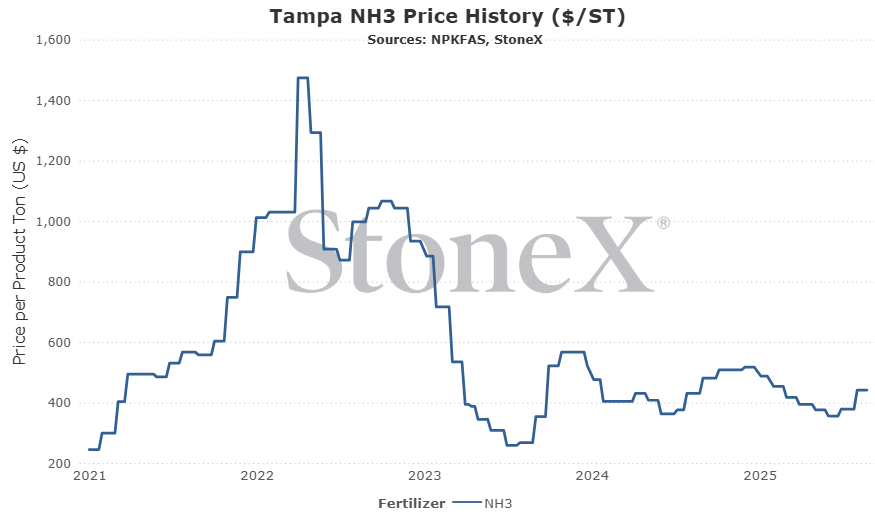
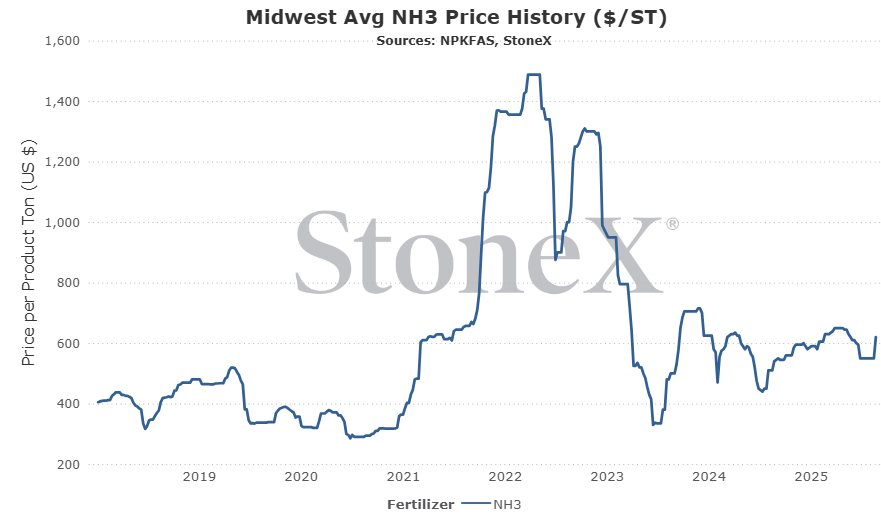
U.S. MIDWEST/TAMPA PRICE GRAPH
The first graph is the AVERAGE of the entire Midwest U.S. region. That means your local value WILL be different than what the graph reflects. Please do not take this into your retailer and say "why isn't my price the same as here". That is comparing apples to oranges. You might be on the cheaper or more expensive side of this graph. This doesn't take into account logistics/storage/interest/insurance/shrink/etc.
This graph looks at the price from a short ton and USD currency POV.
This second graph looks at the price set for Tampa NH3. This value does not have a high correlation to Midwest values. It is a talking point used when prices are rallying...yet somehow gets skipped on the way down. This price is more an indication of the global price. This price is set by two parties (purchaser - phosphate producer in Florida / seller - international producer providing NH3 to FL phosphate production).
This graph CAN be used as an indication of global market price direction/trends. This graph SHOULD NOT be used to determine a Midwest value. Tonnage is listed in short ton and currency in USD.
What everyone wants to know first, what do we think will happen going forward
Global
So I had said a few months ago that I was not going to do the global NH3 market outlooks as it was mostly industrial demand and direct application areas like N.A. do not see their price follow global as directly as you would think.
However, things change.
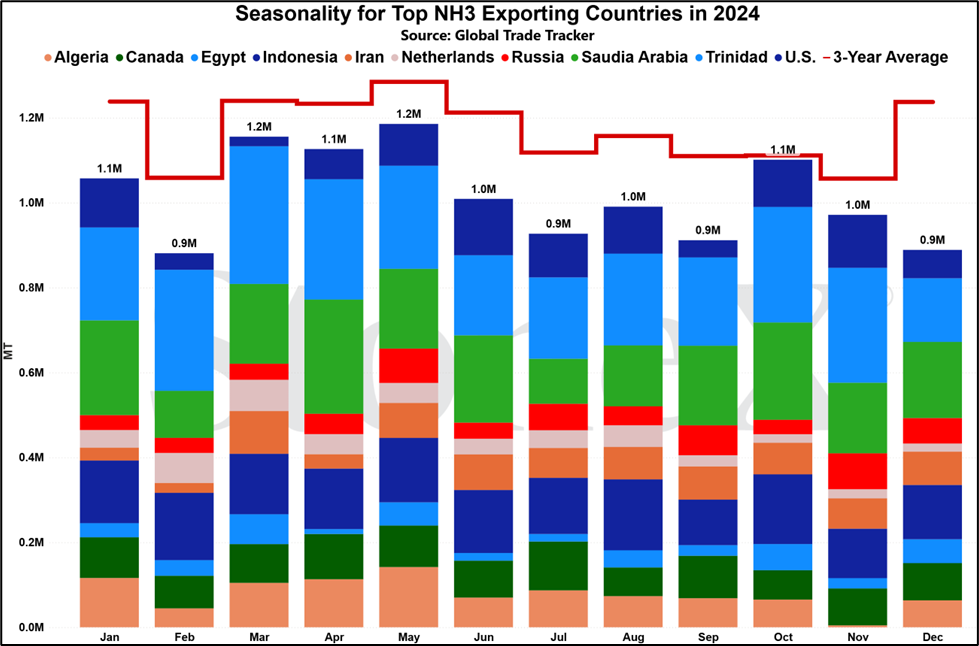
To start, the global NH3 supply situation is still snug. Russia, typically the world's largest exporter of NH3, remains mostly absent as they lost their export pipeline in Ukraine and have struggled and/or been unwilling to use new export facilities within Russia. We also have to keep tabs on Trinidad whose production has been on/off due to shaky natural gas supplies. Right now, it appears production is rolling well but we will see how long that lasts.
The reason I have restarted this piece is the Russia/Ukraine peace talks. Now, I am a realist and I do not believe that we will see peace between these countries in the short-term. I continue to hope that will be the case, but Putin is too far into this fight to back away now. However, the fact that there have been talks means we have to consider the possibility. If peace were to be found, Russia likely could start fully utilizing their export facilities in Ust-Luga and Taman. Maybe they struggle to get back to their 4.4M tons per year, but they could get much closer than they are today.
I continue to see global NH3 values supported for the near-term on tight supplied and continued solid demand. However, if real progress is made on peace talks between Russia/Ukraine that ends with Russian exports picking up, that could have buyers running for the hills and sellers desperate to offload positions. A perfect recipe for lower prices.
North America
60-days is all that separates us from the bulk start of North American direct application season.
Manufacturers and suppliers appear VERY comfortably sold so not much of a chance of them turning into desperate sellers.
NH3 values across the Midwest remain attractive when compared against nitrogen alternatives and are not terrible vs grain values. Even more attractive with farmers looking to lower input costs any way possible.
Overall nitrogen demand should remain high as our far too early 2026 crop outlook includes 93M acres of corn.
Now, the next few months will still depend on Mother Nature giving us solid application windows. It would not be the first time we have had a solid lead up to fall just to be undercut by dry/wet/hot/cold conditions.
Assuming weather gives us a window this fall, demand should be solid which will help keep prices supported. I continue to believe this fall could be on the larger side of history. If that is true, then we will head into the winter with an empty system and the market pointing to the short 3 months between fall and spring. Not much time to refill everything.
Unfortunately, my outlook on NH3 remains firm.
General Global NH3 Information
What has happened in the last 30 days?
Russia/Ukraine peace could substantially change the global NH3 market
President Trump has been at the front pushing Russia and Ukraine to discuss peace. While it continues to feel that the road that ends with peace is still very far off, it is raising hopes that it will come sooner than later. For global NH3, this has created a bit of a crossroad of sorts. Success could mean global NH3 market returning to normal as Russian exports climb back toward their normal flows which would put Russia back to the world's largest exporter. However, on the opposite side, failure could mean even more hindrance of Russian export trade routes for its already meager export offering.
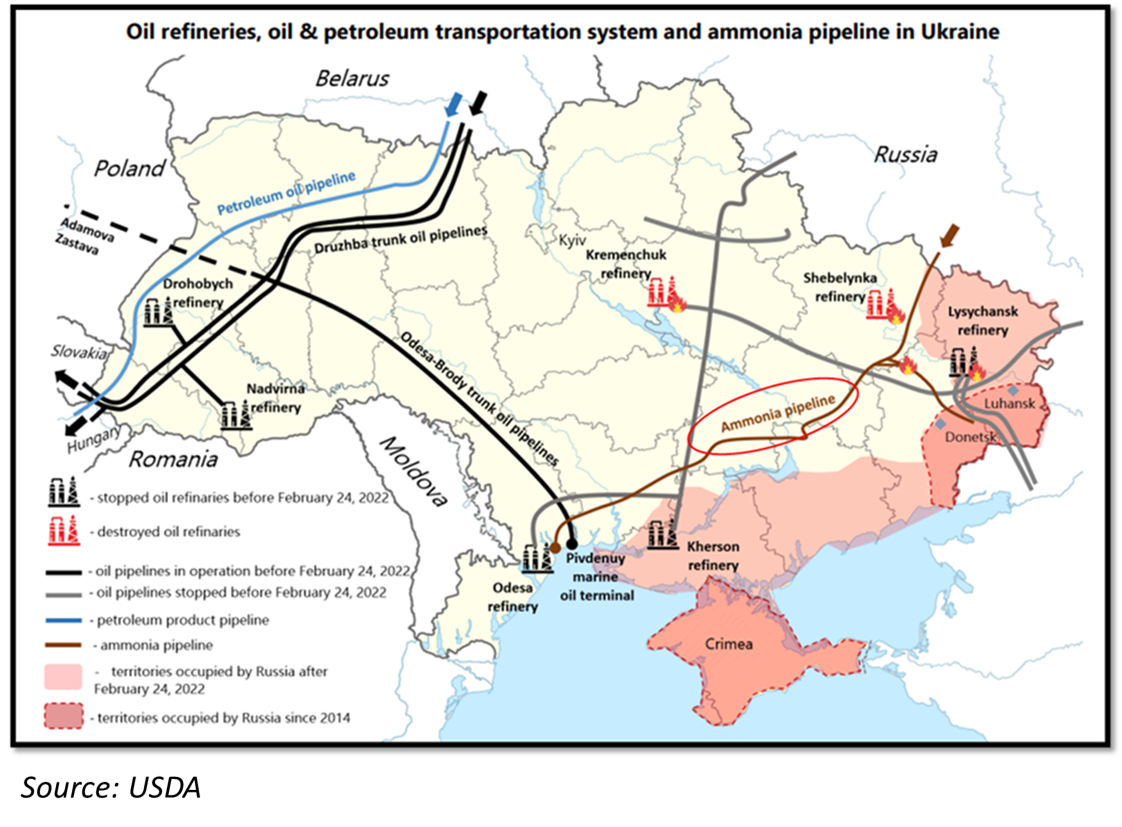
For a bit of back story, in 2021 Russia was the world's largest NH3 exporter. Trinidad sat at a distant 2nd place with over 1M tons less exported. In 2022, they fell to 7th place and by 2023, they were nowhere to be found. Russia's issue was with Ukraine. Now, obviously it was tied to their invasion of Ukraine but NH3 was unique. Russia had long relied on Ukraine to export its NH3. Russia would produce the tons within Russian territory, then place it into a pipeline that ran through the east/south of Ukraine which ended near Odessa, then would load vessels that would sail around the world.
Turns out when you invade a country, they are not so keen to continue doing things like this.
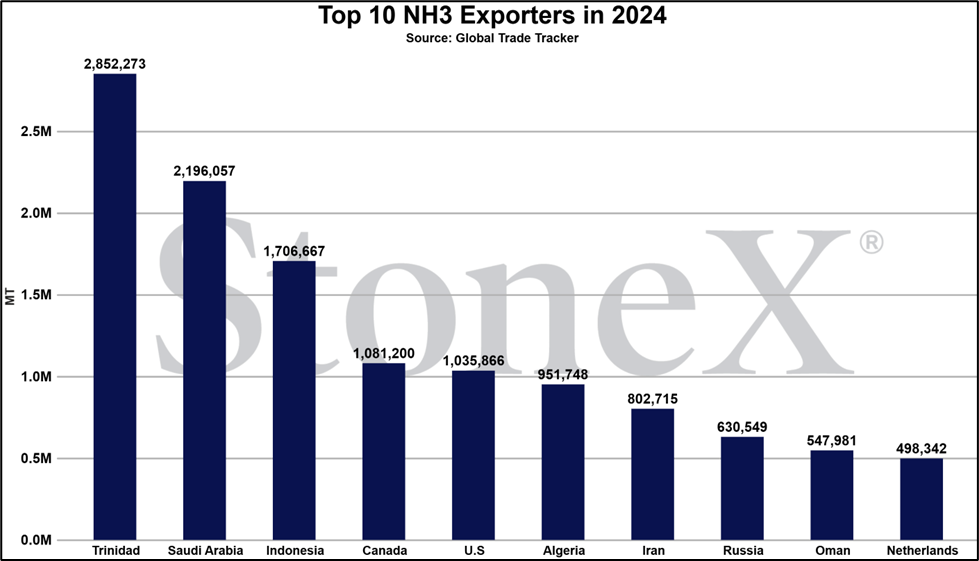
Today, Russia has improved their export flows and sits at 8th place internationally for 2024. New logistical/export routes continue to be worked on/expanded but these projects take time. Their main export facility currently sits in Ust-Luga (outside of St. Petersburg). While operational, it appears that vessels carrying product from this port have had an issue with small explosions. They have also built a new export facility in Taman that is expected to be a heavy flow facility. The issue with this terminal is where it sits just east of Crimea. Ukraine has gotten very good at attacking targets within Russia. If you have ever applied NH3 and had a leak, you know how little it takes to be dangerous. Now imagine a major storage tank holding tens of thousands of tons...and Ukraine sends a drone that explodes and ruptures the tank. The public and environmental catastrophe would be huge. It appears/sounds that the Russia government is not giving approval for the facility to come online until closer to peace.
For now, the world continues to operate without its largest supplier which leaves a massive hole in global supplies. This lack of supplies has allowed global values to continue trading at much higher values than what we would consider normal. It is not the only reason (Europe at 75%, Trinidad and other nations spotty recent production record, etc.), but as the typical world's largest supplier, their absence is playing a big part.
On the other side of the equation, what could peace mean? While anything can happen long term, I assume that the traditional pipeline that runs through Ukraine will never again be operational. Not only has it sat idle for some time, certain parts have been heavily damaged due to the war. Whether that damage was intentional or not does not matter. The damage was done. We also have to assume/believe that Russia will want to rely on supply routes that they control rather than routes that can be cut off in other nations. If there is peace, we could see a surge in export flow from Ust-Luga (assuming the "vessel explosion" situation resolves itself) as well as the Taman facility finally being allowed to operate. We do not know if these facilities would be enough to return Russia to their normal 4.4M tons per year, but at the very least it would get them a solid way there and the world a solid step toward normal supplies.
Further down the road could be the return of Russian natural gas to Europe whose production has been sitting at approximately 75% and has caused the region to become a major buyer. If Russia were successful in forcing Europe to take their gas flows as part of a peace agreement, European gas values could tumble and allow offline plants to resume production. No doubt it would take a while and the plants that have been offline are not guaranteed to restart, but the hope would at least be there.
Unfortunately for now, all we can do is sit back and watch/wait. We do not know how peace negotiations will proceed. All we can do is be prepared in case there is a change.
What does this mean for farmers?
Returning Russia to the fold for normal NH3 exports could change the trajectory of the global nitrogen market. The most immediate change could be in global NH3 values as Russian exports pick up. This "should" have a fairly major bearish effect on values. Then, we would hopefully see European nitrogen production return to 100% which would remove that region as a global buyer. This could eventually see China returning to normal export flows.
Essentially, Russia/Ukraine peace continues to be the major story that I am linking to the greatest chance of the global nitrogen market resetting anywhere close to normal. It still would not solve the issue that global production capacity has failed to keep up with demand growth (still excess capacity, but not much), but it could/should provide relief...eventually...hopefully.
Trinidad looking for new NH3 buyers as U.S. implements 15% tariff rates
It turns out that when the global NH3 market is largely missing its largest exporter (Russia), continues to see an entire regions production reduced by 25% (Europe), and multiple other large exporting nations continue to have on again/off again production (Iran and Egypt), you can tell countries like the U.S. to take their tariff rate and shove it.
In the middle of everything happening around the world, the U.S. tariff war against most of the world continues to play out. Trinidad continues to be on that list...and from the sounds of it, they are not taking it well.
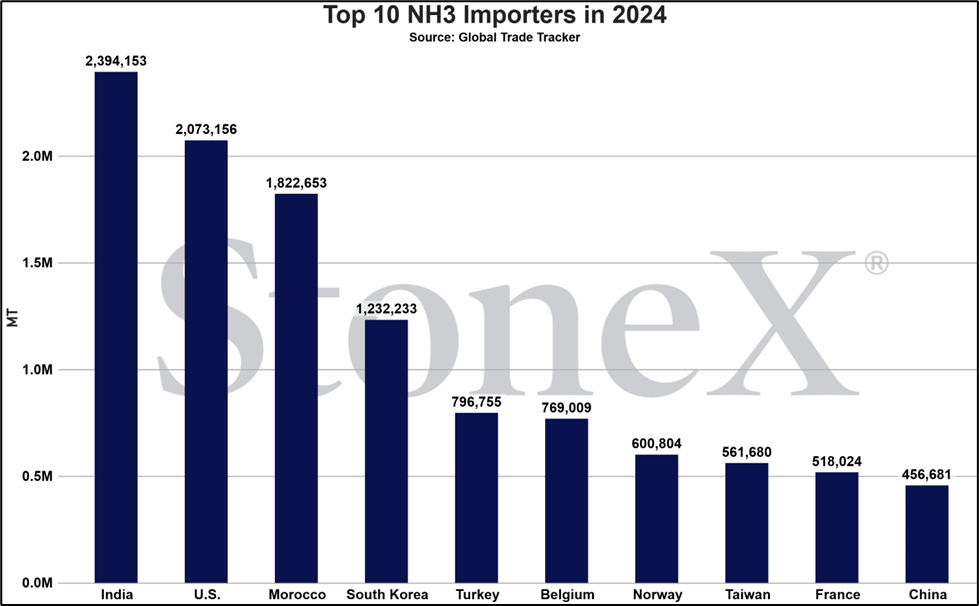
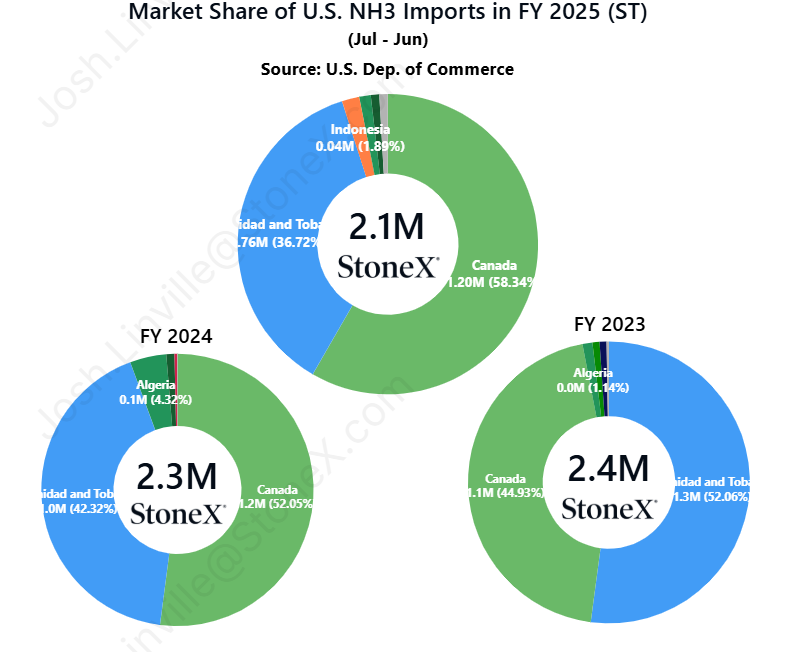
Looking at past years, Trinidad has been a major supplier of NH3 into the U.S. marketplace, sitting only behind Canada in terms of volume. However, much like the rest of the world, Trinidad understands how tightly supplied the global NH3 marketplace is today. With so many production hiccups and export restrictions, they know that they can flex their muscle a bit against the U.S. farmer.
From a politician POV, tariffs do exactly what they think they do. Money flows into the U.S. from the tariffed country on affected products. In fact, there are a lot of products/industries where the tariffed country needs the U.S. more than the U.S. need the tariffed country. In these instances, if that tariffed country has few/no other alternatives for destinations, they have little choice but to pay the rate and move on.
However, global NH3 today is not a market that is flush with supplies. The opposite, in fact.
In the case of NH3, Trinidad has strength. They can look at the U.S. as a destination, then look at the world, and then realize that they can make more money shipping their product elsewhere. Ultimately, that is what it all comes down to. Which destination is the best in terms of making money. With the U.S. imposing a 15% penalty, Trinidad can now examine other global destinations to see if there are better alternatives. With global supplies in such bad shape, that should not be a problem and that is exactly what they have been pushing. Rather than sit back and "take" the tariff, they have essentially announced that they are looking for new destinations.
In this case, the country that has put the tariffs in place is actually the one paying the rate. If the U.S. needs Trinidad's NH3 worse than Trinidad needs U.S. demand, then the U.S. may have to start rallying its price to essentially pay the 15% so that Trinidad's netback is the same/higher than global options. Now, I'm not sure about you, but I've yet to see someone willing to just eat a higher cost/lower margins. Those are typically pushed down the line to the end user. Who is the end user for NH3? Farmers. So in this situation, politicians are right. Trinidad will pay a 15% tariff rate, but what they do not understand is that the rate will be paid using U.S. farmer cash that had to pay the premium price...
So far, we have not seen Midwest NH3 values change significantly since this battle began to brew, but fall is drawing near. As we get closer to application season and demand starts to materialize, no doubt this will play a part.
What does this mean for farmers?
For U.S. farmers, it could be one of two things...or both things.
One, if U.S. NH3 values do not climb to offset the 15% tariff rate against Trinidad, import flows could slow/stop from there and leave the market wanting for tons this fall.
Two, if the U.S. rallies its price to keep import flows unchanged, that will likely represent a higher price that will most likely get passed down the line as things tend to do.
The worst outcome would be that the U.S. price does not rally to reflect the tariff rate, imports slow, and then suddenly we start fall season finding out that inventories are snug and in season values more than factor in the tariff rate in the form of a tight S&D.
Isn't fertilizer fun?
N.A. NH3 looking very good vs nitrogen alternatives. Big fall coming?
There is nothing cheap about NH3 values today. Heck, there is nothing cheap out there for the farmer except for grain prices...but that does not mean that NH3 cannot be cheap by comparison. That is our current POV which could have this fall season being a big one.
- The first comparison is the price of NH3 vs grain values. Specifically corn.
- The second comparison is the price of NH3 vs urea values.
- The third comparison is the price of NH3 vs UAN values.
- Finally, there is the flat price approach with farmers looking for the cheapest route forward during very hard times.
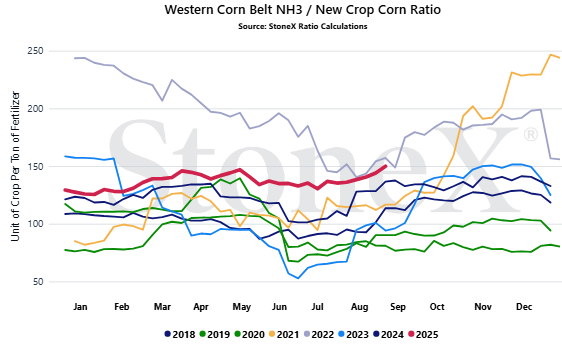
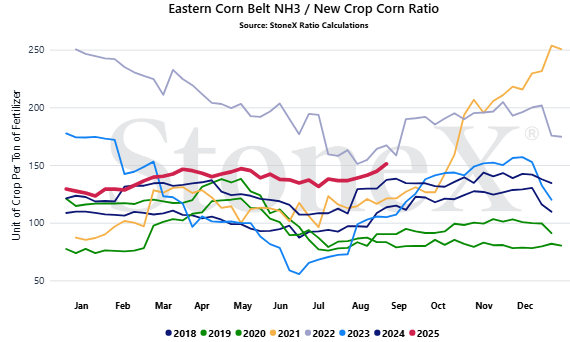
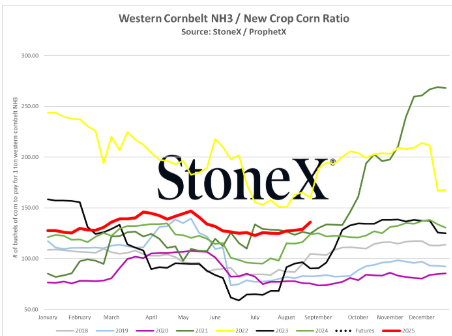
So the first is the price against corn values. NH3, along with potash, are the only major fertilizers that are even remotely close to what we would consider "normal" when compared against the past. Sure, the graph below shows the current/red line being on the high side of the bulk of recent years, but it is at least near the recent years. It is nowhere near the extremely high ratio values of 2021 and 2022.
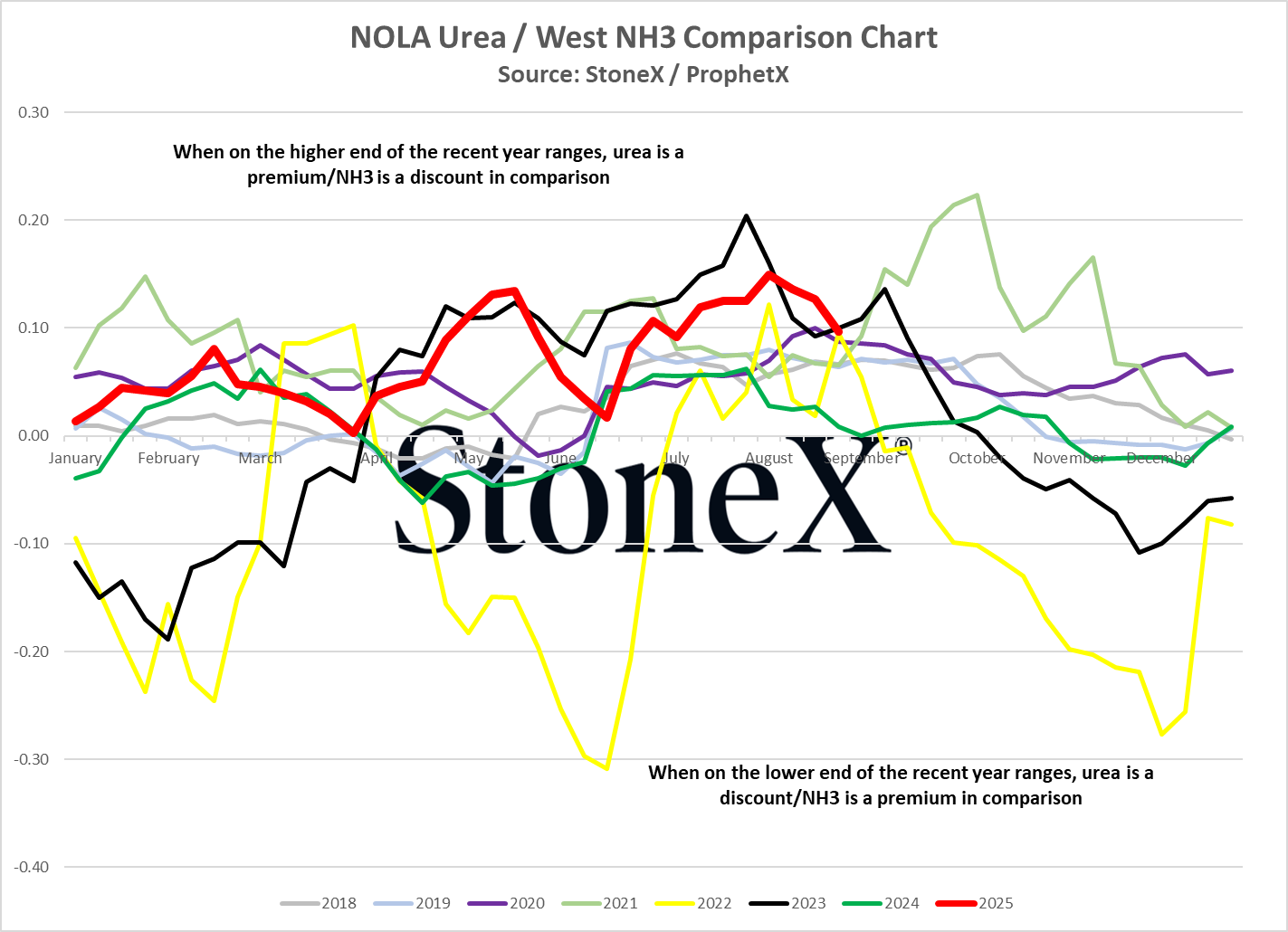
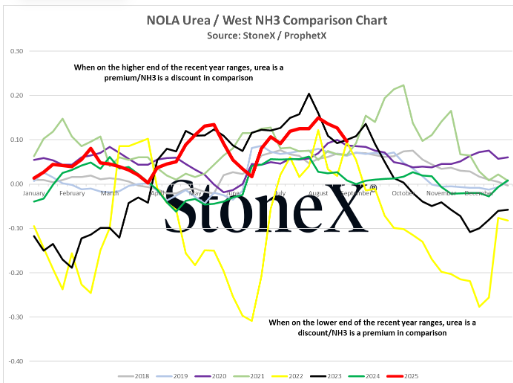
Second is the current price of NH3 vs the price of urea. Now, this one is a little bit of a stretch as I look at Midwest NH3 value vs NOLA urea value. That is two distinctly different points to compare, but history still shows what we should consider normal. Urea can see plenty of basis shifts and changes, but ultimately the comparison works. Looking at this comparison continues to put NH3 as well valued vs current urea values and likely to capture the attention of a lot of farmers.
Third is the current price of NH3 vs the price of UAN. Again, two different points but the same comparison can be made...and what a comparison it is. For this time of year, NH3 is the largest discount to UAN values that we have seen in recent years. That should have a lot of UAN demand considering a change. More, after the spring UAN supply debacle, an even larger shift could be see this fall.
Last is the flat price of NH3. I could fill a book looking at all the price differences across North America between NH3/Urea/UAN. However, I am lazy!!!
Most folks we talk to are saying that in their local market, NH3 is a solid price on a price per pound of N basis vs the alternatives. With farmer economics suffering as badly as they are this year, no doubt a lot of folks will be looking for the cheapest route forward. For nitrogen, NH3 fits the bill.
All of this still comes down to weather. If Mother Nature says no, all of these comparisons mean squat. However, all the current looks are lining up to this fall direct NH3 application season being a big one.
What does this mean for farmers?
If/when demand starts to step forward because NH3 is showing such a solid price, it should have an effect on the price. As the S&D gets more and more snug, the price will likely reflect it in higher values.
Where are current values in relation to the past
U.S. Midwest Wholesale price average
Vs 30 days ago - 13% or approximately $70 higher
Vs 90 days ago - 2% or approximately $10 higher
Vs 6 months ago - -2% or approximately $10 lower
Vs 1 year ago - 15% or approximately $80 higher
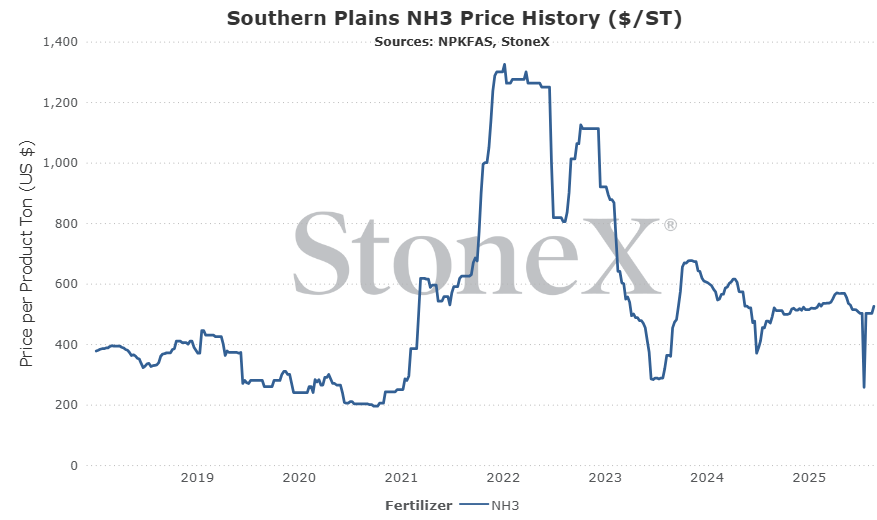
U.S. Southern Plains price average
Vs 30 days ago - 5% or approximately $23 higher
Vs 90 days ago - -1% or approximately $5 lower
Vs 6 months ago - -2% or approximately $10 lower
Vs 1 year ago - 7% or approximately $34 higher
Bull/Bear Factors
Because no market is ever guaranteed to go higher/lower, we try to consider the factors that can sway values so that we are able to act when they occur rather than react.
- Bullish Factors
- Russia/Ukraine peace talks fail - this is more an indirect situation than direct. Today, Russia still is not exporting much in the way of NH3 vs their normal rates. Their last "normal" year saw them export approximately 4.4M tons. 2024 saw them just over 600K tons. If peace talks fall apart, it is not as though we lose tons. They are already gone. The reason I list this here is because of the effects on urea and UAN. If those values start to move higher on failed peace talks, then NH3 will naturally follow that pattern.
- Further production issues from Trinidad (or anyone else on the top 10 export list) - it appears Trinidad nitrogen production is doing better...for now. Recent history has us very skeptical of their nitrogen plants being able to run at full production rates for long periods of time. Nothing to do with the plants themselves or the workers making them run, but from gas supplies. The global NH3 market is already tightly supplied with Russian tons missing. Any other unseen hiccups only make it worse.
- North American fall direct application demand steps forward earlier/larger than the market expects - if grain markets were any better than they are today, I would be SCREAMING about this. I think the fall direct NH3 application market could be huge this fall. NH3 is "cheap" vs the nitrogen alternatives. There is likely another big corn crop coming next year so big nitrogen demand. Harvest looks like it will be big and on-time/out of the way for November. Everything is set up for a big fall run that should run the market very low on product. The only thing that pulls me back from the ledge is knowing how poorly the farmer is doing today and what that could mean for "normal" approaches...
- Bearish Factors
- Russia/Ukraine peace talks are successful and return Russian exports - this could be HUGE. The global NH3 market has been operating for years without its largest supplier in Russia. Nearly 4M tons per year are essentially missing. If these peace talks are successful, we could see Russia return very quickly. Maybe not back to their normal rates, but a marked improvement from recent years. Not only that, peace may allow a path to be created that returns European nitrogen production. This is less confident and takes longer, but it creates another bearish watch point. Peace could be huge for buyers.
- Major global exporting countries see their production stabilize - we have been experiencing a lot of years where uncertainty of production/supply is the only certainty out there. Hearing production going down, export flows being blocked, etc. has become the norm. However, if we suddenly move into a longer period where everyone operates normally, we could see market values start to calm as wel.
- N.A. farmers opt away from N intensive corn acres to lower input costs - this is a distinct possibility. Farmers have likely had a few funds remaining from the decent years we just completed. Those funds made it easier to keep growing input extensive crops. However, a lot of those funds are no longer around. Farmers may be forced to go to their banks for the necessary money...and that is no guarantee. Looking at 2026 economics, bankers may be reluctant to fund as many corn acres as farmers want. We could see that 2026 corn estimate fall which would take overall nitrogen/NH3 demand with it.
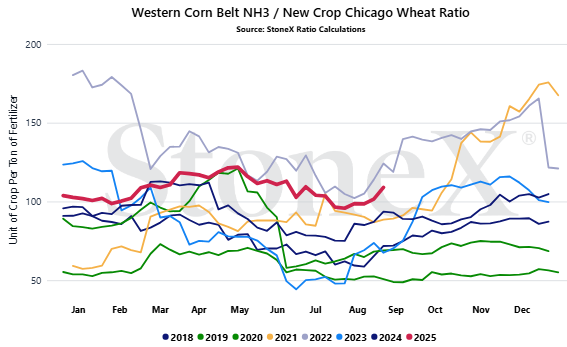
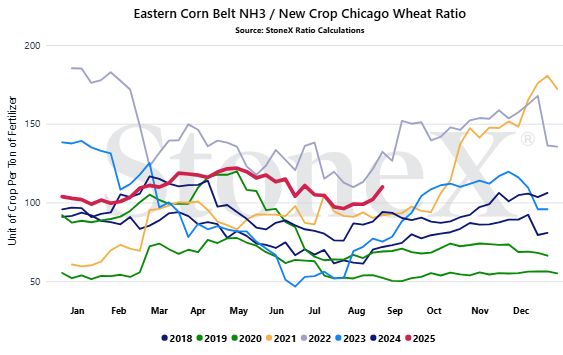
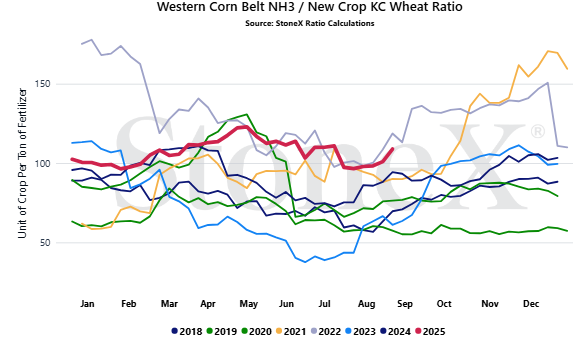
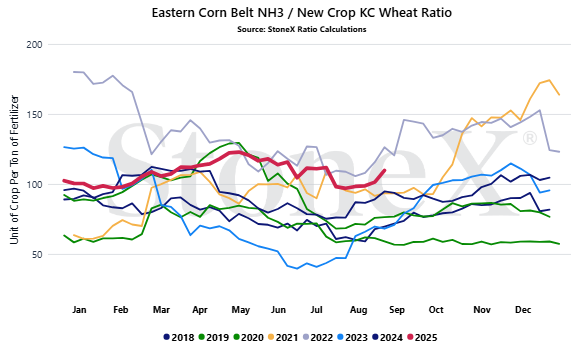
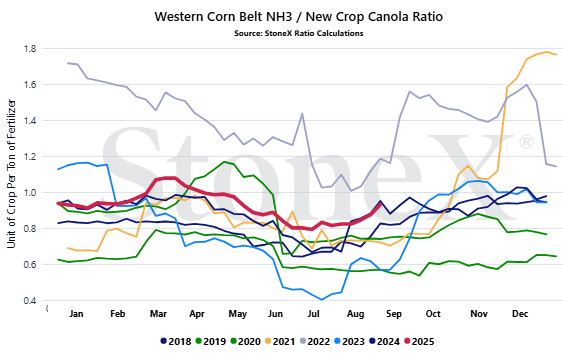
Where are the current NH3/grain ratio values today
We believe that only looking at the flat price of either grains or fertilizer can be misleading:
We look at the ratio "value" to get a better indication of where we are or how many bushels of X does it take to pay for 1 ton of fertilizer.
Would you rather:
When we compare the current ratio value against recent years, we start to see if we are high or low.
YOUR VALUES MAY LOOK DIFFERENT
This graph looks at the NOLA NH3 price vs the flat grain price. There are no logistics on either product. Your location will look different due to fertilizer logistical costs, grain basis, etc.
- Josh Linville’s Focal Points
- Russia/Ukraine peace talks - when Russia initially invaded Ukraine, the NH3 world lost its single largest supplier of tons. Russia had been exporting around 4.4M tons per year. The invasion made sure that the export flows were largely stopped. While Russia has had some success finding new avenues (exported a little over 600K last year), they are still well short of normal. If peace can be found, Russia can likely ramp up exports from the Ust-Luga and Taman facilities. We are still not sure if those terminals can reach 4.4M tons per year, but they can certainly boost flows from their current low volumes. This could be a more immediate impact on the global market. However, failure in talks likely means that Russian exports remain low and supplies remain tight.
- Trinidad production rates/export destinations to fight U.S. tariffs - Trinidad is expected to continue to struggle with nitrogen production rates as a result of natural gas supply availability. That in itself is troublesome for the global market as Trinidad is a major supplier. It is worse for the North American farmer. Nearly 1M tons annually flow from Trinidad to the U.S., up through river or pipe logistics, and out to the farmer. The U.S. has placed a 15% tariff Trinidad and that is not going over well. With Russian exports still not flowing which is creating a low supply situation globally, Trinidad may not struggle to find new buyers for their product outside the U.S.
- N.A. NH3 value in relation to urea/UAN - I fully realize that there is nothing cheap about NH3 values today. However, when I look at N.A. NH3 values in relation to urea, UAN, and to a certain extent many grain values, it isn't bad. You the farmer are struggling. Grain prices are low. Input prices are high. Profitability scenario talks are giving way to conversations around how to get close to break even. Farmers are going to look in some cases for the cheapest route forward. Today, NH3 provides that for a lot of areas. This fall application run could be huge if everything holds and that could change the way NH3 currently looks.
StoneX Ratio Calculation
The ratio calculation is derived from Bloomberg historical grains values as well as fertilizer values from StoneX, NPKFAS, and Argus.
The calculation is simply dividing the fertilizer price by each grain price.
All data was sourced from StoneX unless otherwise noted.