September '25 UAN
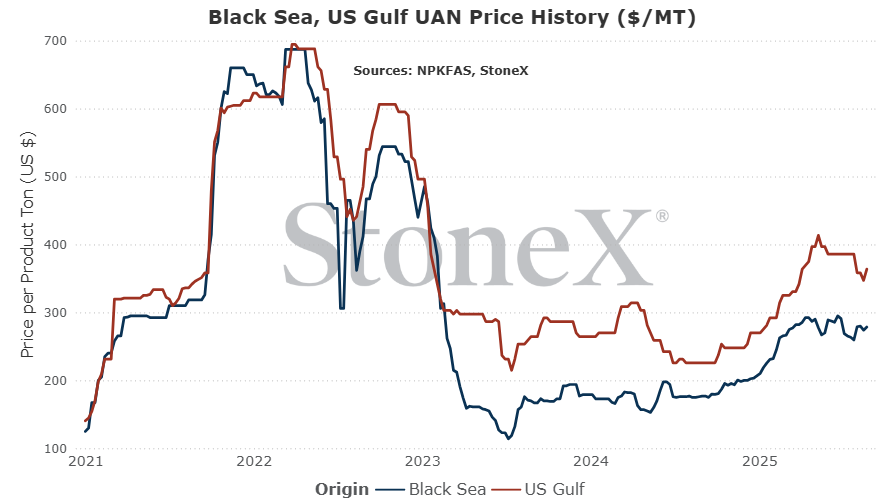
Major global UAN Export Location Price Graph
The intention of the below graphs are not to use to say "my price should be X based on this graph". These prices are derived from an FOB price point average. The intent is to show major global price movement trends. Your values will likely have significant basis difference (similar to your local grain price being different than the traded market price).
This graph is labeled as MT in USD currency.
What everyone wants to know first, what do we think will happen going forward?
GLOBAL
If Russia/Ukraine peace talks fall apart, the global UAN market is in deep trouble.
President Trump has been very vocal about his threats on Russia. It appears that he wants to find peace between these nations but is willing to do everything possible to economically hurt Russia if they are the cause of peace talks falling apart.
On the global UAN marketplace, there is already a lot of supply issues. Trinidad production has been improving, but its recent history of production rates does not fill me with longer term confidence. European production remains approximately 75% of normal which means there are a couple million tons of production missing there. If we see President Trump impose massive tariffs on Russia, that will mean the world losing even more supply and it frankly cannot afford that today. Without the U.S. as a destination, Russia may have to decide to stop their UAN production which would move global supplies from bad to worse.
Countries like Australia, Canada, and many across Europe have already blocked Russian direct flows of fertilizer. That has cause those buyers to look elsewhere for their needs which is why the U.S. is now a major exporting nation. Russia being allowed to send UAN to the U.S. helps to improve that S&D and as a result, help the global price. If the U.S. loses access to Russian tons, expect an even larger "fight" to keep tons in country meaning higher prices.
If we start to see real progress regarding peace between Russia/Ukraine, that could be the first step toward global prices falling as trade routes reestablish and Russian UAN production picks up. However, this is a much longer term story. Would be hard to see major price changes before next spring.
NORTH AMERICA
Unless something massive happens, North American UAN is going to be a bigger premium nitrogen than the last few years...and it could get worse.
U.S. importers have been able to access Russian produced UAN without restrictions while many around the world put blocks in place. While U.S. exports have increased, the import flow of Russian UAN helped to alleviate some of that strain.
But we also know that President Trump is losing patience.
Recently, Trump and Putin met in person to discuss peace. Any hope that progress had been made was dashed as Russia has continued its onslaught. It does not mean that peace is not possible, it just lowers the hopes/chances. The thing that scares me the most is the coming months. President Trump has been vocal about his future plans if peace is not found. He is planning to put big tariffs in place against anything Russian. If that happens, the U.S. could lose that supply of UAN which would be...hurtful.
However, if peace is found, we could see Russian flowing back to its normal areas like Europe/Canada/Australia. This would likely help Russia increase its production rate, which would boost global supplies. It very well may see U.S. imports slow, but it should also see U.S. exports slow which would be a win.
Today, I am still of the mind that the future market sees further price increases across the Midwest. Manufacturers were very successful with their first round of fill. No doubt they will try for higher prices on rounds 2, 3, and beyond. This is especially true with the horrible N.A. UAN market outlook for this fertilizer year.
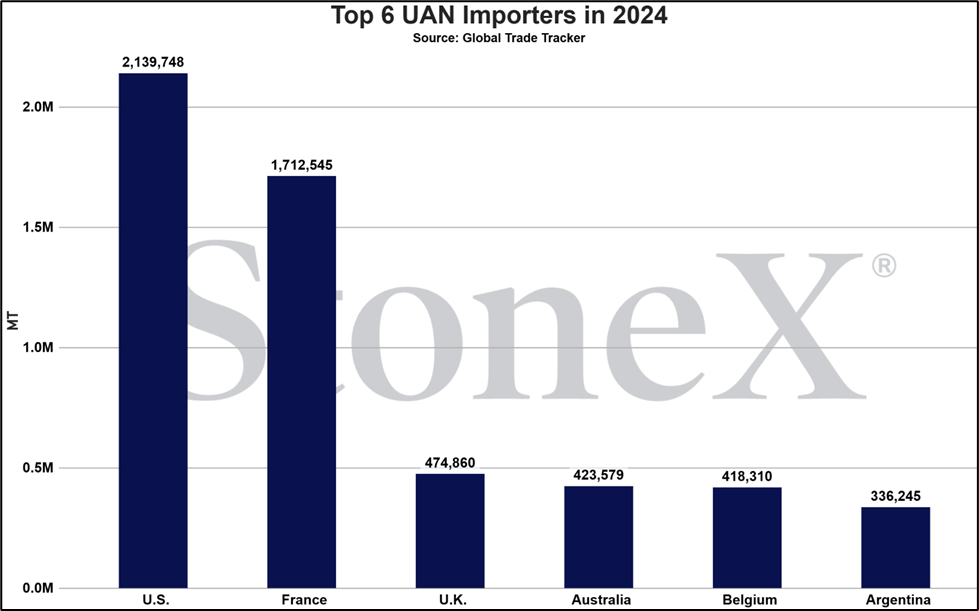
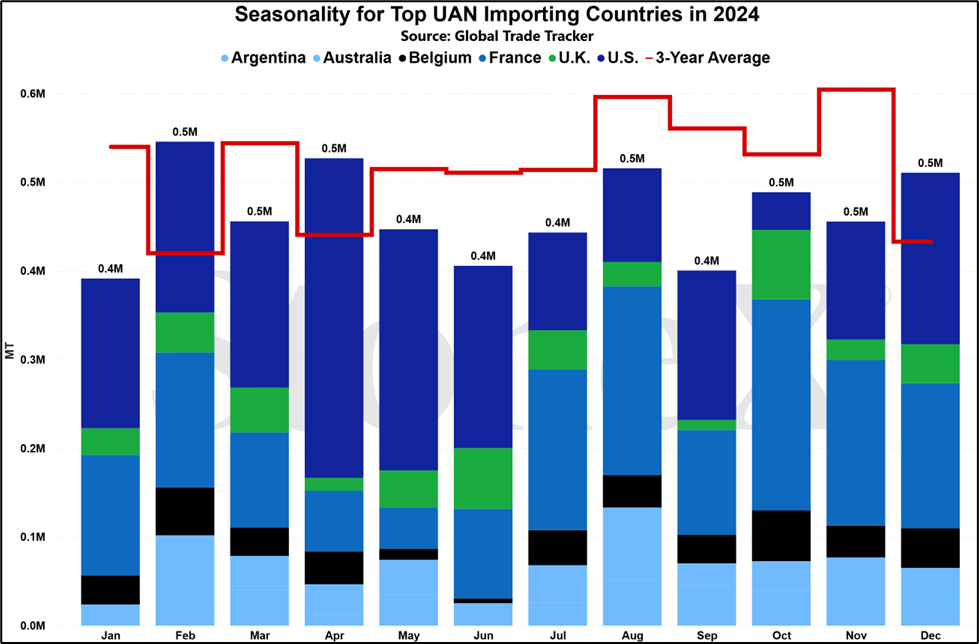
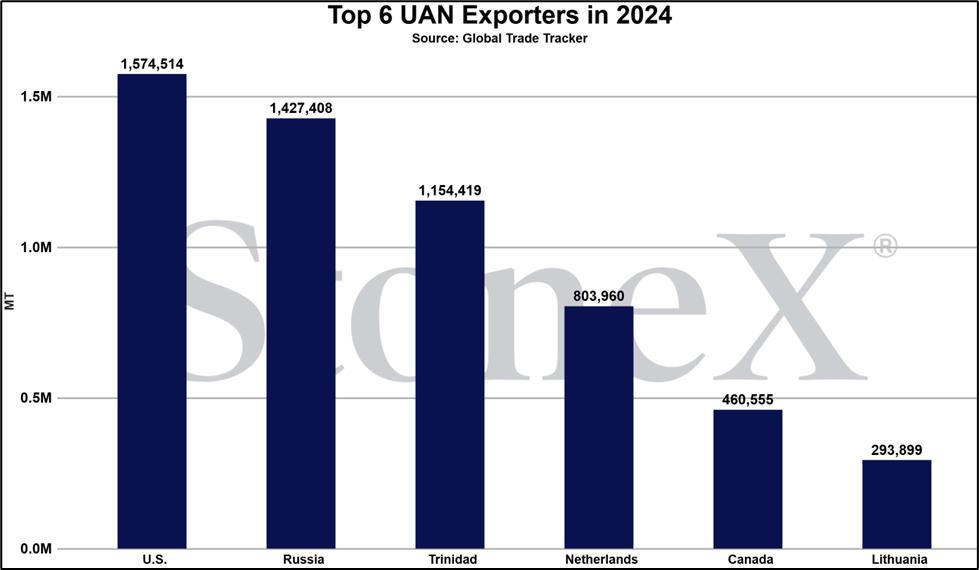
General global import/export UAN information
What has happened in the last 30 days
Russia/Ukraine peace would likely have massive impacts on global UAN markets
I've struggled with how to start this section for a couple days but I think this is the best approach: To start, I do not expect to see meaningful progress on peace between Russia and Ukraine. I would not be surprised if Putin doesn't give just enough progress to keep Trump from imposing massive economic penalties, but nothing to the extent that we wake up one day to an actual ceasefire/peace agreement.
However, we are closer today than since the start of the invasion. That means we need to consider what peace would mean for fertilizer if it happened. We also need to consider the opposite route. If Russia refuses peace, Trump may follow through with his threats.
What if there is no peace
In this case, the global UAN market can go from bad to worse. At the start of the invasion, both Canada and Australia blocked Russian goods. Both countries were receivers of Russian UAN. Normally, in markets with a lot of origins and destinations, this wouldn't be a huge deal. Global trade flows would change to show these blocks. Russian goods would flow to other countries and Australia/Canada would start receiving goods from other countries. It would mean less efficient trade flows and slightly higher prices, but nothing huge. However, UAN isn't that big globally. There are not a lot of parties on the production or consumption side. Russia losing both countries (and eventually Europe as well) meant that it lost access to a lot of demand. Production rates have been lowered as they do not have anywhere to go.
In all of this, the U.S. has remained as Russia's lone major UAN destination. Why does it matter if there is no peace? Trump has threatened massive tariff's on Russia. He went as far as to say that he would consider tariffing any country that did business with Russia as well.
So if there is no peace and Trump follows through with his threats, Russia has just run out of major destination options. This will likely mean that they need to further reduce their production of UAN which will be a major hit for the global S&D.
That would also mean worse things for U.S. AND Canadian farmers. With half of the U.S. UAN import flow coming from Russia, losing that flow would put even more power in the hands of the manufacturers. Tighter S&D's typically mean higher prices. Canadian readers might be wondering why they are included here if they cannot get product from Russia. The U.S. has been able to send more UAN north as the Russian imports have flowed. However, if those flows stop, the U.S. will hold onto its supplies even tighter. Ultimately, North America is an S&D. If it loses that flow from Russia, it hurts the entire region.
What if there is peace
This is where things could get fun. Now, let's be serious. We all know that bullish markets move much quicker than bearish markets. This would be no exception. It will take a lot of dominos to fall but it might finally put us on a path to normal.
If Russia decides to move toward peace, they will be in a position to make some demands. One of the first things I would do if I were in that position is demand that global relations with Russia go back to normal immediately. Basically, the world needs to act like nothing ever happened. What would that mean? It could mean that Australia, Canada, and Europe reopen its borders to Russia. In that case, Russia may immediately increase their UAN production as they can now target demand that has been out of reach for years. That would be great for the world as the global S&D improves. It would also be phenomenal for all those areas as they now can look at other supply options.
If Russia decides to move toward peace, they may demand that Europe resume taking natural gas from them once again. Remember, the Nordstream pipelines were attacked deep under water. Both lines of the Nordstream 1 were damaged and need repaired. One of the two Nordstream 2 pipelines was also damaged...but one was spared and as we understand it, could be operational very quickly. If Europe agrees to this term, one pipe could start flowing gas once again and repairs on the other 3 begins. In this scenario, we might be able to anticipate the 25% of Europe's nitrogen production that has been offline since the invasion began begin restarting. This would not only improve the global S&D with more supply coming online, it removes Europe as a buyer from places like Trinidad and the U.S.
Then, we would also need to start considering the removal of "war-time premiums" and those sorts of things.
Basically, peace could help settle the global UAN market back to something we would all consider normal once again.
What do we do?
Nothing except we watch. I am not going to write this and act like I am some expert global political expert. Everyone, I am in fertilizer. I know my limitations!!!! My biggest thing here is to help understand why the Russia/Ukraine thing is such a big deal and to know that we need to continue watching global events and consider its impact on our domestic markets. We are part of a global economy whether we like it or not.
What does this mean for farmers?
It could be huge either way. Peace could have prices around the world falling...eventually. Continued war could have prices rallying around the world...more quickly.
The global UAN market is in bad shape already and we are already far enough into fertilizer year 2026 that if everything normalized today, we would still need to factor in the losses already seen. We would still be in catch up.
Just keep watching the world.
1st round of N.A. summer fill successful, market waits for round 2
For North America, the first round of UAN summer fill has come and gone. Now, the market waits to see what comes of round 2.
From the sounds of it, manufacturers sold everything that they wanted to sell and could have sold a lot more. Given our POV on UAN today, that is absolutely no surprise. UAN is in bad shape (will discuss more on the next section) and has buyers backed into a corner. If the program was declined, there is a real fear that they may not find the tons to get refilled by spring. I realize that spring is a long ways off but in the world of fertilizer, it will be here before you know it.
Today, the market is waiting to see what happens with round 2. It isn't a question of if round 2 will be higher priced, the questions are how much higher and how many tons will be available to purchase. The answers to those questions lie with the few parties that produce UAN.
Outside of that, there really isn't much more to talk about. This is typically how UAN behaves because globally speaking, it is a small market. Just may be worth having a conversation with your supplier to see what they have available. Your answer may ultimately be no, but it is worth a bit of time to have the discussion.
N.A. UAN market outlook looks bad...could improve...not likely
I really hope that by next spring, everyone reading this will be able to reach out and say "Linville, you were dead wrong on your UAN outlook. I hope you stub your little toe every evening walking around your house.".
That said, I still see N.A. UAN (and because of that, Europe/Canada/Australia) markets in a much worse place than last year. Keep in mind that last year ended with this most recent spring where big territories struggled to find supplies. It was not a pricing conversation, it was merely that supplies did not exist.
Does that guarantee a repeat for spring '26? Absolutely not. This all just means that we are significantly closer to that story repeating itself.
So why is it so bad from my POV?
- Starting inventories for the fertilizer year are very low - after this last spring, tanks were empty nearly everywhere. The industry was scrambling well into June to find tons to meet the last parts of demand. If you start the new fertilizer year (July 1) low on inventories, that means there is a lot of space to fill. That is a major win/bullish point for manufacturers.
- Exports could be larger than last year - Europe/Canada/Australia continue to look to "non-traditional" places to find UAN. To make it worse, we continue to see production problems popping up in places like Trinidad. Basically, U.S. manufacturers have plenty of export options to consider.
- Imports could be smaller than last year - my hope is that we will wake up one morning soon to the news that peace has been found between Ukraine and Russia. However, if it continues, the U.S. may shut off any supply flows from Russia. That reduces U.S. supplies as well as reducing global supplies.
- Several nitrogen plant repairs will eat into available supplies - nitrogen plants use high temperatures and high pressures to create product. That wears down equipment. If repairs are not scheduled/made, then the plant may break causing a much longer downtime. There are several N.A. plants with scheduled repairs that will chew into available UAN supply.
- Nitrogen demand outlook remains high - this number will change. Let me repeat that. THIS NUMBER WILL CHANGE. However, our current POV is that 2026 will see approximately 93M acres of corn on top of all the other N craving crops out there. There will be a solid amount of nitrogen demand that will further help the bullish UAN case.
Now, a lot of these factors could change:
- Exports could fall if Russia/Ukraine peace is found
- Imports may continue if no economic penalties are introduced on Russia
- The nitrogen plant downtime is already factored in. Hopefully no unplanned downtime this winter like last couple years have seen.
- 93M acres of corn may be overstated as input prices are stupidly high. Farmers may choose to not spend massive input flows and opt for "cheaper" options like beans.
All this to say and repeat, this does not guarantee this last springs supply situation. Just trying to point out how worse off we are today vs where we typically are this time of year. I spent a lot of last winter trying to warn folks of what could happen in the spring. That story played out. I am not sending this warning lightly...
What does this mean for farmers?
Basically, it means that until improvements start to be seen domestically and globally, sellers are in control. UAN should be a bigger premium to other nitrogen products. UAN supplies "could" be tighter next spring.
Anything can and probably will change, but it is bad enough that it needs to be watched.
Where are current values in relation to the past
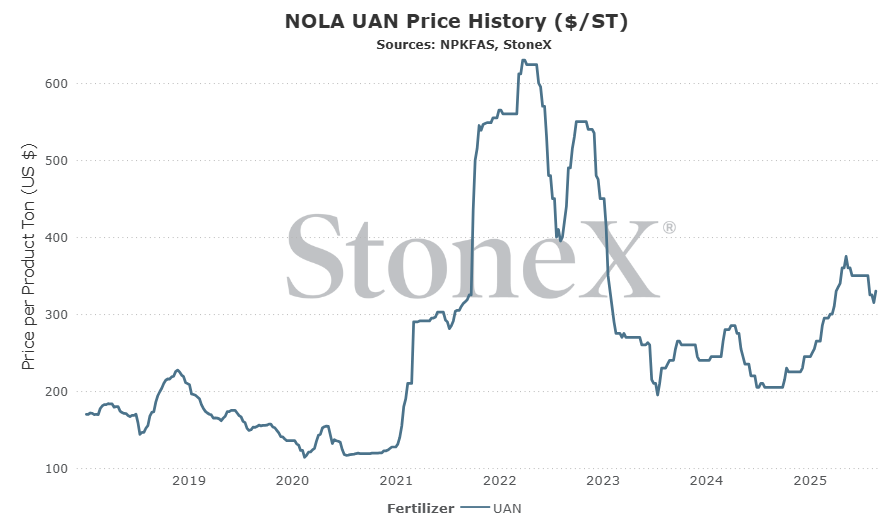
NOLA/New Orleans, Louisiana
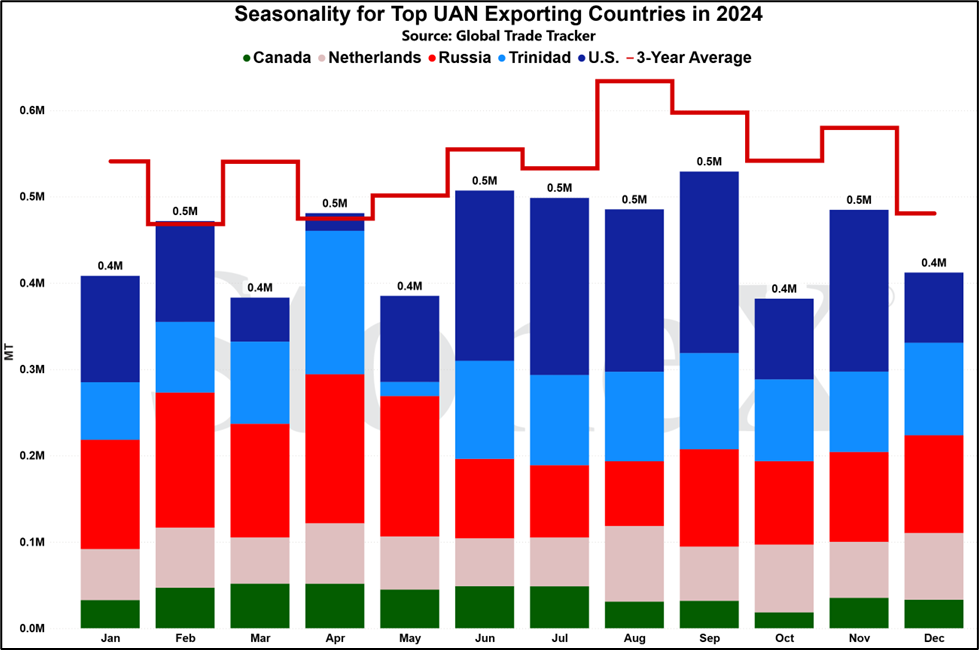
Number 1 global importer in 2024
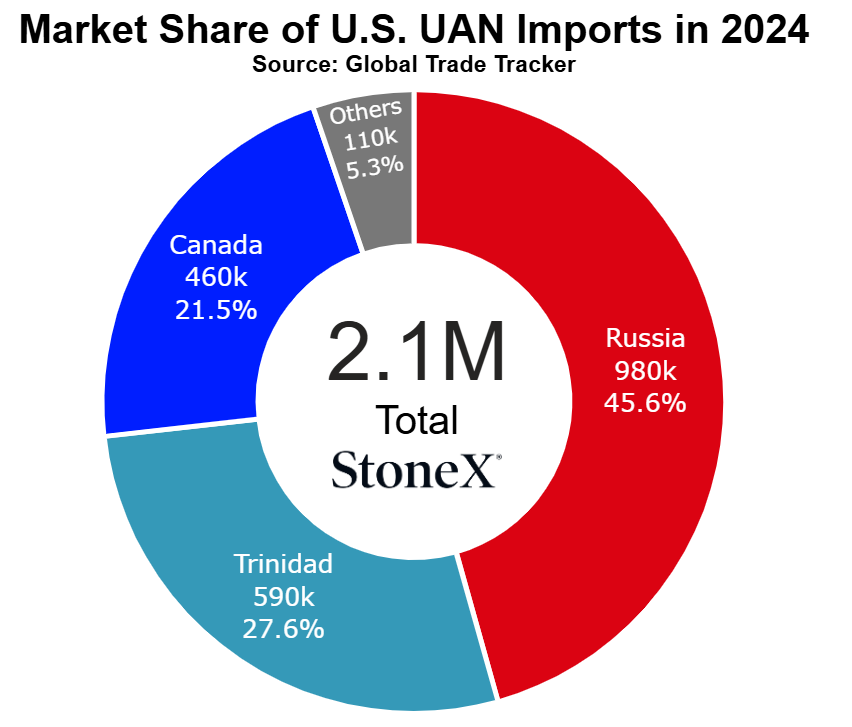
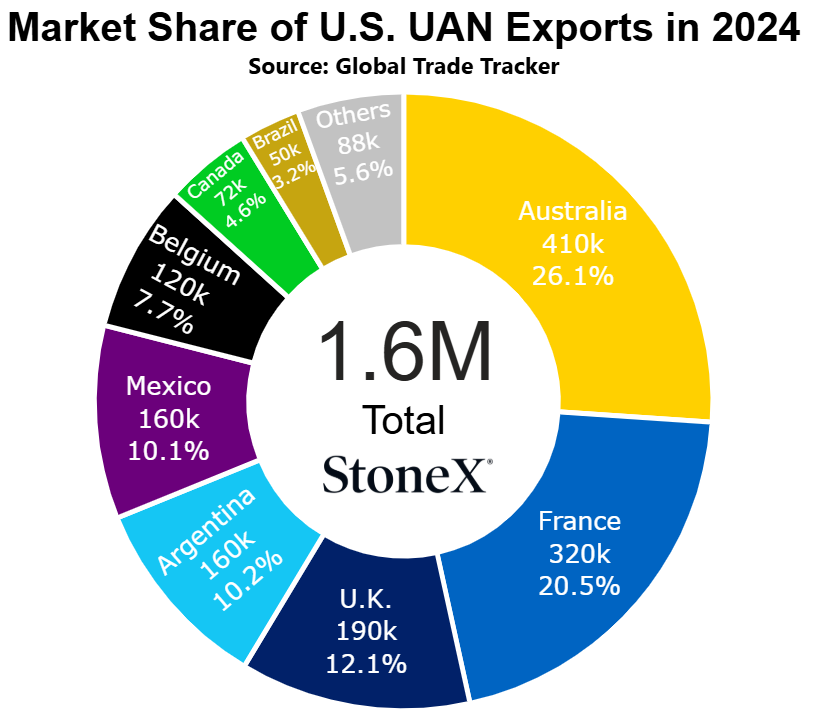
Number 2 global exporter in 2024
Price Comparisons
Vs 30 days ago - -6% or approximately $20 lower
Vs 90 days ago - -6% or approximately $20 lower
Vs 6 months ago - 12% or approximately $35 higher
Vs 1 year ago - 61% or approximately $125 higher
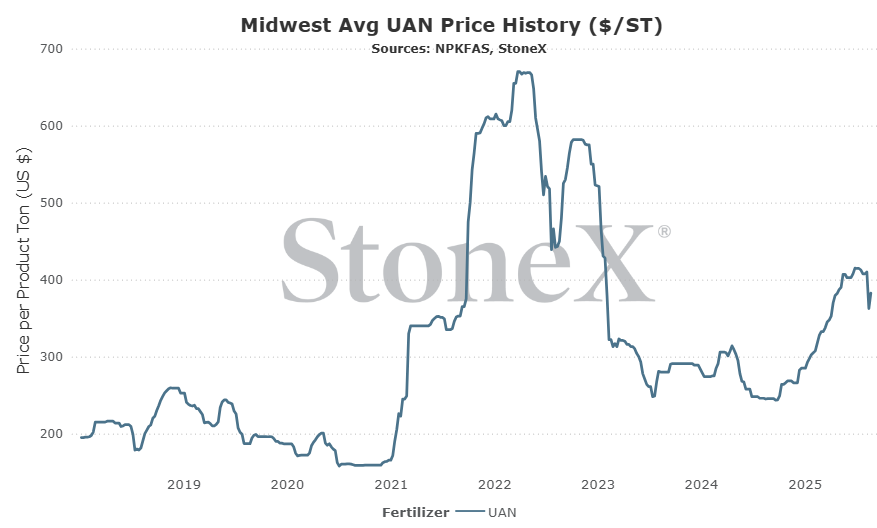
U.S. Midwest Average
Vs 30 days ago - -6% or approximately $25 lower
Vs 90 days ago - -5% or approximately $20 lower
Vs 6 months ago - 15% or approximately $50 higher
Vs 1 year ago - 56% or approximately $137 higher
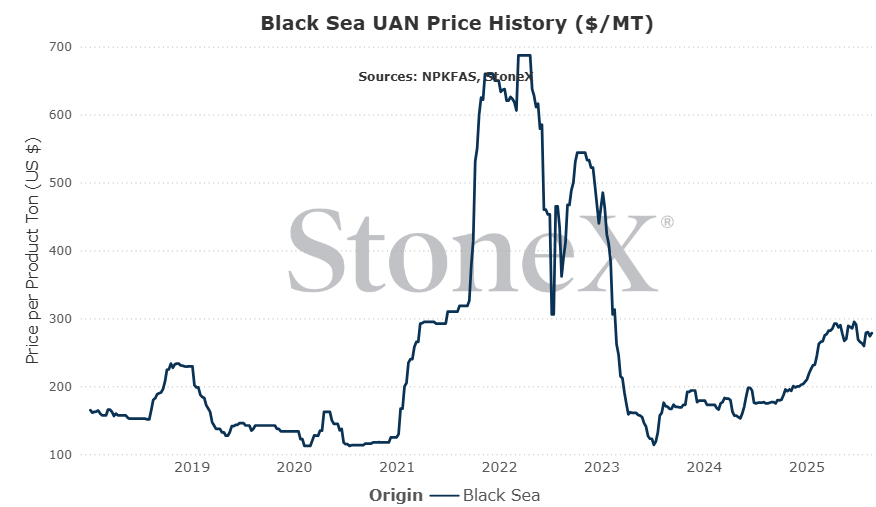
Black Sea (Russia)
Number 1 global exporter in 2024
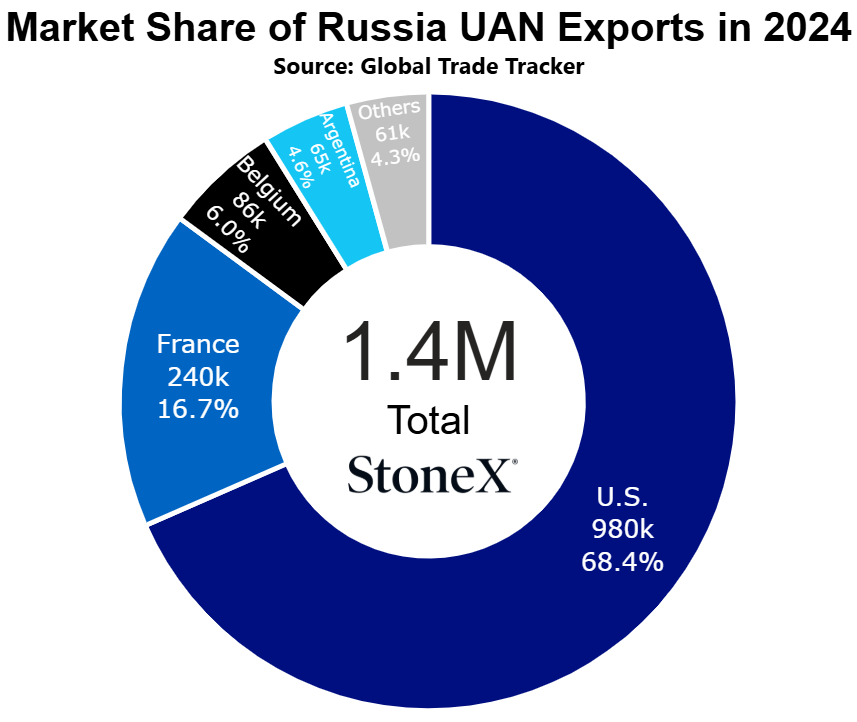
Price comparisons
Vs 30 days ago - 7% or approximately $19 higher
Vs 90 days ago - -4% or approximately $11 lower
Vs 6 months ago - 5% or approximately $12 higher
Vs 1 year ago - 58% or approximately $103 higher
- Bullish Factors
- Russia/Ukraine peace talks fall apart – while actual peace between Russia and Ukraine is still very far off, the prospects are improving. Trump and Putin met in person. Then Trump and Zelenskyy met in person. The hope is that peace becomes reality, but the chance it falls apart is more likely. If it does fall apart, we know that President Trump has threatened massive tariffs against Russia and anyone doing business with Russia. The U.S. has become one of Russia's last major UAN destinations. If that gets cut, Russian UAN has nowhere to go which would likely lead to lowered production rates and lowered global supplies which would hurt buyers around the world.
- North American nitrogen plant turnarounds take longer than expected – if you have ever toured a nitrogen production plant, you know the first thing you do is go thru safety briefings. Nitrogen production is a high temperature/pressure process that wears down equipment. Either the plant owners plan production downtime to repair equipment that can take weeks or they roll the dice and the plant possibly breaks which takes longer to repair. There are several plants expected to be down for repairs this year. If those repairs take longer, we could lose even more UAN supply than we already think.
- Urea starts to spark higher – UAN already feels like a product that is going to be the high priced N alternative for a variety of reasons. However, if we start to see further strength in urea, that could easily push UAN values higher in response. UAN, with its tighter supplies globally, "needs" to push some demand away to rebalance its S&D. If urea strengthens and UAN does nothing, it could see too much demand and throw things out of whack.
- Bearish Factors
- Russia/Ukraine peace takes hold – again, actually peace seems very far off, but this is the closest we have been since it started. If peace happens, there are several things that could happen to really help improve the UAN market. Russia could regain global relationships which could mean accessing areas like Europe/Australia/Canada directly once again. If they can access those markets, they can resume full UAN production which helps global supplies. They could make Europe take gas as part of the peace agreement which could help Europe resume their 100% normal production rate which largely removes them as a global buyer. Peace between the countries could substantially change the global UAN market in great ways for the buyer.
- N.A. fall NH3 market picks up more nitrogen demand – this is a tough one. On one hand, farmers are struggling this year with high input/low grain prices. There simply isn't much money coming in to pay for all the inputs that will be needed for the 2026 crop. However, NH3 prices are "attractive" today. Not great vs historical values, but good vs grain values and great vs urea and UAN. Harvest should be on-time. If mother nature allows, this fall application could be huge. If it is large enough, it can absolutely steal demand away from spring UAN. Again, this all assumes farmers have the money to spend...
- Farmers start to move toward less nitrogen intensive crops due to high input costs – for the first time in a VERY long time, the fertilizer market needs to consider the banks attitude toward farming. With low grain/high input values, many farmers are forced to go bank to the bank for funds. If bankers look at the risk and decide they do not want to give all the funds being requested, we could see farmers forced away from input intensive crops like corn and more toward cheaper crops like beans. If that happened on a wide scale, that could devastate nitrogen demand and bring the complex lower.
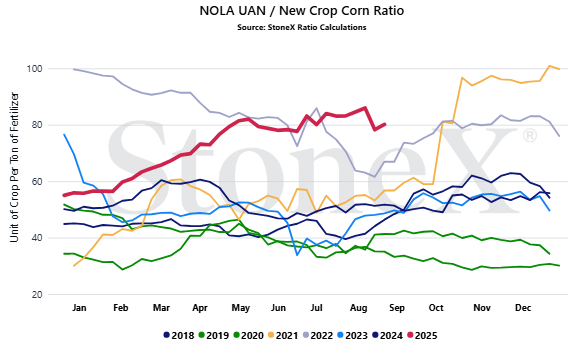
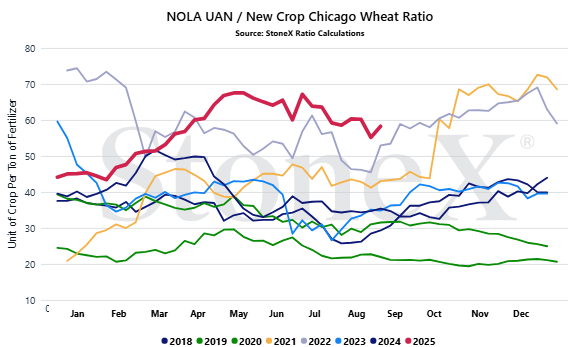
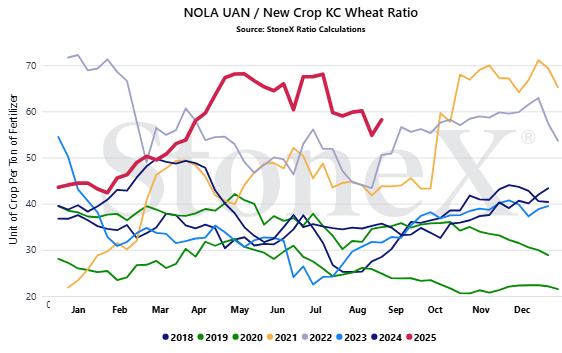
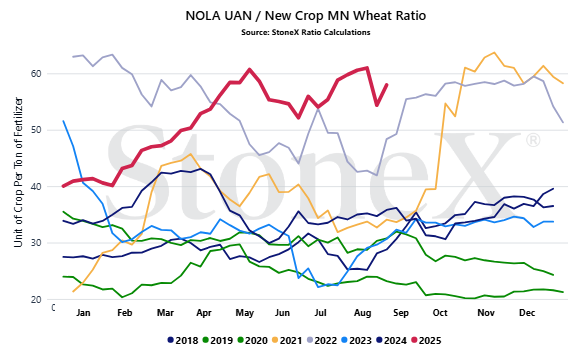
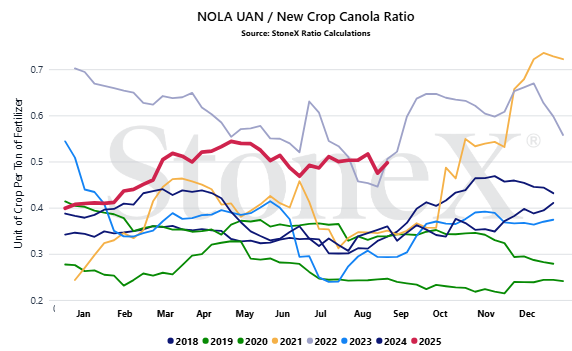
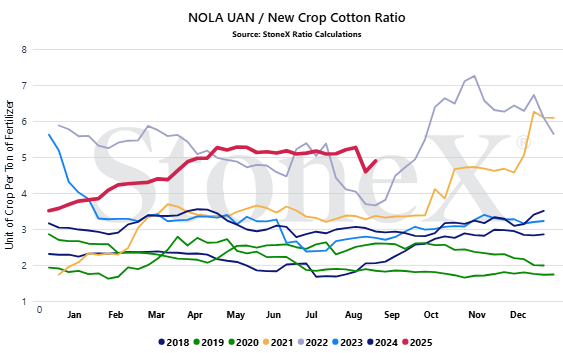
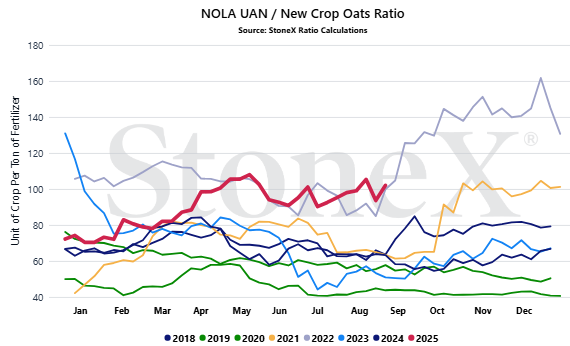
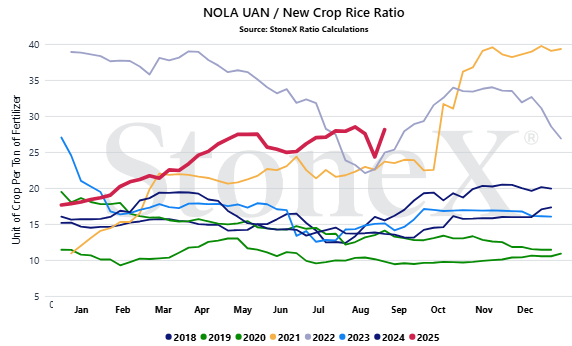
Where are the current UAN/grain ratio values today?
We believe that only looking at the flat price of either grains or fertilizer can be misleading:
We look at the ratio "value" to get a better indication of where we are or how many bushels of X does it take to pay for 1 ton of fertilizer.
Would you rather:
When we compare the current ratio value against recent years, we start to see if we are high or low.
YOUR VALUES MAY LOOK DIFFERENT
This graph looks at the NOLA UAN price vs the flat grain price. There are no logistics on either product. Your location will look different due to fertilizer logistical costs, grain basis, etc.
- Josh Linville’s Focal Points
- Russia/Ukraine peace could be HUGE for global UAN markets...either higher or lower - these peace talks could me monumental for UAN markets for either outcome. If the peace talks are successful and Russia is able to reestablish normal global relations, we could see their production and export of UAN pick up. That helps global supplies. Open trade routes would mean a lot more tons flowing directly to places like Canada/Australia/Europe. That would also mean those areas not needing to come to places like the U.S. for their tons so more tons for those domestic farmers. On the flip side, if talks fall apart, it could be savage on UAN. President Trump could follow through on huge tariff threats against Russia. That would mean the U.S. losing access to half its imports and without a solid alternative supply option. Nitrogen needs to be focused on these talks. UAN especially needs to be focused.
- Can/how will North American UAN markets improve before spring '26? - fertilizer year 2026 started on July 1 and for N.A. UAN, it started about as poorly as one can imagine. Starting inventories are as low as ever. Multiple nitrogen plant repair turnarounds are scheduled. Imports could be lower and exports could be higher. Overall nitrogen demand is still going to be big for the 2026 crop. There are still ways that the price could go lower, but they are farther and fewer between than how it could go higher. Either supplies need to improve (biggest hope is the above point) or demand needs to fall (possible given farmer struggles/need to reduce input costs). Anything is possible and the moment you think you have the market figured out, it changes. That said, it sure seems to be much more a matter of "can" the market improve...
- Does it matter this year if NH3 steals demand from UAN? - I think this is going to become a major story in the coming months. NH3 across N.A. is especially well priced when we compare it against UAN. To a certain extent, given UAN market issues, this is needed to rebalance the S&D's. However, it wouldn't be the first time that an overcorrection has been done. NH3 is set up for a massive fall direct application run (mother nature dependent). If it is a huge fall run on NH3, that can steal demand from the spring UAN marketplace. If it steals enough demand, it can start to shift price ideas for suppliers. Still doesn't feel likely today, but it is something we need to watch.
StoneX Ratio Calculation
The ratio calculation is derived from Bloomberg historical grains values as well as fertilizer values from StoneX, NPKFAS, and Argus.
The calculation is simply dividing the fertilizer price by each grain price.
All data was sourced from StoneX unless otherwise noted.
This material should be construed as the solicitation of an account, order, and/or services and represents the opinions and viewpoints of the individual authors or presenters. It does not constitute an individualized recommendation or take into account the particular trading objectives, financial situations, or needs of individual customers.
The views are current only through the date stated and are subject to change at any time based upon market or other conditions, and StoneX Group Inc. (“SGI”) disclaims any responsibility to update such views. Actual results, performance, or achievements may differ materially from those expressed or implied. Information is based on data gathered from what we believe are reliable sources. Past performance does not guarantee future results.
The StoneX Group Inc. group of companies provides financial services worldwide through its subsidiaries, including physical commodities, securities, exchange-traded and over-the-counter derivatives, risk management, global payments and foreign exchange products in accordance with applicable law in the jurisdictions where services are provided.
References to certain OTC products or swaps are made on behalf of StoneX Markets, LLC (SXM), a member of the National Futures Association (NFA) and provisionally registered with the U.S. Commodity Futures Trading Commission (CFTC) as a swap dealer. SXM’s products are designed only for individuals or firms who qualify under CFTC rules as an ‘Eligible Contract Participant’ and who have been accepted as customers of SXM.
StoneX Financial Inc. (SFI) is a member of FINRA/NFA/SIPC and registered with the MSRB. SFI is registered with the U.S. Securities and Exchange Commission (SEC) as a Broker-Dealer and with the CFTC as a Futures Commission Merchant and Commodity Trading Advisor. StoneX Financial (Canada) Inc. (SFCI) is registered in Canada and is a member of CIRO and CIPF. References to certain securities trading are made on behalf of the BD Division of SFI and are intended only for an audience of institutional clients as defined by FINRA Rule 4512(c). References to certain exchange-traded futures and options are made on behalf of the FCM Division of SFI. Wealth Management is offered through SA Stone Wealth Management Inc., member FINRA/SIPC, and SA Stone Investment Advisors Inc., an SEC-registered investment advisor, both wholly owned subsidiaries of SGI.
R.J. O’Brien & Associates, LLC (RJO) is registered with the CFTC as a Futures Commission Merchant and is a member of NFA.
StoneX Financial Ltd (SFL) is registered in England and Wales, company no. 5616586. SFL is authorized and regulated by the Financial Conduct Authority (FCA) (registration number FRN:446717) to provide services to professional and eligible customers including: arrangement, execution and, where required, clearing derivative transactions in exchange traded futures and options. SFL is also authorized to engage in the arrangement and execution of transactions in certain OTC products, certain securities trading, precious metals trading and payment services to eligible customers. SFL is authorized and regulated by the FCA under the Payment Services Regulations 2017 for the provision of payment services. SFL is a category 1 ring-dealing member of the London Metal Exchange. In addition SFL also engages in other physically delivered commodities business and other general business activities which are unregulated and not required to be authorized by the FCA.
This communication is issued in the European Economic Area by StoneX Financial Europe GmbH (SFEG). StoneX is the trade name used by STONEX GROUP INC. and all its associated entities and subsidiaries. StoneX Financial Europe GmbH (“SFEG”) is a securities trading firm registered in Germany under Company No. HRB 80844.
StoneX Financial Pte Ltd (Co. Reg. No 201130598R) (“SFP”) is regulated by the Monetary Authority of Singapore and is a Capital Markets Service Licence holder (for dealing in capital market products), an Exempt Financial Adviser (for advising on investment products and issuing or promulgating analyses/ reports on investment products) and a Major Payment Institution (for domestic and cross-border money transfer services).
SFP may distribute analysis/report produced by its respective foreign affiliates within the StoneX Group of companies pursuant to an arrangement under Regulation 32C of the Financial Advisers Regulations Recipients should contact SFP at (65) 6309 1000 for any matters arising from, or in connection with, this webinar.
StoneX APAC Pte. Ltd. (“SAP”) (Co. Reg. No 200616676W) is regulated as a Dealer (PS20190001002) under the Precious Stones and Precious Metals (Prevention of Money Laundering and Terrorism Financing) Act 2019 for purposes of anti-money laundering and countering the financing of terrorism.
StoneX Financial (HK) Limited (CE No.: BCQ152) (“SHK”) is regulated by the Hong Kong Securities and Futures Commission for Dealing in Securities and Dealing in Futures Contracts.
StoneX Financial Pty Ltd (ACN 141 774 727) holds an Australian Financial Service License (AFSL: 345646) for Dealing in Securities, Exchange-Traded Derivatives Contracts, OTC Derivatives Contracts and Foreign Exchange Contracts, and is regulated by the Australian Securities and Investments Commission.
StoneX Securities Co., Ltd. (“SSJ”) (Co. Reg. No 010401047199) is regulated by the Japanese Financial Services Agency as a Type-I Financial Instruments Business Operator (Kanto Local Finance Bureau (FIBO)No.291’), is a member of the Financial Futures Association of Japan for dealing and broking FX and FX Option transactions, and is a member of the Japan Securities Dealers Association for dealing and broking stock indices and option transactions.
Trading swaps and over-the-counter derivatives, exchange-traded derivatives and options and securities involves substantial risk and is not suitable for all investors. Past performance of any futures or option is not indicative of future success. Indicators are not a trading system and are not published as a specific trade recommendation. The information herein is not a recommendation to trade nor investment research or an offer to buy or sell any derivative or security. It does not take into account your particular investment objectives, financial situation or needs and does not create a binding obligation on any of the StoneX group of companies to enter into any transaction with you. You are advised to perform an independent investigation of any transaction to determine whether any transaction is suitable for you. No part of this material may be copied, photocopied or duplicated in any form by any means or redistributed without the prior written consent of StoneX Group Inc.
The report/analysis herein is not directed to, or intended for distribution to or use by, any person or entity who is a citizen or resident of or located in any locality, state, country or other jurisdiction where such distribution, publication, availability or use would be contrary to law or regulation.
© 2026 StoneX Group Inc. All Rights Reserved.