- World production in 2023/24 estimated above consumption, according to the USDA;
- Improvement in productivity with the harvest progress in Brazil;
- USDA cuts Brazil's crop by just 1 million tonnes;
- Crop should be favorable in Argentina;
- Concerns about the pace of global demand;
- Weak US export sales;
- StoneX raises soybean production for 2023/24;
- Cuts in estimated production by CONAB, USDA, and ABIOVE;
- Hot and dry weather worsens crop conditions in Argentina;
- Argentinian situation still favors holding onto soybeans as insurance.
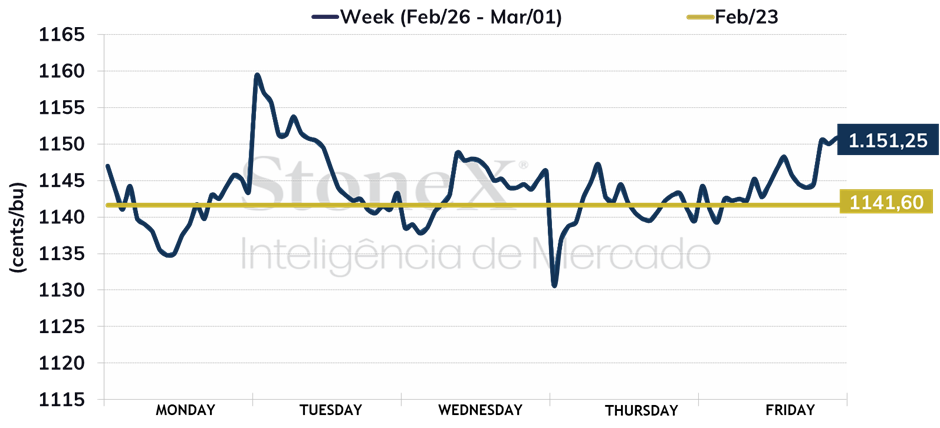
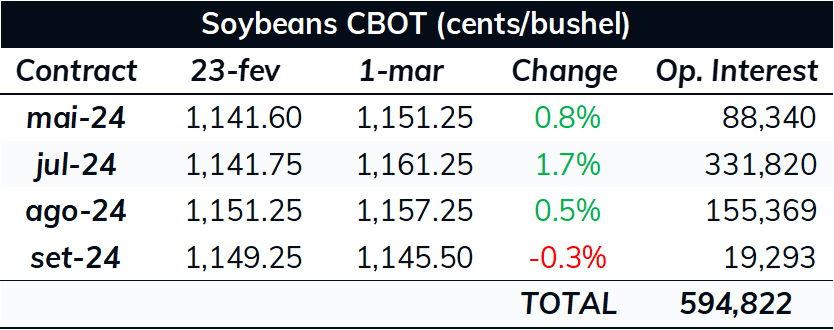
Soybeans fluctuated over the past week, with the market trying to establish some floor for prices on the exchange after the almost continuous decline since mid-November, with the continuous contract hitting its lowest level in over three years. Due to a rebound recorded on Friday (day 01), soybean ended the period at 1.141 cents per bushel, a weekly gain of 0.8%.
Overall, the fundamentals remain similar. The market remains optimistic about the South American crops, with expectations of a strong recovery in Argentina and with the latest updates from StoneX's estimates for the Brazilian crop reducing fears of significant losses in the country. Additionally, the expectation of an increase in production area in the United States, signaled in the USDA planting intentions report, adds another favorable factor to supply.
On the other hand, demand remains slower, which contributes to the feeling of a more comfortable supply and demand balance, especially in the 1st half of 2024. While the slower pace of demand for soybeans shows no signs of improvement in China, in the United States, the production of biodiesel and renewable diesel continues to be sluggish, influenced by RINs D4 (Renewable Identification Numbers) issued and traded by producers of these biofuels, still greatly undervalued, which discourages both demand for soybean oil and crushing.
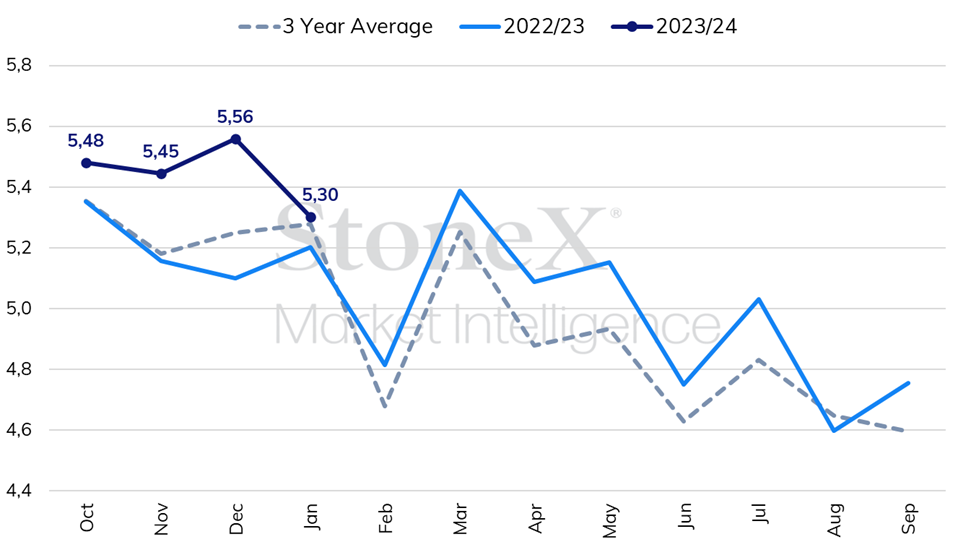
On Friday (March 04), USDA (United States Department of Agriculture) updated the official soybean crushing data in the United States in January, slightly below expectations. The country totaled 5.302 million tonnes of soybeans crushed in the month, 0.9% below estimates of 5.349 million and down 4.6% from December. Despite crushing being 1.9% higher than the same month in 2023, seasonally, January usually marks a slight increase compared to December, which raises some caution. Additionally, the report showed that soybean oil consumption in the month totaled 712 thousand tonnes, a 5.9% decrease from December and 5.7% below January 2023. Oil stocks, in turn, rose 13.8% to 700 thousand tonnes, in line with the stock indicators shown by NOPA, which eases concerns about the historically low levels seen in previous months.
This week, market participants will be waiting for the release on Friday (08) of the USDA's WASDE report, which will update the department's estimates for supply and demand indicators of the main oilseed producers.
The agenda of macroeconomic indicators also deserves attention and tends to affect commodity prices in the week. For China, the S&P Global/Caixin will release the country's Services and Composite PMI between this Monday (04) and Tuesday (05), which will help assess the pace of the country's activity level recovery and may affect market sentiment, especially regarding global demand. The Chinese Consumer Price Index (CPI), which will be released on Friday (08) and estimates from analysts that it will reach the highest level since January 2023, suggesting a rekindling of consumption due to the lunar new year, can also act as a supportive factor.
US export inspections: Considered a leading indicator of exports, the USDA Export Inspections Report indicated a decline in export shipments, which fell compared to the previous week, totaling 1.10 million tonnes. Thus, there was an 8% decrease compared to the previous week, marking the third consecutive week of declines.
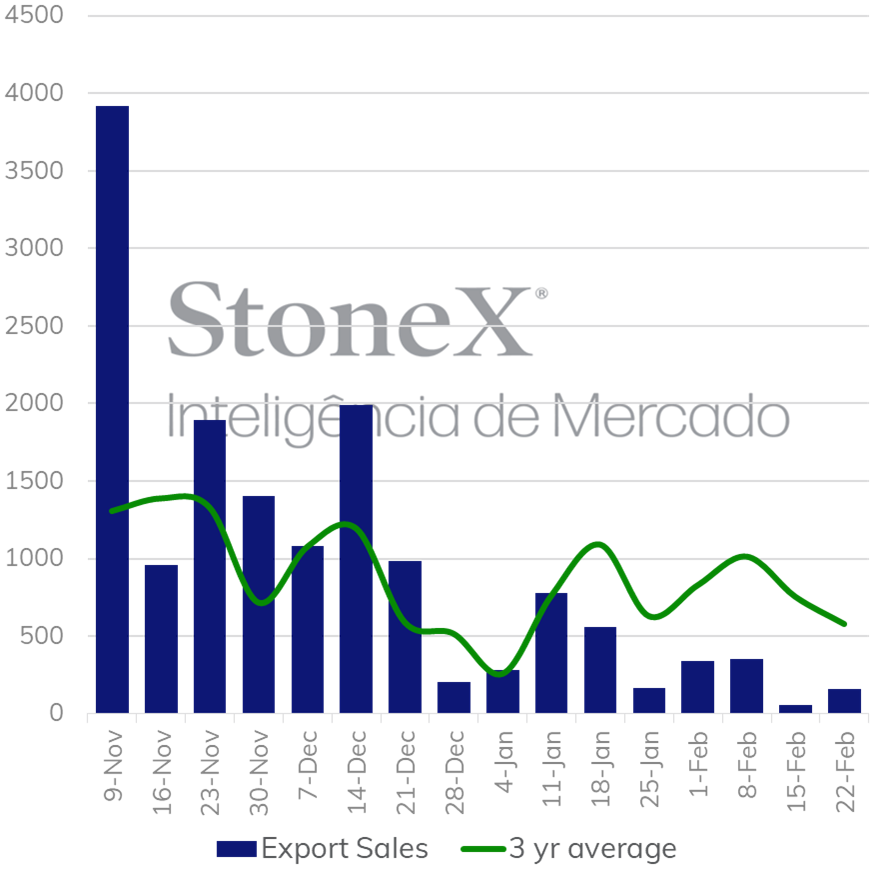
US export sales: The average net sales export of the current crop recovered in the week ending on February 29, with 159.7 thousand tonnes. However, the level of trade remains far below the average seen in the last three years, when 579.9 thousand tonnes were observed. The new crop was not sold for the second consecutive week, while in previous years, a certain volume of sales was already observed, showing that demand remains weak.
Brazilian crop: With Brazilian production being key to defining the international oilseeds supply, the week was marked by updates of different estimates. On the ABIOVE side (Brazilian Association of Vegetable Oil Industries), the crop was reduced by 2.3 million tonnes compared to the institution's previous publication, with an expected production of 153.8 million tonnes for 2023/24. Adverse weather conditions are the justifications for the cut.
Meanwhile, StoneX Brazil updated its estimate for the 2023/24 crop, increasing production to 151.55 million tonnes (0.8% higher than the last report). As expected, a new record will not be recorded, remembering that the previous 2022/23 crop was 157.9 million tonnes. In this increase scenario, the results were influenced by upward adjustments in the MAPITOPA region and the states of Bahia and Goiás. In this case, good precipitation levels in recent weeks have benefited the crops planted later, potentially leading to a higher yield. On the other hand, Mato Grosso do Sul adjusted the expected harvest downwards. Therefore, the scenario projected by StoneX consolidates a strong crop for the country.