- World production estimated above consumption in 2023/24, according to the USDA;
- Improvement in productivity with the harvest progress in Brazil;
- USDA cuts Brazilian crop to 155 million tonnes;
- Crop should still be favorable in Argentina;
- Concerns about the pace of global demand;
- Growth prospects for area in the USA.
- Lower production figure by CONAB;
- Record crushing in the USA on March 24;
- High net short position of spec funds;
- Buenos Aires Exchange cuts 23/24 Argentine crop;
- The Argentine situation still favors holding soybeans as insurance.
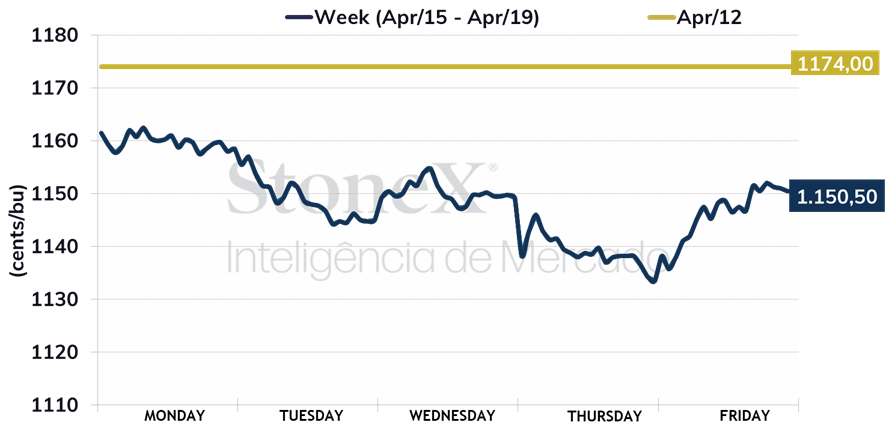
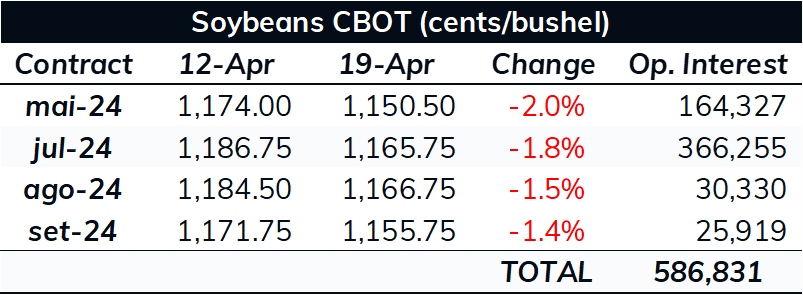
Soybean quotes showed another week of decline in Chicago, with the May contract ending on Friday (19) at 1150.5 cents per bushel, a 2% decrease in the period. The lower prices even attracted buyers to the market at times, but the lack of new bullish fundamentals prevailed.
The market continues to monitor the completion of the harvest in Brazil, still with doubts about the size of the crop, amid divergent estimates, the development and start of the harvest in Argentina, and the pace of demand. In addition, it is worth noting that planting in the US is ongoing, with the USDA having started to release its weekly updates.
The difference between CONAB and USDA estimates for the Brazilian production 23/24 has not been resolved in the latest releases and is expected to continue generating doubts in the market. Despite CONAB's figure being considered the official one, the market seems to be considering a higher production, given the practically null impact on price evolution. It is worth mentioning that USDA's production, at 155 million tonnes, is one of the highest in the market. The last figure from StoneX was 150.8 million tonnes.
Regarding Argentina, the Buenos Aires Exchange indicated that 13.9% of the soybean crops had already been harvested by last Wednesday (17), with a delay of 22 p.p. compared to the five-year average due to rains mainly in areas of the Entre Rios province and the northern region of the country. Crops in regular/poor conditions increased by 1 percentage point, reaching 23% of the total, but for now, the production estimate has been maintained at 51 million tonnes.
In the USA, the first crop progress report for the 24/25 soybean crop indicated that 3% of the crops planted by Sunday (14) were in line with last year's level and above the five-year average of 1%. Soybean has a cycle a few weeks later than corn, but there are some records of producers starting the cultivation of the oilseed early, which could benefit the yields. Anyway, it is still early, and it cannot be affirmed that it is a generalized behavior and that it will remain.
On the demand side, Brazilian soybeans remain competitive compared to American soybeans for China, with the Asian country focusing its interest on the product from Brazil. Moreover, the recent dollar appreciation further favors the competitiveness of Brazilian soybeans and contributes to some progress in producer negotiations. According to StoneX's report, released last Friday (19), 48.2% of the soybean 23/24 crop has been sold, close to the level of April last year for the 22/23 crop, when it reached 50%. With the harvest progress, sales picked up slightly, but they remain slow compared to previous years (except 22/23).
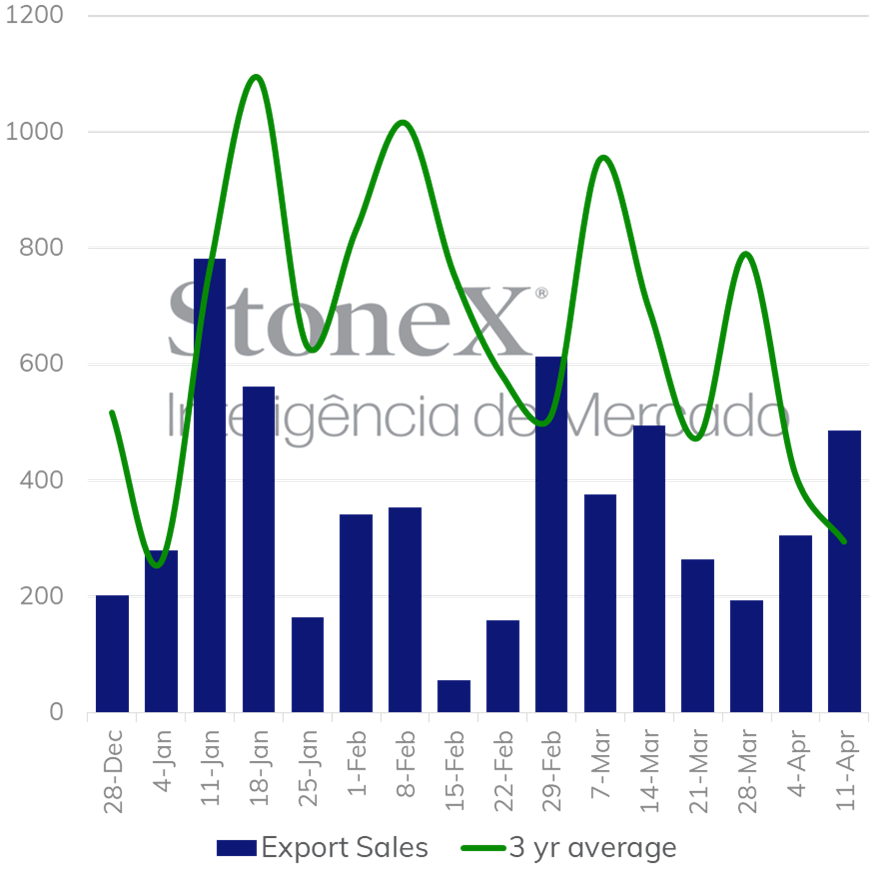
US export sales in the week ended on 04/11 reached 485.8 tmt for the 23/24 crop, within the market's estimated range from 300 to 650 thousand tonnes. In total, 41.3 million tonnes were traded, compared to 50.1 million in the same week of the previous year. China is responsible for 7.4 million tonnes of this difference.
Compared to domestic consumption in the US, NOPA (National Oilseed Processors Association) reported that 5.35 million tonnes of soybeans were crushed in March, a historical record surpassing the previous peak in December 2023 but slightly below market expectations at 5.38 million tonnes. With this crushing, oil stocks reached 839.6 thousand tonnes, exceeding the market expectations and signaling that production may be higher than what the market can absorb, with American oil potentially "returning" to the export market and doubts about the country's renewable diesel segment.
This week, in addition to the progress of crops around the world and monitoring from the demand side, with any news coming from China being able to move the market, there are significant macroeconomic releases, such as the GDP and inflation of the USA.