- World production estimated above consumption in 2023/24, according to the USDA;
- Improvement in productivity with the harvest progress in Brazil;
- USDA estimates Brazilian crop at 155 million tonnes;
- Crop should still be favorable in Argentina;
- Concerns about the pace of global demand;
- Growth prospects for the area in the USA.
- Lower production figure by CONAB;
- Record grinding in the USA on March/24;
- High net short position of spec funds;
- Buenos Aires Grain Exchange cuts 23/24 Argentine crop;
- The Argentine situation still favors holding soybeans as insurance.
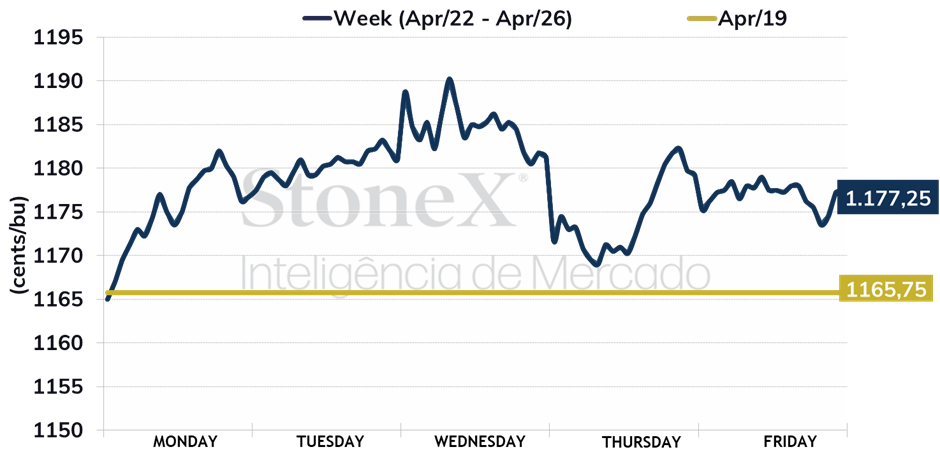
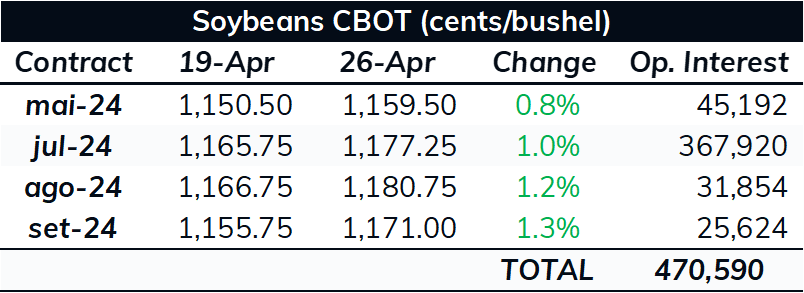
Last week, soybean prices in Chicago appreciated on short covering. It is worth noting that, even with the recent movement, the net short position remains high, leaving the market subject to new rounds of short covering. The July contract reached 1177.25 cents per bushel on Friday (26), a weekly gain of 1%.
No major changes were made compared to the fundamentals. However, given the lack of convergence among the several market estimates, there are still doubts about the size of the Brazilian crop, with the initial planting progress in the US and demand, mainly from China, on the radar.
In Brazil, the 23/24 soybean harvest reached 93.2% of the total on Friday (26), according to StoneX, slightly below last year. Preliminary exports for April indicate that 10.2 million tonnes of soybeans were shipped by April 19. Shipments continue to rise in these first months due to increased post-harvest availability. Even so, the prospects for annual declines in soybean exports remain, following the lower production this year.
Regarding Argentina, the harvest continues to face headwinds due to rain, having reached 25.5% of the total on Wednesday (24), a delay of 22.8 percentage points compared to the five-year average for this period but only three percentage points compared to last year. The harvest is still in the early stages in the country's northern provinces (NOA and NEA), with below-average yields recorded. On the other hand, in the Northern core of the producing region (located more towards the center of the country), the yields have been surprising, surpassing the average. Thus, the Buenos Aires Exchange maintains the soybean production estimate for 23/24 of the country at 51 million tonnes.
In the USA, the 24/25 crop planting reached 8% on Sunday (21), the same level as last year. This is ahead of the five-year average, which is 4%. It is still too early to conclude this faster pace of field work. An earlier planting of soybean could eventually be beneficial for the yields. As for the final planted area, the market still believes that the combined soybean and corn acreage may increase, with corn gaining ground, mainly because the cereal's acreage was below expectations in the producer's planting intentions released at the end of March.
As for demand, US export inspections in the week ended 04/18 reached 450.3 tmt, lower than the previous week but above the same period last year. In total, 38.5 million tonnes were inspected against 47 million at the same period of the previous crop. Even with USDA estimating lower shipments in the 23/24 cycle, this lagging pace, if maintained, could lead to the need for new adjustments in the department's export figures.
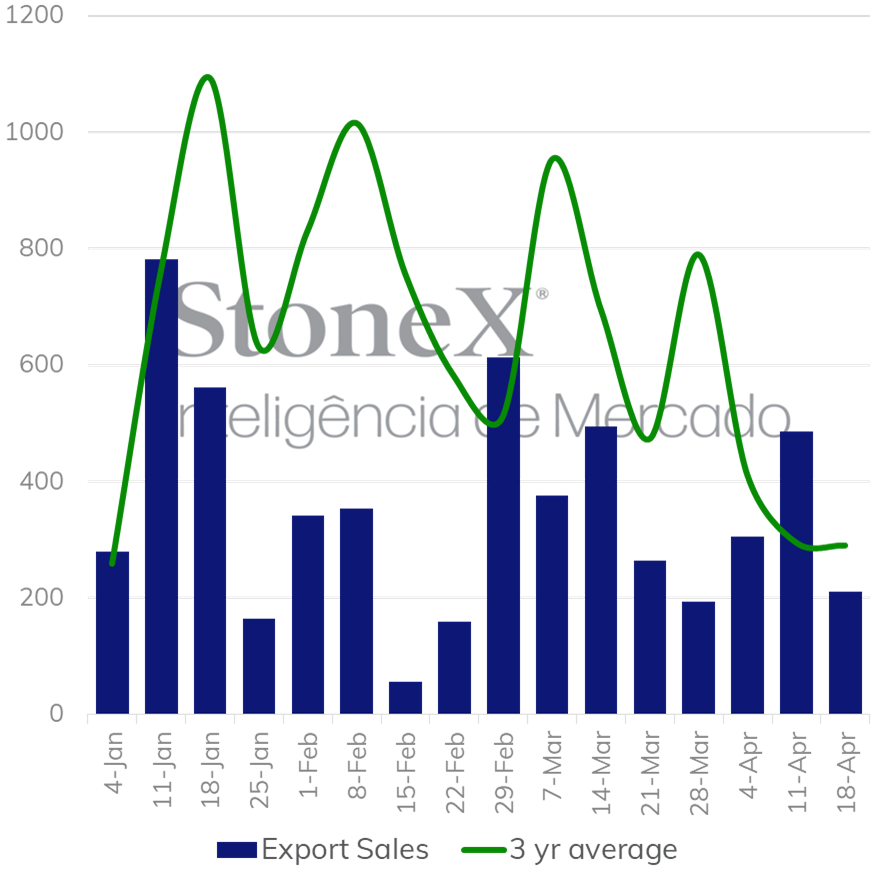
On the other hand, the country's export sales in the same week reached 210.9 thousand tonnes for the 23/24 crop, below the lower end of the estimates, which ranged from 300 to 600 thousand tonnes. The accumulated sales total 41.5 million tonnes, compared to 50.4 million tonnes last year, an almost 9 million-tonne difference. China accounts for 7.2% of that total. Just like in the case of inspections, even with the estimate of exports being lower for this cycle, the lagging pace of sales, if maintained, could also indicate that USDA will need to make new adjustments.
It is worth noting that the current period does not tend to document more significant purchases of American soybeans by China, indicating that the country is expected to end the 23/24 crop year with fewer purchases from the US, giving "preference" to Brazil, which continues to have more attractive prices. Nonetheless, it is important to remember that the lower Brazilian crop production this year is expected to result in weaker soybean shipments in the second half of the year compared to last year, which could benefit the new crop in the US, harvested from September onwards.
This week, in addition to the usual disclosures, StoneX will update its crop estimate for 23/24 next Thursday (02). On the macroeconomic side, the Fed's monetary policy meeting stands out, with expectations of interest rates being maintained. On Friday (03), the country's labor market data for April (Payroll) will be released.