- Bearish factors
- Global production 24/25 widens the gap compared to consumption, according to USDA;
- Improved productivity with the advance of the harvest in Brazil;
- USDA estimates the Brazilian crop in 23/24 at 154 million tonnes;
- Conab increases the 23/24 soybean crop;
- Concerns about the pace of global demand;
Prospects for acreage growth in the USA.
- Bullish factors
- Impact of rain on the planting pace in the USA;
- Crop losses in Rio Grande do Sul due to floods;
- Speculative funds reduce short positions;
- USDA continues to bet on very strong Chinese imports.
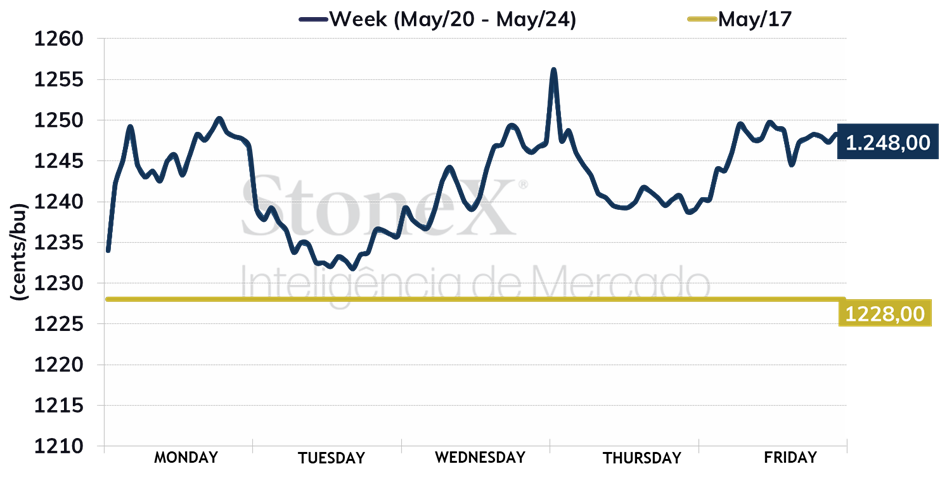
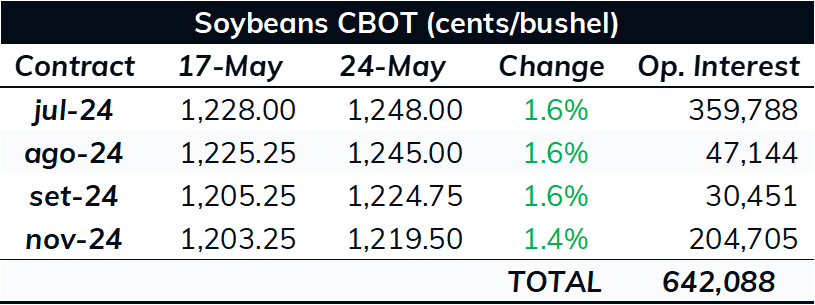
Soybean prices in Chicago fluctuated considerably last week, with a predominant upward trend as the market followed planting in the USA, the consolidation of the 23/24 crop in South America, and demand data. The July contract ended Friday (24) at 1248 cents per bushel, a weekly advance of 1.6%.
Rainfall in the USA has been closely monitored, including the occurrence of tornadoes in Midwest regions, a situation that has slowed fieldwork after a very fast start to the 24/25 crop planting. By Sunday (19), 52% of the country's soybean crop had been planted, still above the five-year average for the period, at 49%, but below the same week last year, at 61%. As today (27) is a holiday in the USA, the next US crop update will be released only late tomorrow afternoon and is eagerly awaited. Delayed planting usually has no direct impact on US soybean crop productivity, although it increases the risks associated with cultivation. On the other hand, the planting windows defined for each region are tied to crop insurance, and as the deadlines are exceeded, coverage gradually decreases. Thus, there is more speculation about prevented planting areas as June approaches.
In Brazil, the situation in Rio Grande do Sul continues to be monitored, with the state's soybean harvest reaching 92% of the total last Friday (27), according to StoneX. The damages, including those to the soybean chain such as storage, processing, and logistics, are not yet fully known, but regarding the crop, StoneX maintains its estimate of a loss of 3 million tonnes. In any case, in addition to the impacts on supply, demand will also be affected. For example, the mandatory biodiesel blend was temporarily relaxed in the state, from 14% to 2%, and this measure is expected to be reviewed at the beginning of June. It is worth noting that Rio Grande do Sul is the largest national producer of biodiesel.
In Argentina, the soybean harvest reached 77.9% of the total last Wednesday (22), according to the Buenos Aires Grain Exchange, a weekly advance of 14.2 percentage points, with yields stabilizing, according to the institution. Thus, the estimate for the country's crop remains at 50.5 million tonnes.

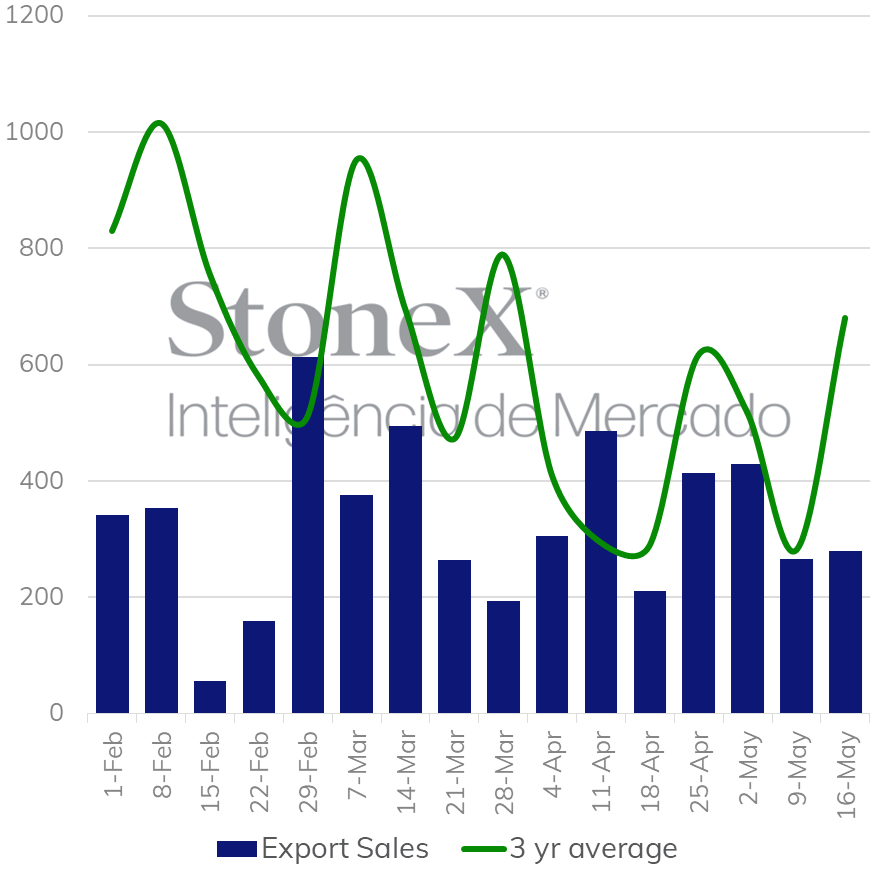
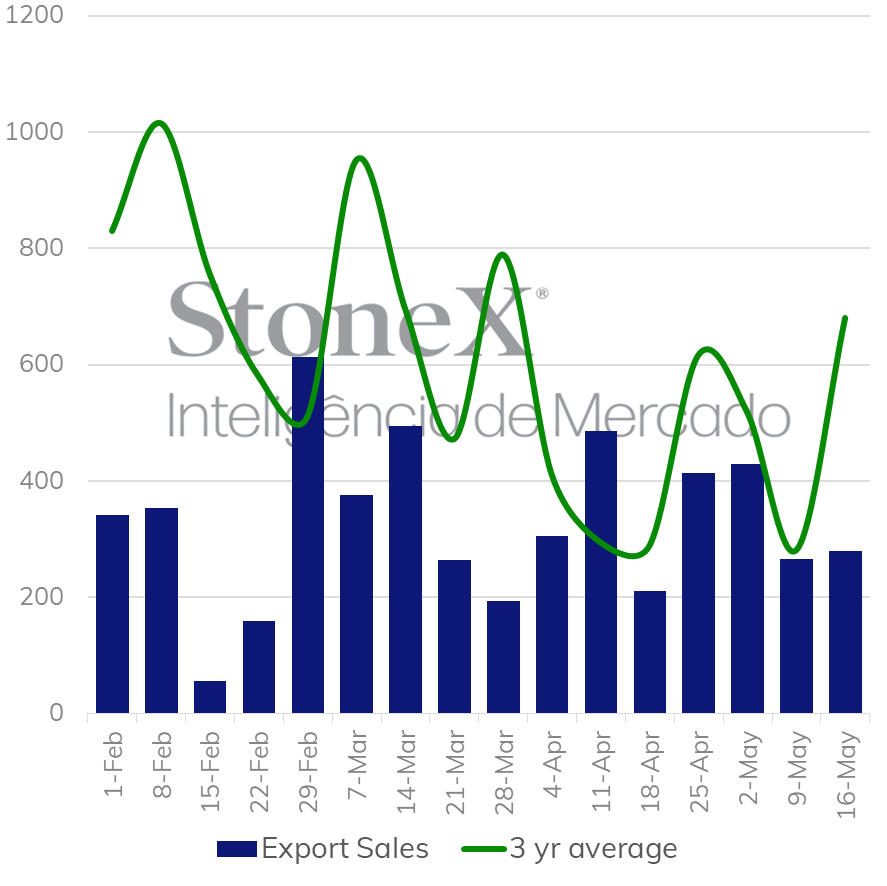
On the demand side, US exports remain on the radar, with sales of the 23/24 crop reaching 2.794 million tonnes in the week ending 05/16, the low end of estimates ranging from 275 to 550 thousand tonnes. A total of 42.8 million tonnes have been traded, with this pace still sufficient to reach USDA's export estimate by August, which is currently at 46.3 million tonnes. It is noteworthy that Brazilian offers to China remain more competitive than those of the USA, with exports originating in Brazil remaining very strong despite the smaller crop here.
Domestic demand in the USA is being closely monitored, particularly in the renewable diesel segment. This segment has attracted numerous investments in recent years, leading to an increase in soybean crushing capacity. In April, the National Oilseed Processors Association (NOPA) reported significantly lower-than-expected soybean processing. On the export side, attention is being given to soybean oil data, as increased negotiations and shipments of vegetable oil could indicate weaker performance in the renewable diesel sector. This could potentially mean less absorption of the feedstock. The most recent release indicated a net cancellation of soybean oil export sales, which was well-received by the market as it would not confirm the possibility of an internal soybean oil glut. Nevertheless, the demand for oil for biofuels in the country should continue to play a key role in balancing the soybean supply and demand.
Since it is a holiday in the USA this Monday (27), the lack of reference from the Chicago Board of Trade should keep the market quieter today, with US data releases resuming tomorrow, always with great anticipation regarding the progress of the country's crop.
On the demand side, the pace of Chinese purchases should also remain on the radar, with the country focusing its imports on Brazilian soybeans, while there are doubts about the size of annual imports, with USDA being more optimistic and diverging from Chinese Customs data.