- Bearish Factors
- World production in 24/25 widens the gap compared to consumption, according to the USDA.
- Improvement in productivity with the harvesting progress in Brazil;
- Crushing margins more pressured in China;
- Concerns about the pace of global demand;
- Growth prospects for the area in the USA.
- Bullish factors
- Tax changes in Brazil are expected to impact exporting companies;
- Crop losses in Rio Grande do Sul, due to floods;
- Spec funds reduce short position;
- USDA continues to bet on very heated Chinese imports.
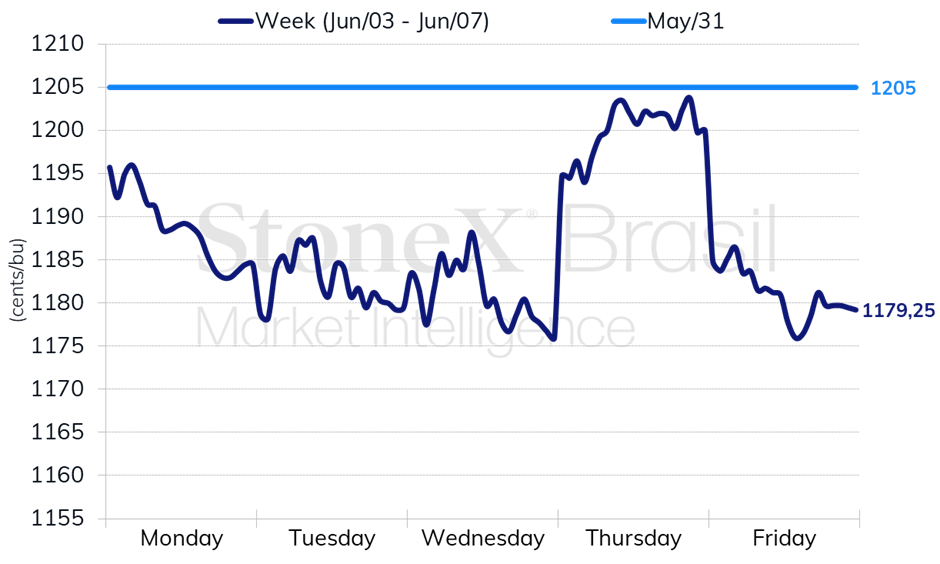
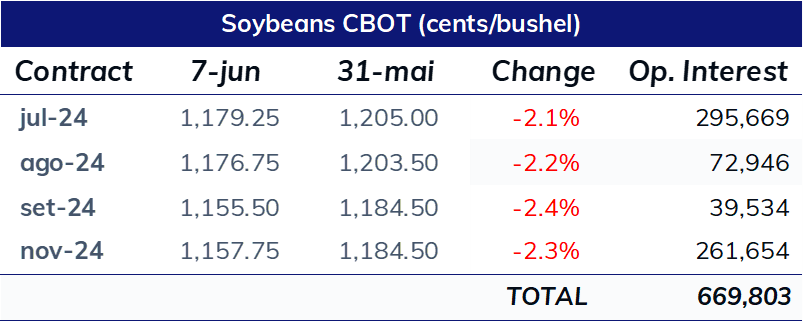
The soybean quotes in Chicago ended last week lower but also had periods of appreciation. The July contract ended Friday's session (07) at 1179.25 cents per bushel, a drop of 2.1%.
The US 24/25 crop continues to be closely monitored, with concerns about the pace of planting having eased as fieldwork progresses above the five-year average and the weather has not posed major threats.
In the week ending on 06/02, 78% of the US soybean crop was already planted, compared to the five-year average of 73%. Last year, the pace was faster, with 89% of the work completed in that period. The weather forecasts indicate a drier pattern throughout the Midwest until the end of the week, when it should start raining again in the northern producing region, near the Canadian border.
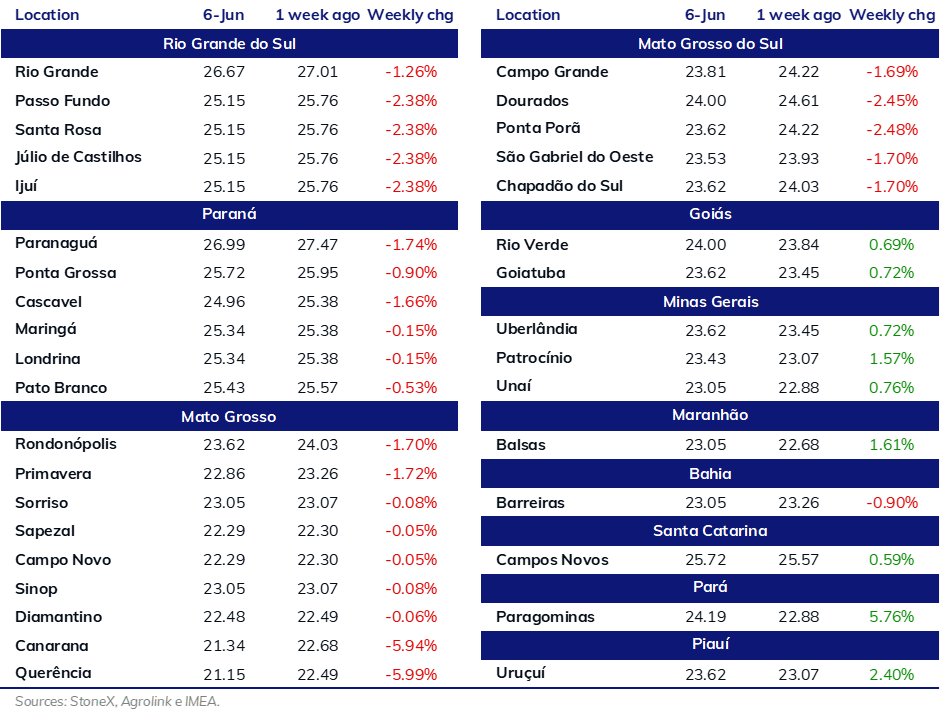
In Brazil, StoneX updated its estimate for the Brazilian 23/24 crop, with production falling to 149 million tonnes, 1.2% less than the figure released in early May. This drop was motivated by the reduction of three million tonnes in the Rio Grande do Sul crop, due to the floods that affected the state between late April and early May. As part of the soybean still needed to be harvested, especially in the southern half of the state, the extreme weather event led to productivity losses in the field. On the other hand, the positive review in the states of Mato Grosso and Goiás partially offset the losses in Rio Grande do Sul. In these two states, despite the harvest already being finished, the area was revised upwards, with positive impacts on production.
It is worth mentioning that Emater from Rio Grande do Sul reduced its estimate for soybean in the state by 2.7 million tonnes, due to the extreme weather phenomenon, with production reaching 19.5 million tonnes. The StoneX figure for the soybean crop in Rio Grande do Sul also decreased from 23 to 20 million tonnes. The harvest of the crop in the state is nearing completion, reaching 97% last Friday (07), according to StoneX.
In Argentina, the absence of rain allowed the progress of work in the field, with the harvest entering its final stretch, having reached 92.2% of the total on Wednesday (05), according to the Buenos Aires Exchange. The soybean production estimate for 23/24 in the country remains at 50.5 million tonnes.
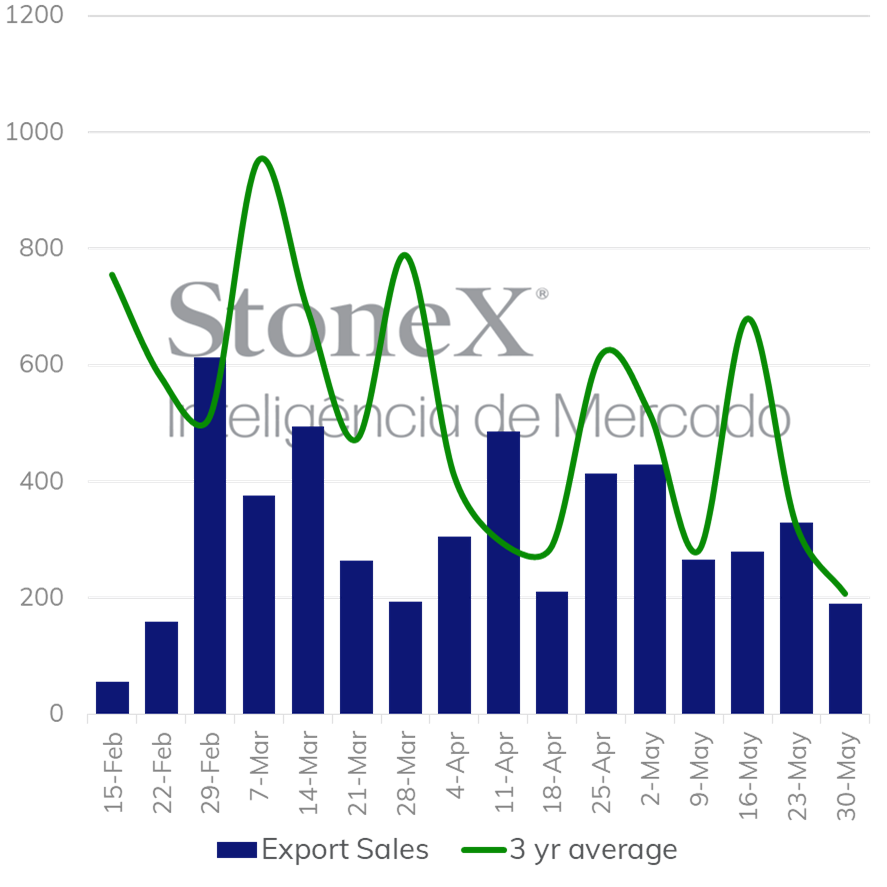
Regarding demand, US export sales in the week ended on May 30 were at 189.6 tmt for the 23/24 crop, at the lower end of market estimates, which ranged from 175 to 650 tmt. In total, 43.4 million tonnes were traded, a volume that is in line with the necessary to achieve USDA's export estimate of 46.3 million tonnes.
In Brazil, soybean exports closed the month of May at 13.5 million tonnes, below the 15.6 million registered in the same month last year. In the accumulated total since January, 50.2 million tonnes were shipped, a volume still higher than that recorded in the first five months of 2023 when the total reached 49 million tonnes. Anyway, the expectation is that in the coming months, the shipped volumes will decrease, following the more usual seasonal pattern of Brazilian exports, in addition to the lower availability, since the 23/24 crop was smaller than the record recorded in the 22/23 cycle.
Also on Brazilian soybean, it is worth mentioning that the commercialization continues to be slower, as has already happened with the 22/23 crop. Until June 6, according to StoneX, 62.1% of the 23/24 soybean crop and 10% of the 24/25 oilseed crop had been traded, which will start to be planted in September. It is important to highlight that, even with this lagging pace of negotiations, it does not mean that there will be no soybeans available for crushing or export. The marketing information refers to how much of the crop the producer has already fixed. The physical product ends up being moved by tradings and other companies, as there is a lack of storage capacity and the producer resorts to third parties.
Another highlight of last week here in Brazil was the edition of the Provisional Measure (PM) 1,227/24, which changed the use of PIS/COFINS credits and the reimbursement of the presumed credits of these taxes. From this measure, the credits can only be used for offsetting PIS/COFINS in other parts of the chain, not being able to offset other taxes, as it used to happen before. Despite not changing the tax burden, in practice, companies will need to use their resources for the payout of taxes that would have been offset before, which impacts cash flow. This measure is likely to affect exporting companies, which do not pay PIS/COFINS and will not be able to slaughter other federal taxes with the credits accumulated in previous stages.
This week, the monthly reports from USDA and CONAB will be released. In the case of USDA, significant changes are not expected for the US 24/25 crop, with the acreage revision expected at the end of June, while productivity adjustments taking into account field-collected data are only expected in August. Anyway, possible revisions of the South American crop 23/24 may occur. CONAB is expected to provide a better assessment of the impacts of the floods in Rio Grande do Sul.