- Bearish Factors
- World production in 24/25 widens the gap compared to consumption, according to the USDA.
- Brazilian crop still robust, despite weather impacts;
- Pressured crushing margins in China;
- Concerns about the pace of global demand;
- Harvest completion in Argentina, strong crop;
- Favorable crop conditions in the US.
- Bullish factors
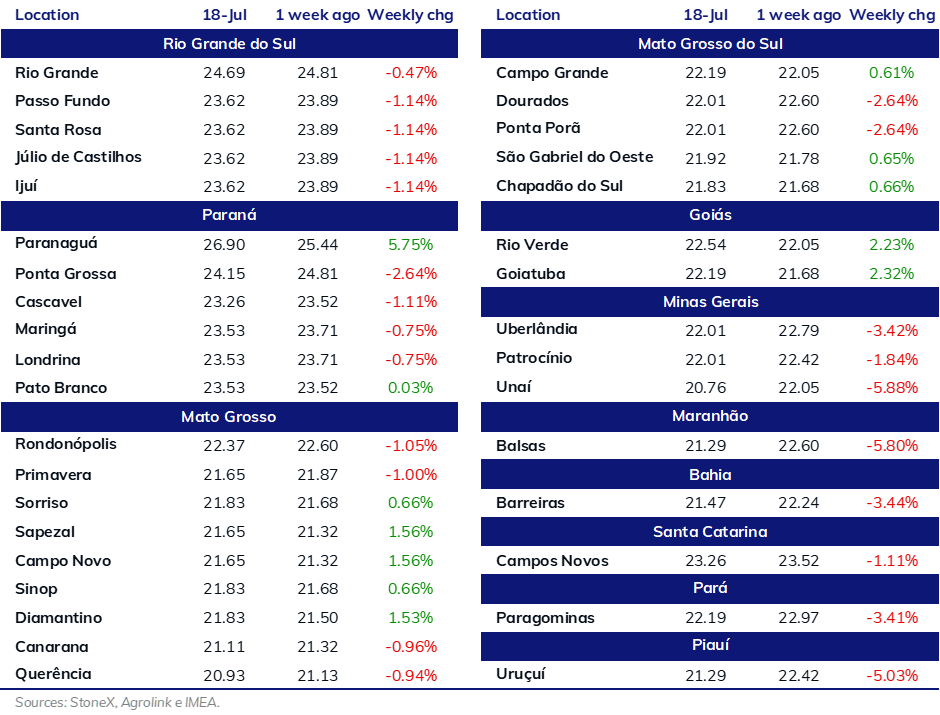
- Crop losses in Rio Grande do Sul, due to floods;
- Investment funds with a high short position
- Heated crushing in the US;
- Conversion of plants to renewable diesel in California;
- USDA increases Chinese imports again.
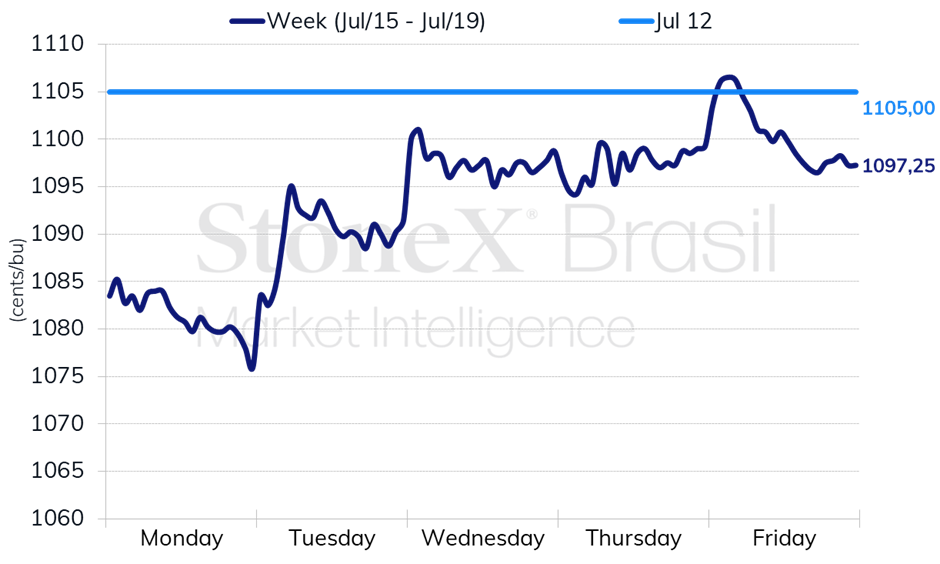
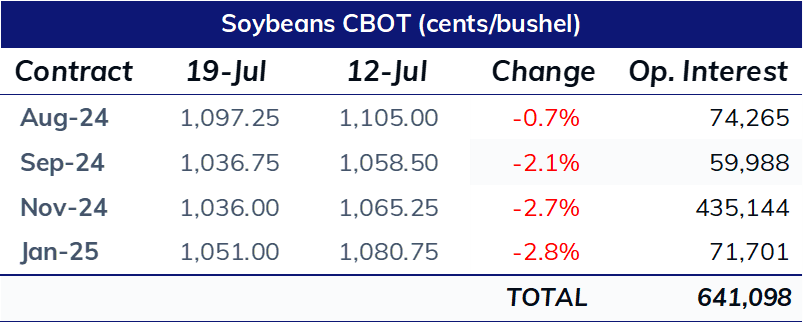
Last week, soybean prices in Chicago remained under pressure, alternating between highs and lows, but ending the period in decline once again. The contract for August ended Friday's session (19) at 1097.25 cents per bushel, a decrease of 0.7%. The most pronounced contracts posted a more significant decrease.
Usually, the first half of the year is marked by price volatility on CBOT, under the influence of the weather in the US and its potential impacts on the American crop. Nonetheless, this year, the weather has been more favorable, without major threats, after the rains have eased the drier pattern in the eastern belt.
The USDA's weekly crop progress report continues to show a higher good/excellent percentage of crops, with the result for the week ending on July 14 remaining at 68%, while the five-year average for the period was at 60%. As already highlighted in previous reports, the continuation of these high percentages for the good/excellent percentage until August tends to be associated with very good yields possibly exceeding the trend.
The demand side, without surprises and with a more predictable growth in global consumption, is also unable to alter this trend of more pressured soybean prices.
The market is following Chinese consumption, with the country maintaining strong soybean imports, but its pork industry still facing challenges. The sector is responsible for about a third of the country's feed consumption. There are reports of culling of breeding stock, which has contributed to the increased meat supply, but expectations indicate that production may decline as this culling process has already concluded. Even with USDA raising the estimate of soybean imports from China, from 105 to 108 million tonnes in the 23/24 crop year, this surplus would be destined for stocks and not for higher consumption.
In the US, domestic soybean consumption is at the center of attention, driven by the renewable diesel segment, which has encouraged the increase in soybean grinding capacity, as soybean oil is the main feedstock.
The National Oilseed Processors Association (NOPA) released the US soybean crushing, which stood at 4.78 million tonnes, while the market estimate average was 4.84 million. Even with this lower-than-expected result, the volume processed by 95% of the North American market, represented by NOPA, is still on track to reach USDA's crushing estimate in the 23/24 crop year, at 62.3 million tonnes. Regarding oil stocks, the level of 735.7 thousand tonnes also fell below expectations, the third lowest level for June considering the last nine years.
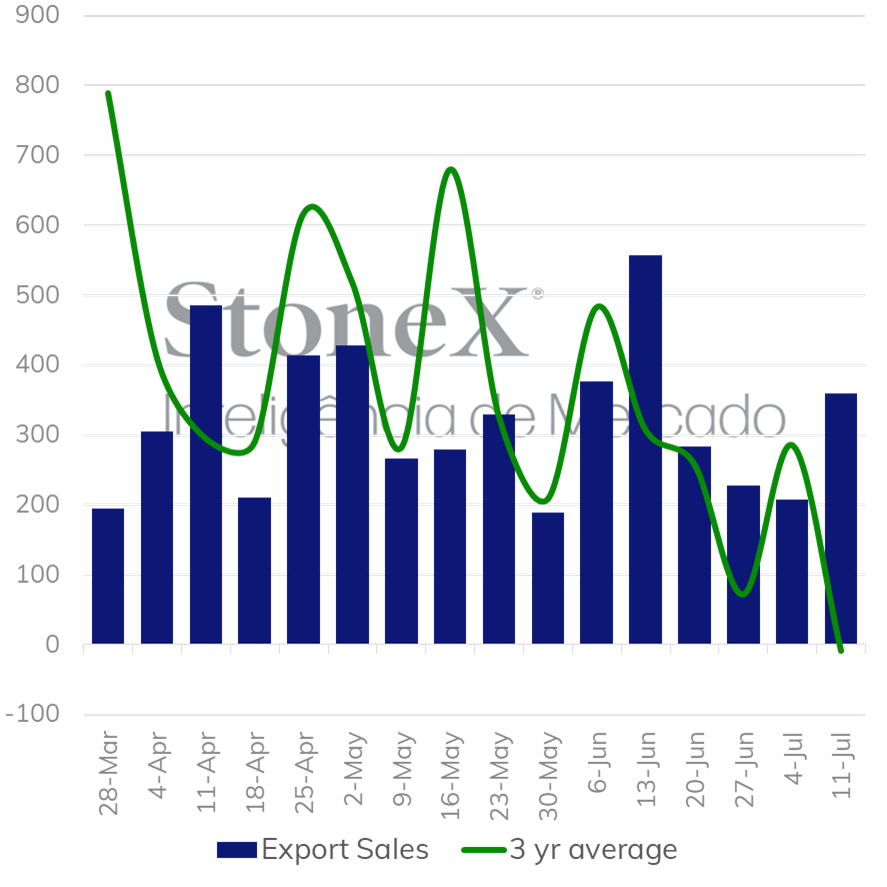
Regarding US exports, net sales in the week ended on July 11 reached 360.1 thousand tonnes of the 23/24 crop, within the estimated range from 150 to 600 thousand. In total, 45.2 million tonnes were traded, with the USDA's shipment estimate for the cycle at 46.3 million.
In recent years, the US has been investing in increasing domestic consumption of soybeans, facing competition with Brazil in exports. Currently, the Brazilian soybean destined for China remains more competitive than the American.
For now, Brazilian exports remain very strong, reaching 5.3 million tonnes in the first two weeks of July, bringing the total since January to 69.4 million tonnes. However, as this year's production was lower, shipments are expected to lose momentum in the coming weeks/months, not surpassing the 2023 record of more than 100 million tonnes.
On the last Friday (19), StoneX updated its farmer sales report, with the 23/24 crop reaching 67% and the 24/25 crop at 17.7%, still lagging percentages, even with the incentive of a weaker real, which favors the competitiveness of the national grain.
It is noteworthy that, amid this scenario of the global soybean supply and demand balance without threats on the supply side and with concerns about the pace of demand, the spec funds continued to expand their short position in Chicago, reaching a record net short result of over 185 thousand contracts.
This week, the progress of the US crop should remain on the radar, as well as the country's political issues, after Joe Biden's withdrawal from running for reelection by the Democratic party.