- Bearish Factors
- Global soybean production for 2024/25 continues to outpace consumption, according to the USDA;
- The USDA maintains high productivity estimates in its September review;
- Concerns remain over the pace of global demand;
- StoneX forecasts a record soybean crop in Brazil for 2024/25;
- The start of the US harvest;
- NOPA reports soybean crushing in the US in August fell short of expectations.
- Bullish Factors
- Stimulus measures introduced by the Chinese government;
- Funds holding large short positions;
- Conversion of plants to renewable diesel in California;
- The US is considering restrictions on used cooking oil (UCO) imports;
- Dry weather in Brazil is delaying the start of soybean planting;
- Expectations of the Federal Reserve beginning its interest rate cut cycle.
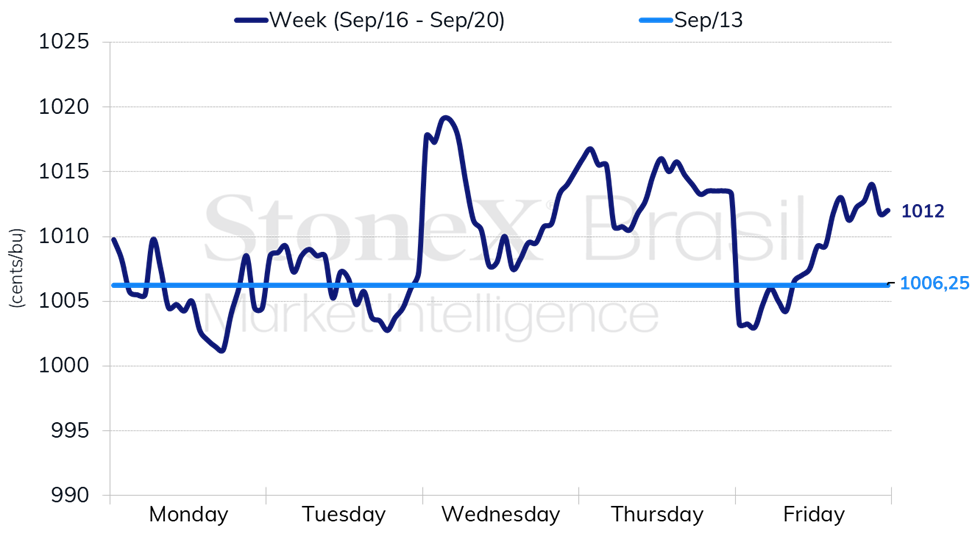
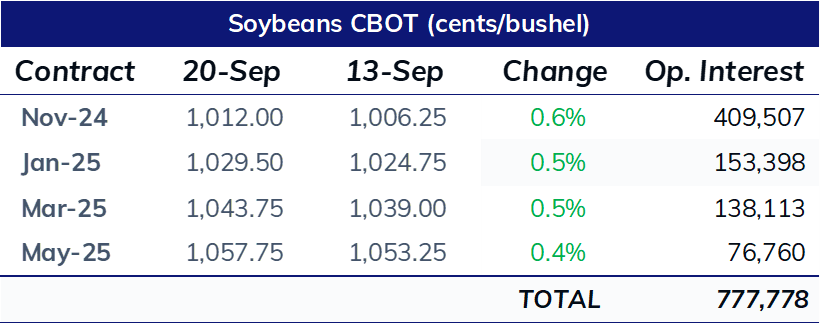
Soybean prices in Chicago saw a slight increase last week, though contracts remained above USD 10.00/bu. Favorable demand data and persistently dry weather in Brazil provided some price support, but the US harvest season exerted downward pressure due to expectations of a record crop for the 2024/25 cycle. The November contract closed on Friday (20) at 1012 cents per bushel.
Data from the National Oilseed Processors Association (NOPA), which represents 95% of the US crushing industry, revealed that 4.3 million tonnes of soybeans were crushed in August. This volume fell significantly below the average estimate of 4.67 million tonnes, a rare deviation from expectations. Simultaneously, soybean oil stocks saw a notable decline due to reduced crushing activity, standing at 615,000 tonnes at the end of August.
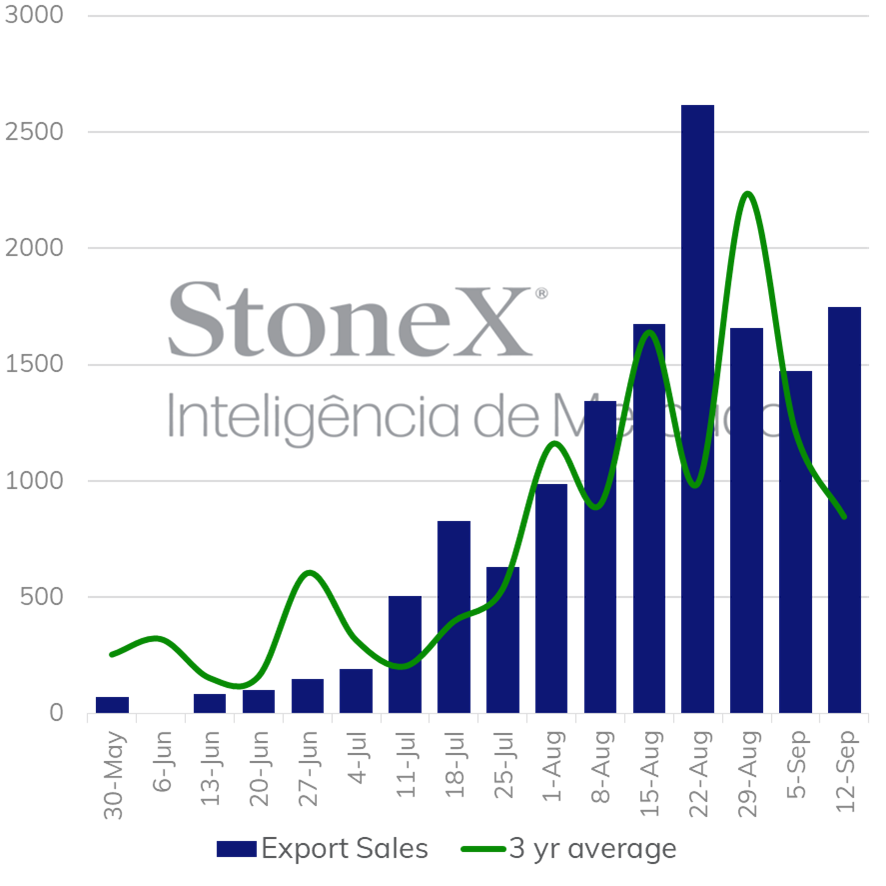
US export sales for the 24/25 crop year in the week ended on 12/09 reached 1.75 million tonnes, a volume above the top of estimates, which ranged from 500,000 to 1.6 million tonnes. Even so, in the accumulated total, the sales of the 24/25 crop are at 16 million tonnes, 1 million less than in the same period last year, remembering that the USDA estimate for American exports in the 24/25 cycle is above the previous crop, potentially reaching 50.35 million tonnes.
The last quarter of the year is the best period for shipments of North American soybean before the new crop enters Brazil, and the progress should be closely monitored, highlighting that export inspections indicate a delay of only 130 thousand tonnes compared to last year. In any case, Chinese demand is on the radar, after the country imported significant volumes of soybean in recent months, contributing to bolster its stocks. Additionally, it was reported a decline in the Chinese herd of pigs exceeded 5% in July of this year, compared to the same month of the previous year.
On the soybean oil front, it's worth noting that India, the world’s largest importer of vegetable oils, has increased its import tariff on vegetable and refined oils by 20 percentage points to protect local oilseed producers amid pressure from lower prices. As of September 14th, the total tax on crude palm, soybean, and sunflower oil rose from 5.5% to 27.5%, while the tax on refined oils increased from 13.75% to 35.75%.
In Brazil, soybean exports have slowed, reaching 3 million tonnes by September 13th. However, the accumulated exports since January stand at 86.5 million tonnes. At present, US soybeans are more competitive than Brazilian soybeans for the Chinese market, which is typical at this time of year as the US harvest begins. A point to watch is the water level of the Mississippi River, which improved following a recent hurricane, but will remain a key factor in the coming weeks and months.
The USDA reported that by the week ending September 15th, 6% of the 2024/25 US soybean crop had been harvested, surpassing last year's 4% and the five-year average of 3%. In the same week, the percentage of soybean crops rated as good/excellent dropped by 1 percentage point, down to 64%. This remains well above last year’s figure of 52% and the five-year average of 56%.
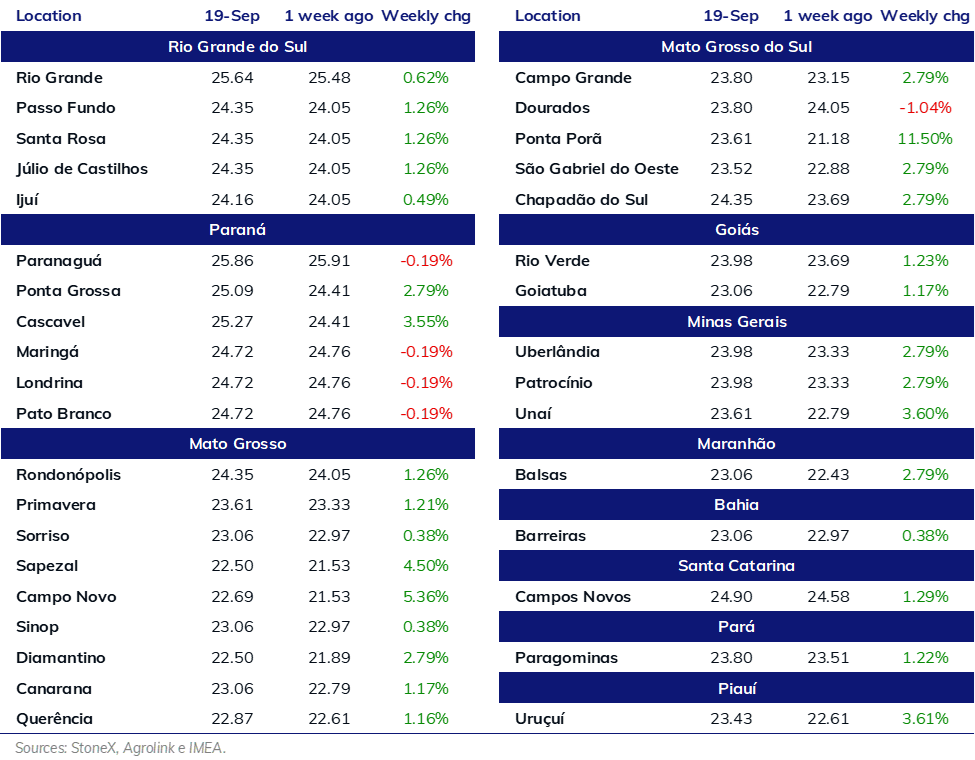
In Brazil, weather conditions remain hot and dry across most of the soybean-producing regions. Planting has already begun in Paraná, reaching 11% of the planned area by last Friday (20th), according to StoneX. In Mato Grosso, sowing has commenced on 0.3% of the total area. On average, Brazil's soybean planting stands at 1.5%. Based on current weather forecasts, the pace of planting is expected to pick up in October.
This week, alongside the crop progress report from the US, Brazil’s weather conditions will also be closely monitored, with forecasts predicting increased rainfall starting next weekend.