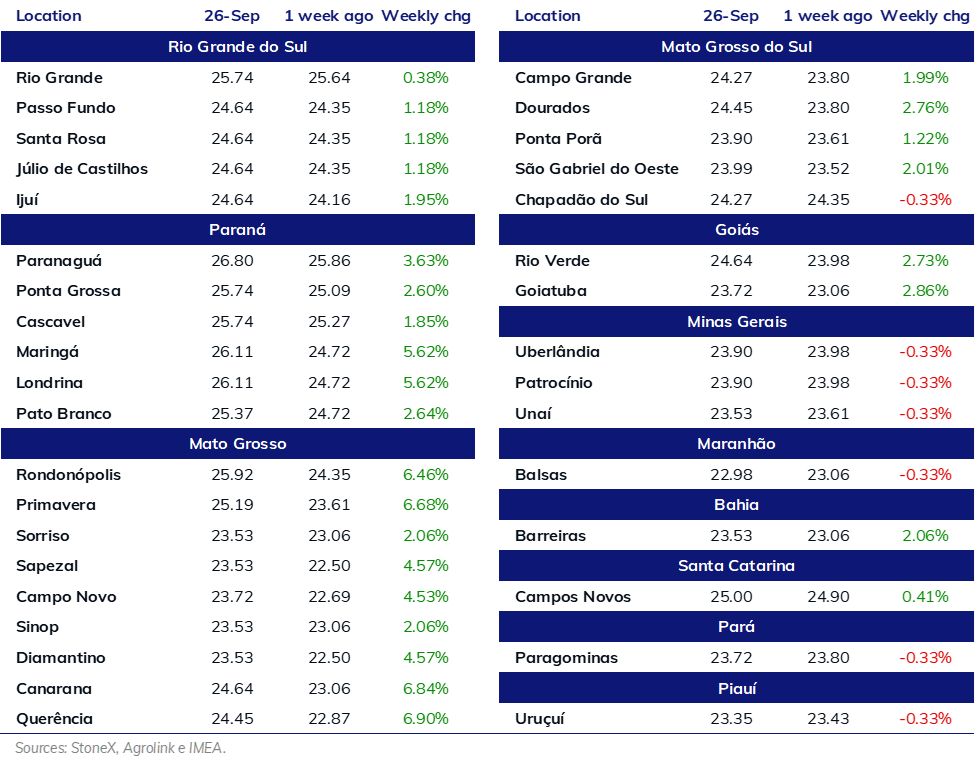
- Bearish Factors
- Global production in 24/25 widens the gap with consumption, according to USDA;
- USDA maintains record production estimate for the US;
- Concerns about the pace of global demand;
- StoneX estimates a record production for Brazil’s 24/25 crop;
- US harvest season;
- US cumulative export sales for the 24/25 season are lagging.
- Bullish Factors
- New incentive measures adopted by the Chinese government;
- Funds shortcovering;
- Conversion of plants to renewable diesel in California;
- US considers limiting imports of used cooking oil (UCO);
- Dry weather in Brazil delays the start of planting;
- Beginning of the Fed’s interest rate cut cycle.
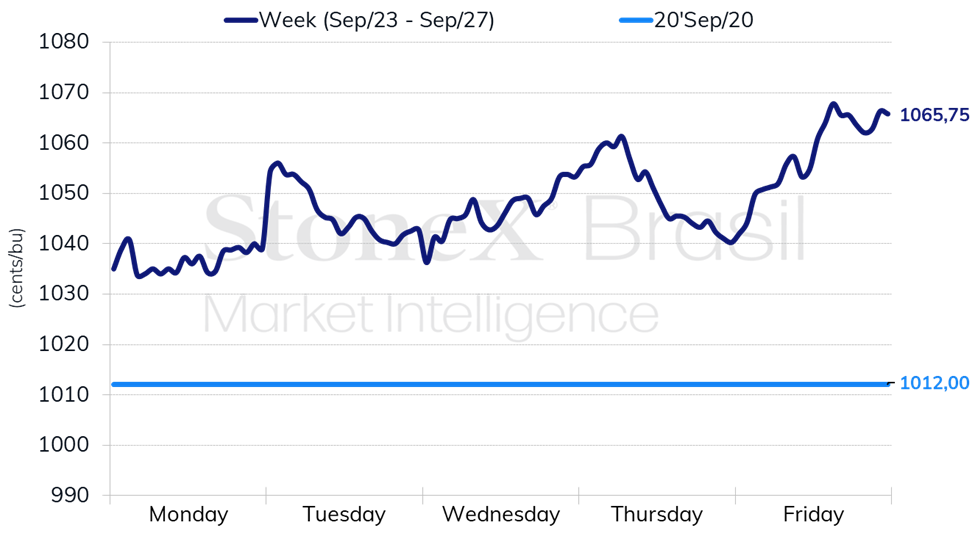
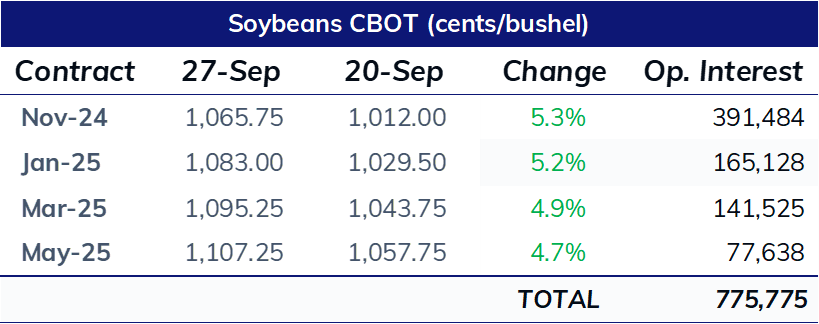
Soybean prices in Chicago registered a significant increase last week as speculative funds covered short positions. Weather in South America is on the radar and has created room for this movement, even though outlooks still point to a more relaxed global supply-demand balance. The November contract closed Friday’s session (27) at 1065.75 cents per bushel, up 5.3% for the week.
As previously noted, speculative funds had been carrying a significant net short position due to the lack of major supply threats, and demand not bringing any surprises either. However, with the focus shifting to South America, the weather here triggered this position adjustment. Conditions remain quite dry with high temperatures in much of Brazil's soybean-producing regions, with planting progressing in Paraná, while sowing is still sporadic in Mato Grosso. As of last Friday (27), 22% of Paraná's 24/25 soybeans had been planted, and only 0.5% in Mato Grosso. Nationally, 3% of the estimated area had been sown. This past weekend, scattered rains occurred in parts of the Center-West and Minas Gerais, while forecasts indicate that rainfall is expected to remain light over the next ten days, with heavier amounts concentrated in the southern part of the country.
Even though this movement by funds is happening, it is important to note that it is still too early to say that these delays will result in productivity losses or even a decrease in the soybean area in Brazil. There is still time to grow a crop within expectations, with producers being able to advance planting quickly once conditions permit. What might happen, apart from a potential delay in the entire soybean cycle, which complicates the scenario for the second crop, is a concentration of planting, increasing crop risks. A larger proportion of crops is planted over a short period, synchronizing their growth stages. This could result in more significant losses if there are weather issues during key development phases, such as grain filling.
In Argentina, it is still early, as soybean planting in the country is later, starting in the second half of October. Estimates indicate an increase in soybean planting area, taking space from corn, which suffered greatly in the 23/24 season due to the high incidence of corn leafhopper. The Buenos Aires Grain Exchange projects a soybean area of 19 million hectares, compared to the 17.3 million hectares sown in the 23/24 season.
In the US, the 24/25 crop harvest reached 13% of the total in the week ending 09/22, a level above the five-year average for the period, of 8%. Crop conditions remain very favorable, with the good/excellent percentage stable at 64%, compared to an average of 56%. Historically, this level of crop rating tends to be associated with above-average productivity, as indicated by estimates, with the US crop heading for a record.
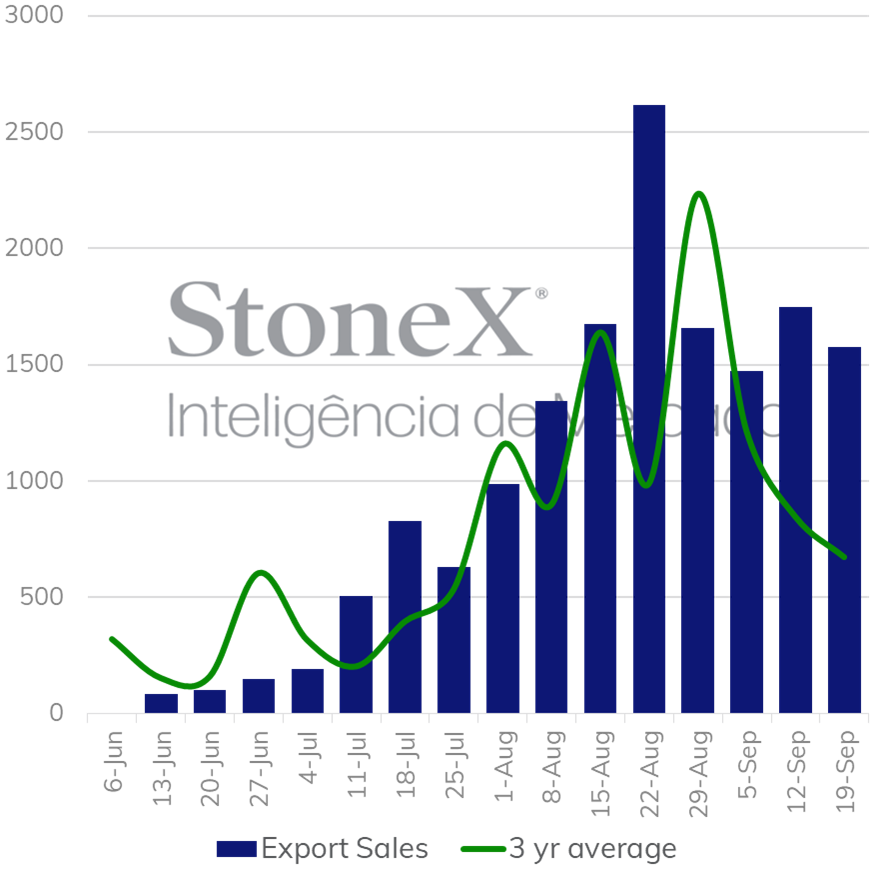
On the demand side, US export sales in the week ending 09/19 reached 1.57 million tonnes, within the range of estimates that ranged from 900,000 to 2 million tonnes. Cumulative sales for the 24/25 season stand at 12.9 million tonnes, 1 million less than in the same period last year. Notably, Chinese purchases are 650,000 tonnes weaker in the annual comparison.
In any case, the announcement of the largest stimulus package for the Chinese economy since the pandemic was well received by the market. The country's Central Bank indicated a significant monetary easing, with a reduction in short-term interest rates and bank reserve requirements, which dropped to their lowest level since 2018. It is estimated that the lower reserve requirement could inject USD 140 billion into the country's economy. Furthermore, the People's Bank of China indicated that further reserve requirement cuts could occur in the future, if necessary. There are also measures to stimulate the real estate market, including authorizing mortgage rate cuts and reducing the down payment required for home purchases. Regarding the animal protein sector, the Chinese government aims to adopt measures to increase its efficiency, avoiding supply excesses.
Given this scenario, possible positive impacts on the country's protein consumption should be on the radar in the coming months, with potential repercussions for soybean consumption and imports.
This week, attention should remain focused on the weather in South America, highlighting that StoneX Brazil will release its monthly crop update tomorrow (Tuesday). Today, in the early afternoon, the USDA will release the stock position for the 23/24 soybean crop, representing the cycle’s ending stocks. Estimates are close to what the USDA already estimates for final US stocks, at 9.25 million tonnes.