- Bearish Factors
- Global 24/25 production widens the gap compared to consumption, according to USDA;
- Record production estimate for the US;
- Concerns over the pace of global demand;
- StoneX estimates record production for Brazil's 24/25 crop;
- Harvest season in the US;
- More widespread and heavier rains in Brazil.
- Bullish Factors
- New incentive measures adopted by the Chinese government;
- Funds shortcovering;
- Conversion of plants to renewable diesel in California;
- The US is considering limiting the import of used cooking oil (UCO);
- The beginning of the Fed's interest rate cut cycle.
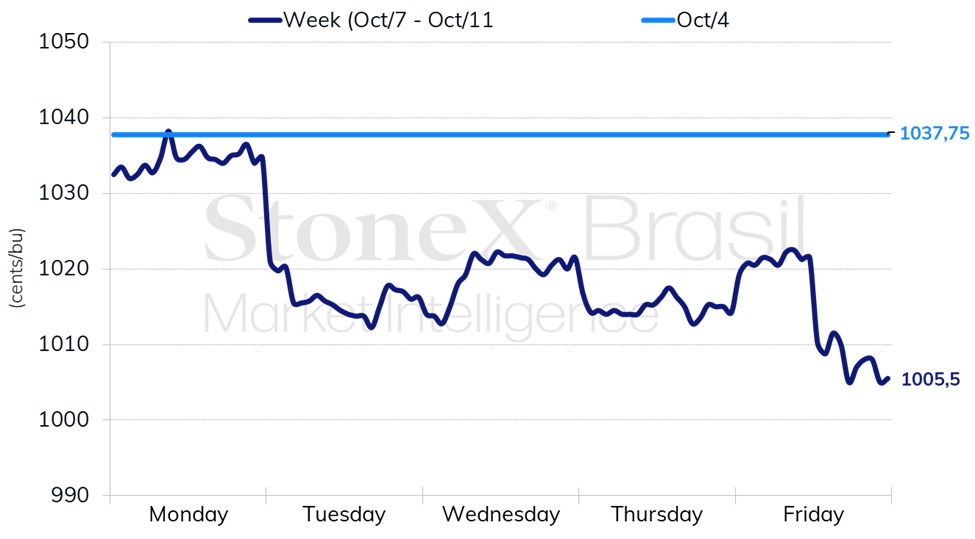
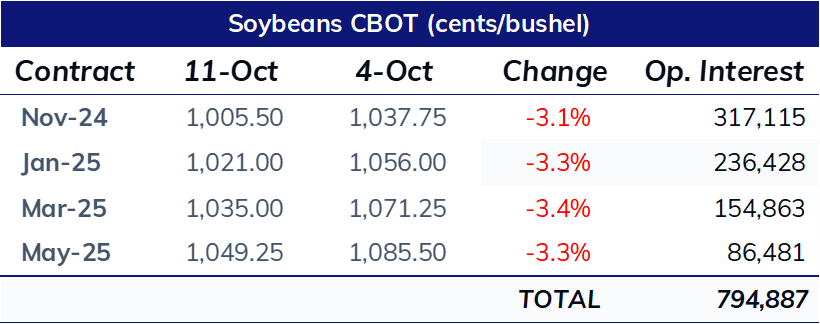
Soybean prices dropped in Chicago last week, with no significant changes on the fundamentals side and the occurrence of more substantial rains in Brazil. The November contract closed Friday's session (October 11) at 1005.5 cents per bushel, a weekly drop of 3.1%.
The US harvest continues to progress, favored by the drier weather that prevails across the country. Some areas in the eastern belt are being monitored for possible impacts of the drier pattern on pod filling. Even so, the outlook remains very positive, with 47% of the harvest completed as of October 6, above the five-year average of 34% and the 37% recorded in the same period of 2023. The good/excellent crop rating dropped slightly from 64% to 63% but remains well above the average for the period, which stands at 57%.
The USDA's monthly supply and demand report, released at the end of the week, brought a small adjustment to the 24/25 US crop, with the national average yield dropping from 3.58 to 3.57 tonnes per hectare, leading the expected production to register a marginal decline, falling from 124.8 to 124.7 million tonnes. Nevertheless, even with this change, production and yield would still be record-breaking.
As the US harvest increases the supply of soybeans in the market, the country’s exports will be increasingly on the radar. The last quarter of the year is the best period for US soybean shipments, and currently, the product from the US is more competitive in China compared to Brazil.
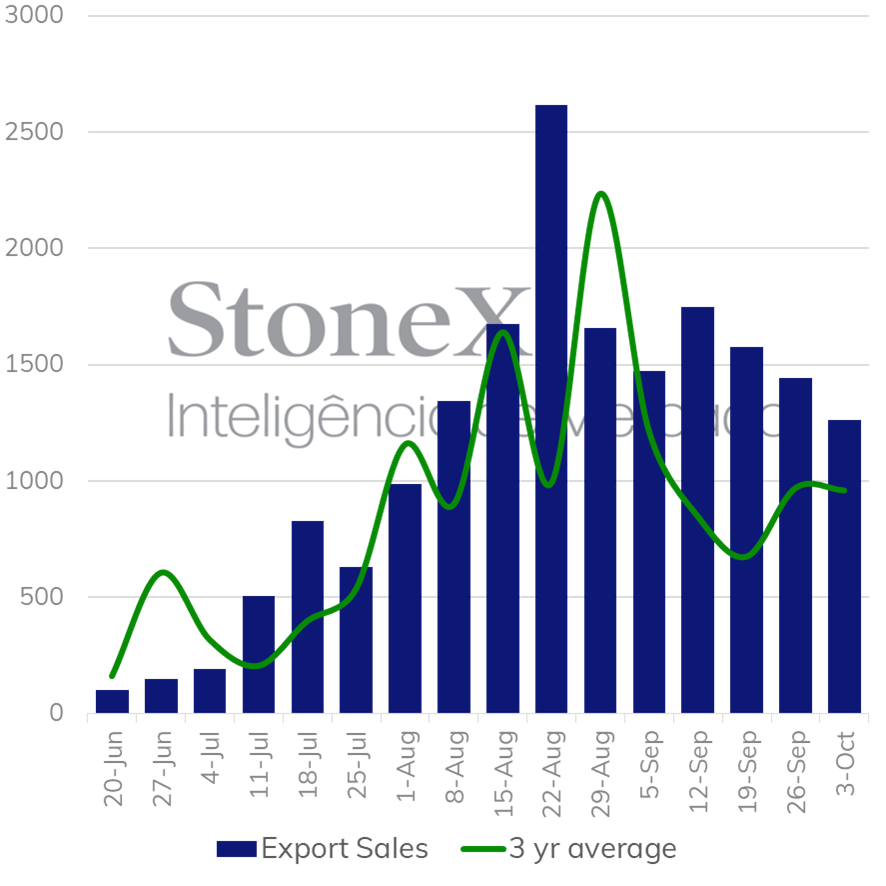
US export sales for the week ending October 3 reached 1.27 million tonnes, within the market expectations that ranged from 800 thousand to 1.7 million tonnes. Cumulatively, 20.1 million tonnes have been traded, above the 19.4 million recorded during the same period last year. Nevertheless, with the USDA estimating annual shipments to grow to 50.35 million tonnes, a little over 4 million above the previous cycle, the pace of negotiations needs to advance further, considering historical seasonality.
In Brazil, recent days have been rainier across much of the soybean-producing region, allowing for a more widespread start and progress of planting. On Friday (October 11), StoneX reported that 11.2% of the projected national area had been planted. The states in the Midwest are behind last year’s pace, while planting in Paraná was 44% complete, compared to 39% during the same week in 2023.
For next week, forecasts indicate the continuation of more widespread rains, which should allow the planting pace to pick up. It is worth noting that this initial delay, by itself, should not have a direct impact on production potential but may concentrate planting more, with a greater proportion of crops developing at the same stage. This increases the risk if any weather issues arise during crop development or excessive rains occur during the harvest, for instance.
On the demand side in Brazil, from January to the first week of October, 90.3 million tonnes of soybeans were exported, a very strong level but one that is expected to slow down in the coming weeks and months as grain availability this year has been somewhat limited due to weather issues affecting the 23/24 crop.
Soybean crushing in Brazil is expected to end the 23/24 cycle close to last year's level, around 54.5 million tonnes, despite the 2 percentage point increase in the mandatory biodiesel blending. With higher demand for soybean oil, the main raw material for biodiesel production, the main impact has been a reduction in oil exports, which has been redirected to the domestic market.
This coming week, in addition to the progress of the South American crop, which remains a focal point for the market, attention will be on the release of Conab's first monthly survey, which will include data on the 24/25 crop.