- Bearish factors
- Global production for 24/25 widening the gap compared to consumption, according to the USDA;
- Record production estimate for the US;
- Concerns over the pace of global demand;
- StoneX estimates record production for the 24/25 Brazilian crop;
- Harvest season in the US;
- More widespread and abundant rainfall in Brazil.
- Bullish factors
- New incentive measures adopted by the Chinese government;
- Funds covering short positions;
- Conversion of plants to renewable diesel in California;
- Strong soybean crushing in the US in September;
- The beginning of the Fed’s interest rate cut cycle.
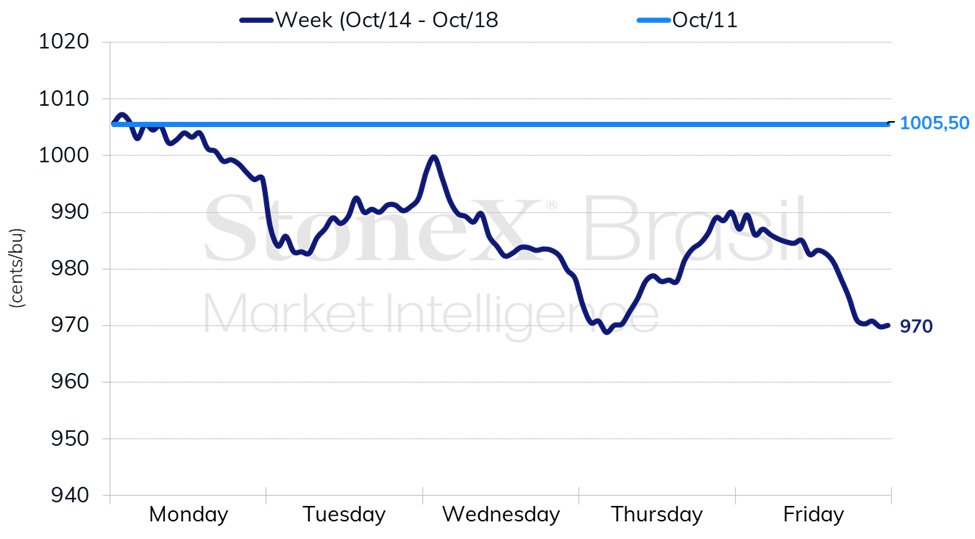
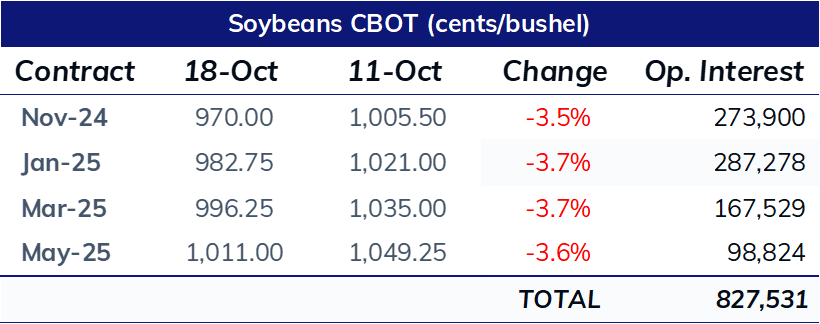
Soybean prices in Chicago continued to decline this week, with the November contract closing below USD 10.00 per bushel, at 970 cents, a drop of 3.5% over the period. Besides the harvest progress in the US, improved weather conditions in Brazil also contributed to selling pressure.
In the US, by October 13, 67% of the 24/25 crop had been harvested, heading towards a record, with USDA estimates at 124.7 million tonnes, while private estimates are even higher. Thus, no significant supply surprises are expected, with more focus likely shifting towards demand.
The National Oilseed Processors Association (NOPA) released the US soybean crush figures for September, which totaled 4.83 million tonnes, surpassing market estimates of 4.66 million. Expectations were more conservative after the weak results from the previous month, but it’s important to note that crushing margins are favorable, and the harvest is progressing, increasing grain availability.
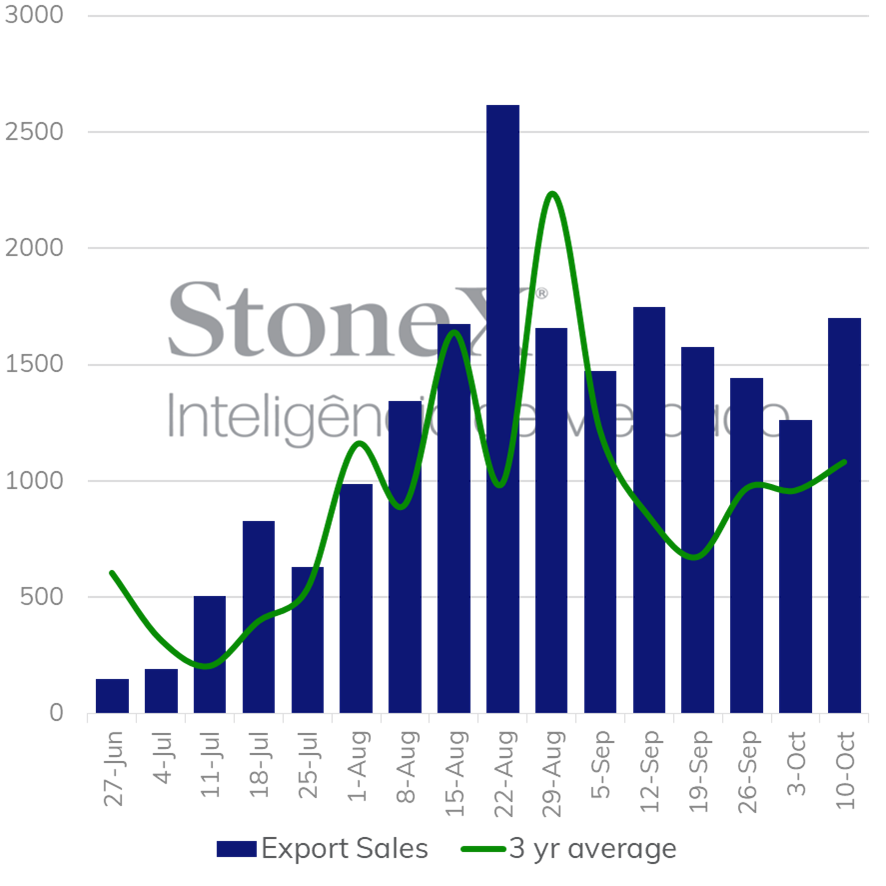
US exports have also posted strong results in recent reports. For the week ending October 10, 1.7 million tonnes of the 24/25 crop were sold, a volume higher than the same week last year. In total, 24/25 crop sales reached 21.8 million tonnes, compared to 20.8 million tonnes in the previous year, but it’s important to note that the USDA projects an annual export growth of 4.1 million tonnes. Therefore, cumulative sales are still behind the pace needed to reach the USDA export estimate of 50.35 million tonnes. It is worth noting that Chinese purchases are 800 thousand tonnes weaker than last year, with the upcoming months being crucial as they represent the peak period for US exports.
Monitoring Mississippi River levels in the US remains critical, as they are already impacting the competitiveness of shipments from the Gulf, while exports through the Pacific Northwest ports are quite strong. In any case, US soybeans remain more competitive for China than Brazilian soybeans, which is typical for this time of year, given the offseason in Brazil. Another key point is Chinese purchasing behavior, regardless of soybean origin. China imported 11.37 million tonnes in September, following a record 12.14 million tonnes in August, according to official customs data. These results brought the 23/24 marketing year total (October 2023 to September 2024) to 104.8 million tonnes, an annual record, fueling speculation about potential increase in stocks, which could impact future imports.
In Brazil, after the return of more widespread and heavier rains, soybean planting is progressing rapidly, with StoneX monitoring indicating that 23.2% of the national area was seeded by Friday (October 18), a 12 percentage point increase in just seven days. Although it is still behind the usual pace for this period, producers are expected to continue planting quickly, alleviating concerns over potential negative impacts on crops or even area losses.
Regarding area, it is worth noting that Conab released its first survey for Brazil’s 24/25 crop, showing a 2.8% increase in soybean planted area to 47.33 million hectares, the smallest increase in six years due to less favorable prices for farmers. With expected weather conditions, Conab projects a record production of 166 million tonnes, a level in line with other market estimates.
Weather forecasts for the next two weeks continue to point to higher rainfall across almost the entire soybean-producing region, which should support continued planting efforts and further reduce delays.
In Argentina, planting is about to begin, as the soybean cycle starts later there, more aligned with the planting calendar in Rio Grande do Sul, Brazil. Forecasts also point to favorable rainfall for the country, which should facilitate soybean planting. As previously mentioned, expectations indicate an increase in planted area to 19 million hectares, according to the Buenos Aires Grain Exchange, with this growth occurring primarily in regions previously dedicated to corn, which suffered from a widespread pest infestation during the 23/24 cycle.
This week, attention will remain heavily focused on weather conditions, both in South America, where the crop is just beginning, and in the US, due to Mississippi River levels. In addition, demand data will also be closely monitored.