- Bearish Factors
- Global production for 24/25 outpaces consumption, according to USDA;
- Record production estimate for the US;
- Concerns about the pace of global demand;
- StoneX raises record production estimate for Brazilian crop 24/25;
- Harvest season in the US;
- More widespread rains with good volumes in Brazil and Argentina.
- Bullish Factors
- New incentive measures adopted by the Chinese government;
- Speculative funds with net short positions;
- Robust renewable diesel production and consumption in the US;
- Strong crushing activity in the US in September;
- Fed’s interest rate cut cycle begins.
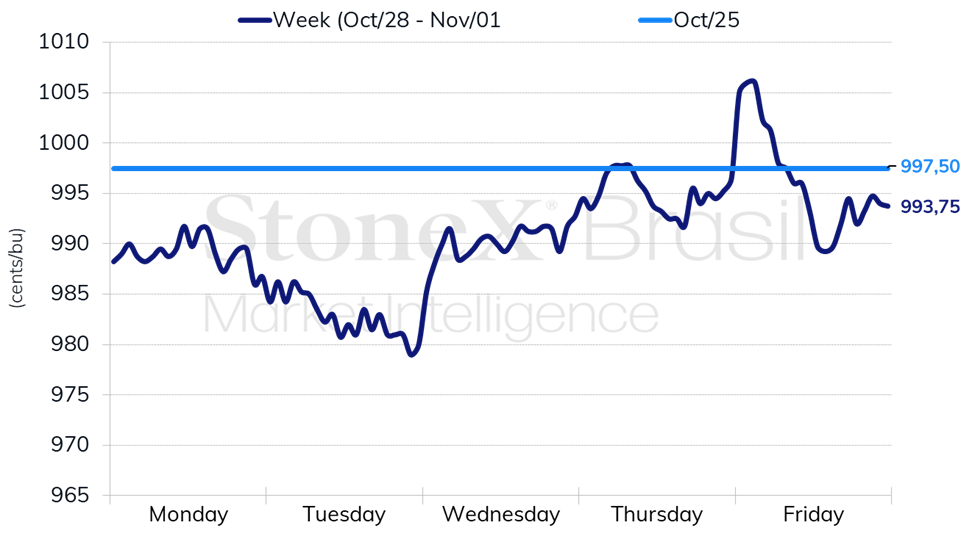
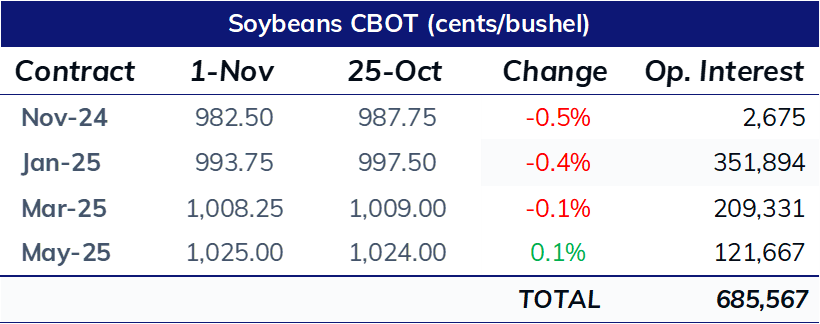
Last week, soybean prices in Chicago fluctuated and closed on Friday (1) at 993.75 cents per bushel, a slight drop of 0.4% for the period. There were no major new developments on fundamentals, with the US harvest progressing and solid expectations for the Brazilian crop remaining stable.
By October 27, the US soybean harvest for 24/25 was 89% complete, compared to 82% at the same time last year and an average of 78%, increasing domestic availability, with demand expected to be the focal point in the coming months for both crushing and exports.
US domestic soybean consumption is heavily tied to the biofuels sector, particularly with the expansion of renewable diesel capacity in recent years, which has also driven the need for increased soybean crushing capacity. Soybean oil consumption for biodiesel and HVO in the US saw its second-best performance of the year in August. Furthermore, HVO/renewable diesel consumption in the country remains on an upward trend. This positive scenario for soybean oil prices, despite uncertainties over US biofuel policy amid upcoming presidential elections, supports vegetable oil prices.
Fonte: CME. Elaboração: StoneX.
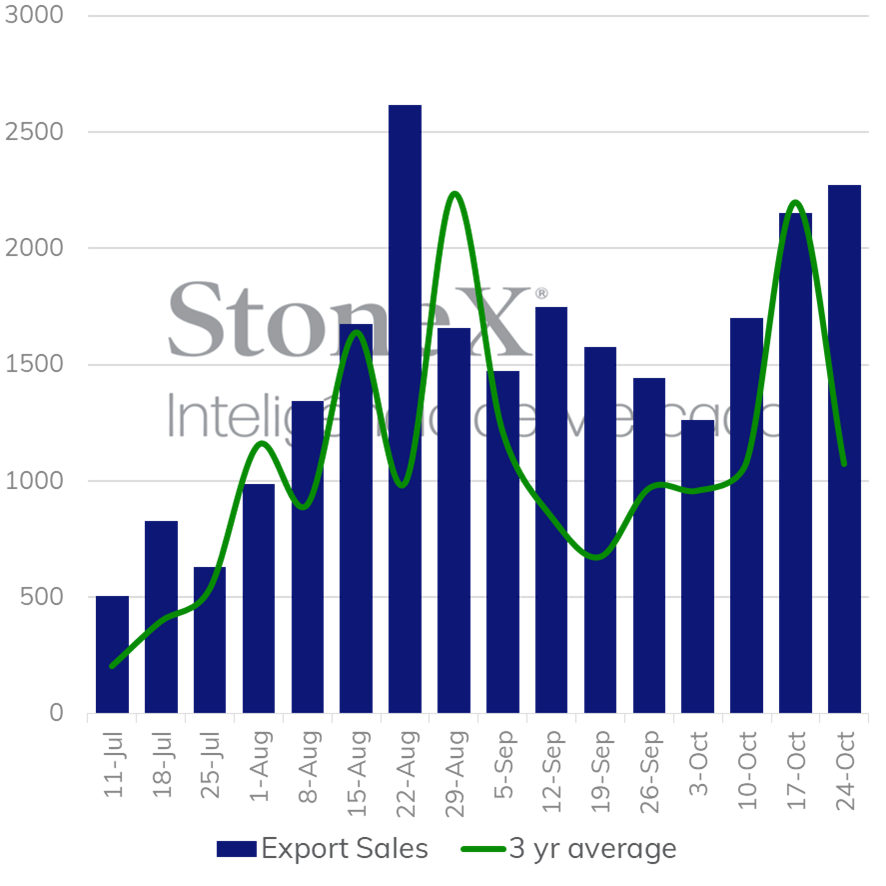
US export sales for the week ending November 24 reached 2.27 million tonnes, within the market estimate range of 1.6 to 2.8 million tonnes. While accumulated sales to China are about 1 million tonnes below last year's levels, transactions with other destinations are about 4 million tonnes higher. Thus, the US soybean trading pace for 24/25 is aligning more closely with USDA’s export estimate of 50.35 million tonnes.
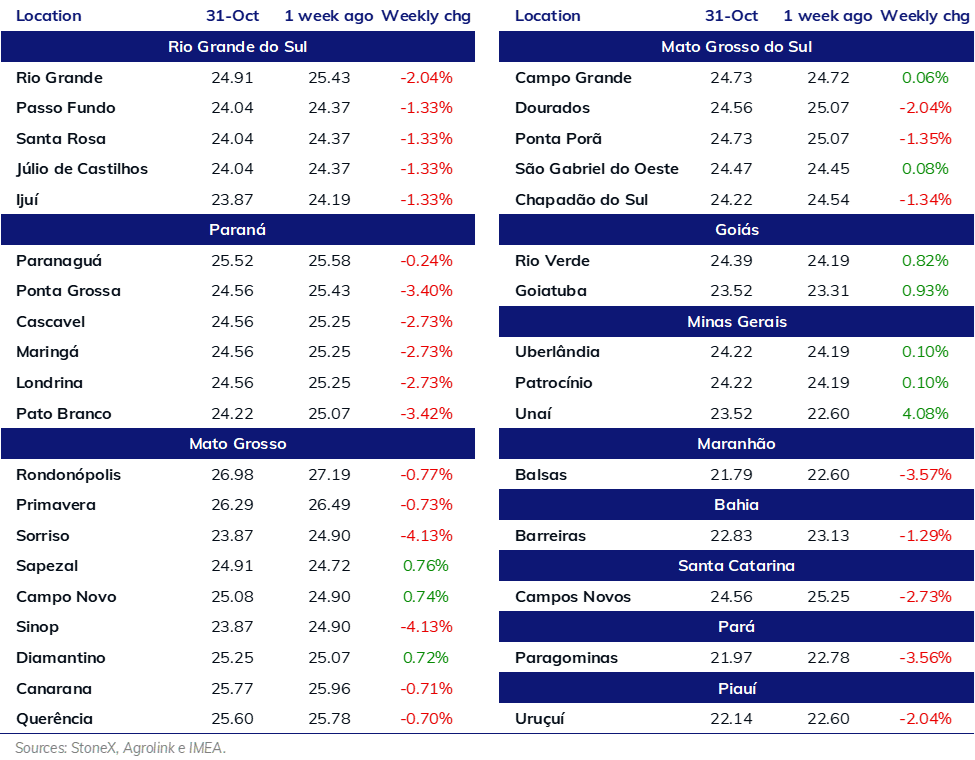
In Brazil, the continued rainfall across nearly the entire country has enabled uninterrupted planting, with the national average reaching 56.9% as of last Friday (1), surpassing last year’s 50.7%, according to StoneX. Early delays due to very dry weather until early October seem to have been overcome. This rapid planting progress increases the concentration of crops at a similar development stage, thereby elevating the risk associated with weather factors. However, if the weather remains favorable, there is potential for a record crop.
Estimates continue to support this scenario, with StoneX revising the 24/25 cycle forecast upward to 166.2 million tonnes, a 0.7% increase over the previous figure. Highlights include a positive revision in planted area, from 46.5 to 46.75 million hectares, reflecting an annual growth of 1.3%. The national average productivity remained stable at 3.55 tonnes per hectare, although positive revisions were made for some states, like Paraná.
Despite this favorable supply context, which limits stronger soybean gains, the exchange rate with a strong dollar supports national competitiveness. Currently, during Brazil’s inter-crop, US soybeans maintain a competitive edge, but it’s worth noting that the co-products of the oilseed, meal and oil, are also closely watched by the markets.
Brazilian soybean exports have been slowing, with ANEC (Brazilian Association of Grain Exporters) predicting a volume of 4.58 million tonnes in October, following a few months of strong activity. Meanwhile, soybean oil prices and premiums have strengthened, also favored by the devaluation of the Brazilian real against the dollar. However, despite the higher dollar benefiting the competitiveness of Brazilian products, it's important to note that the mandatory biodiesel blend in diesel increased by 2 p.p. this year, reducing the surplus available for export.
In Argentina, soybean planting has begun, reaching 3.3% of the estimated 19 million hectares, according to the Buenos Aires Grain Exchange. Recent rains have been quite favorable for the country's productive area, allowing the soybean cycle to start under good conditions.
This week, USDA will update its monthly supply and demand report on Friday (8). Additionally, the forecast for the next two weeks continues to indicate widespread and ample rainfall for Brazil and Argentina, which should benefit soil moisture and initial crop development.