- Bearish Factors
- Global 24/25 production significantly exceeding consumption, per USDA;
- S&D balance still comfortable in the US;
- Concerns about the pace of global demand;
- StoneX raises record production estimate for Brazilian 24/25 crop;
- Accelerated planting in Brazil;
- Favorable weather in South America.
- Bullish Factors
- New incentive measures adopted by the Chinese government;
- Short-covering by speculative funds;
- Strong renewable diesel production and consumption in the US;
- US production estimate cut, already below record levels.
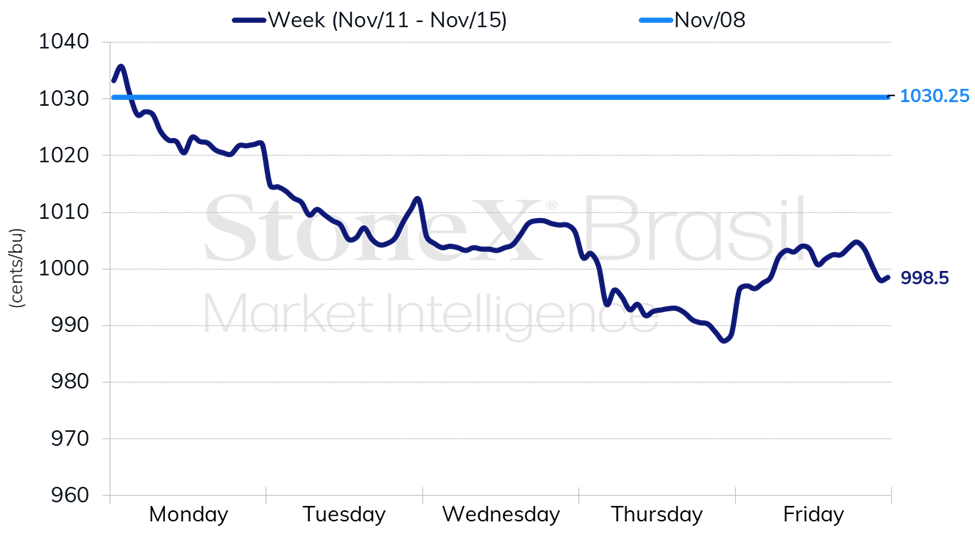
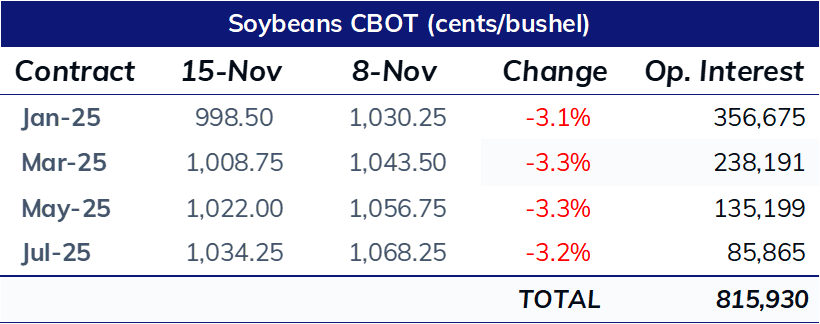
Last week, bearish trends prevailed for soybeans in Chicago, with prices dropping until Thursday (14th). Even Friday's (15th) higher close couldn't offset the predominantly bearish sentiment in the market, driven by perspectives of a still-loose US balance and doubts surrounding the country's biofuels program. The January contract ended Friday at 998.5 cents per bushel, marking a weekly decline of 3.1%.
After the USDA surprised with a cut in the 24/25 US crop estimate to 121.4 million tonnes, below market expectations, investors absorbed the new numbers, maintaining a still-comfortable scenario for the country, while the global balance continues to indicate production significantly above consumption. As a result, post-report gains did not hold, and the market returned to facing this more comfortable scenario for soybeans, at least for now, as the South American crop is just beginning.
Additionally, uncertainties about the new US biofuel incentive program, the 45Z, which will replace the Blenders' Tax Credit (BTC) starting in 2025, persist. The total credit volume and the amounts allocated to biofuels derived from each raw material have yet to be defined. Furthermore, a government transition in the US raises doubts about support for biofuels. It was announced that Republican Lee Zeldin will head the Environmental Protection Agency (EPA) under the Trump administration, with Zeldin having a history of voting against environmental resolutions. On the other hand, a bipartisan proposal is underway in the US Senate to exclude imported raw materials from a new subsidy, which would favor domestic soybean oil.
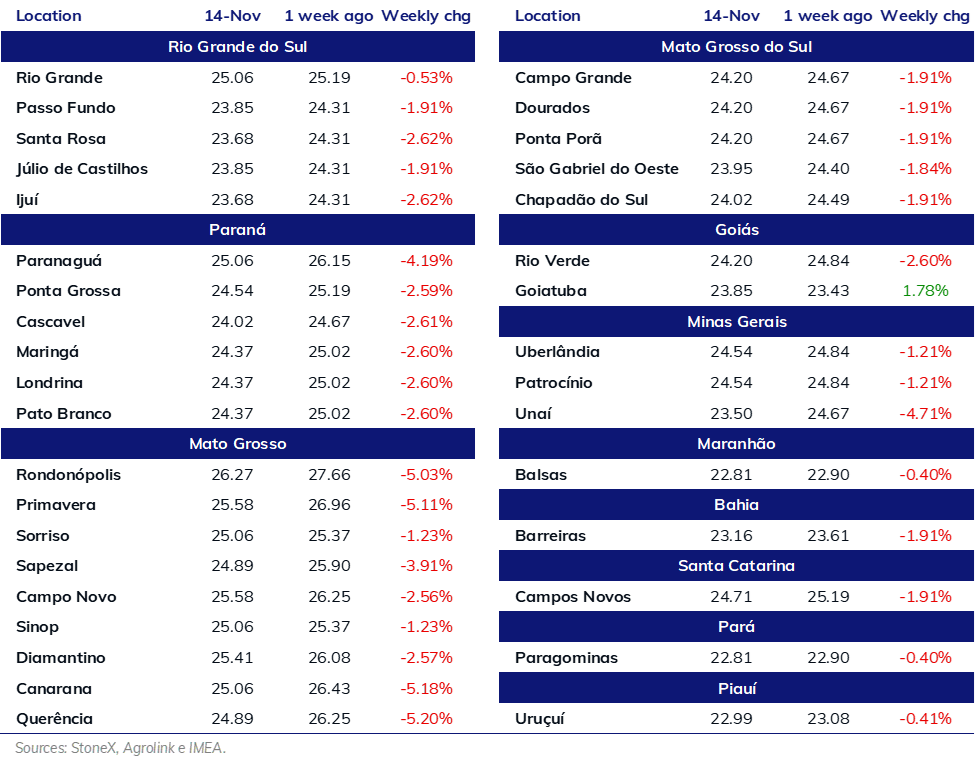
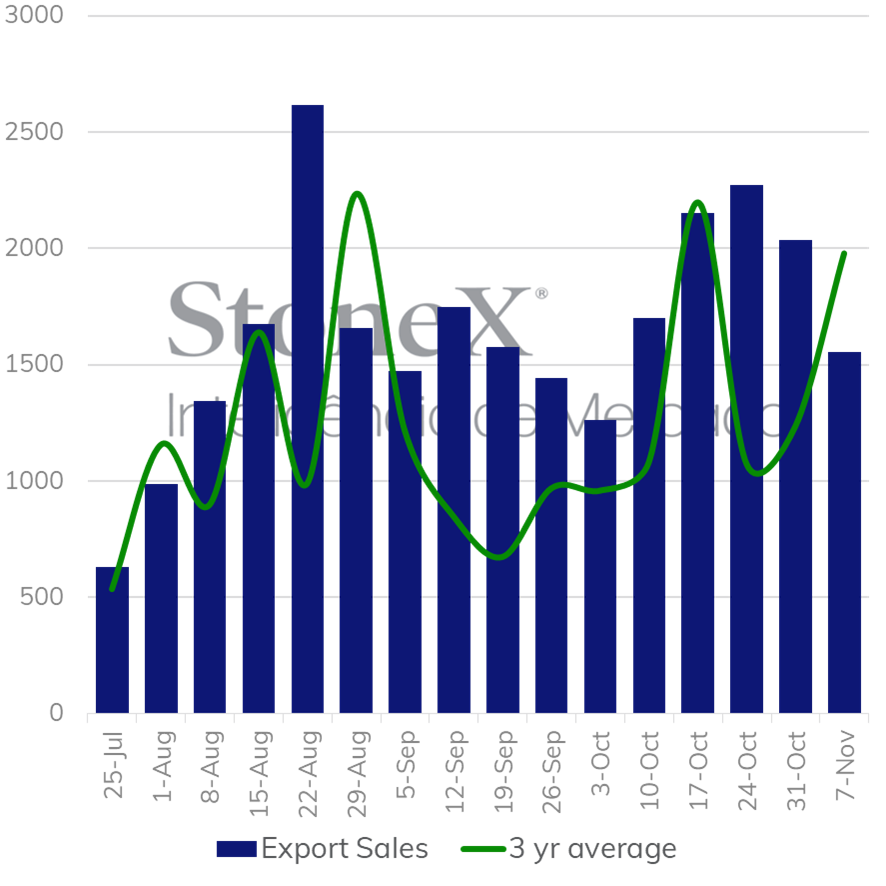
Regarding US exports, 1.56 million tonnes of 24/25 soybeans were sold in the week ending November 7, within the estimate range of 1 to 2.2 million tonnes. China accounted for 1.18 million tonnes, but total sales to the country are 1.8 million tonnes behind the same period last year, while sales to other destinations are 3.6 million tonnes ahead.
In Brazil, Conab updated its crop survey, slightly raising the expected production for the 24/25 crop to 166.14 million tonnes, a figure in line with other private consultancies like StoneX, which estimates 166.2 million tonnes. After initial delays, 24/25 soybean planting has accelerated, with the national average reaching 79.3% last week, over 10 p.p. higher than the 65.6% registered at the same time in 2023. Weather forecasts indicate rain in most parts of the country over the next two weeks, a positive scenario for crop development.
In Argentina, weather conditions are also favorable, with soybean planting reaching 20.1% of the projected 18.6 million hectares for the 24/25 cycle, according to the Buenos Aires Grain Exchange.
On the demand side, Brazil exported 95.3 million tonnes of soybeans between January and November 8, a very active volume. With less than two months remaining in the 23/24 crop year, soybean shipments are expected to fall just short of last year's record of 101.9 million tonnes.
This week, South American crop progress should remain on the radar, especially in terms of weather conditions. Additionally, new US demand data will be monitored, as despite the cut in the 24/25 crop estimate, the country's projected balance remains quite comfortable.