- Bearish Factors
- Global production for 24/25 considerably above consumption, according to USDA;
- U.S. supply and demand balance remains comfortable;
- Concerns over global demand pace;
- StoneX raises record production estimate for the Brazilian 24/25 crop;
- Accelerated planting in Brazil;
- Favorable weather in South America.
- Bullish Factors
- New incentive measures adopted by the Chinese government;
- Speculative fund short-covering;
- Strong renewable diesel production and consumption in the U.S.;
- Reduction in U.S. production estimates, which were not record levels to begin with.
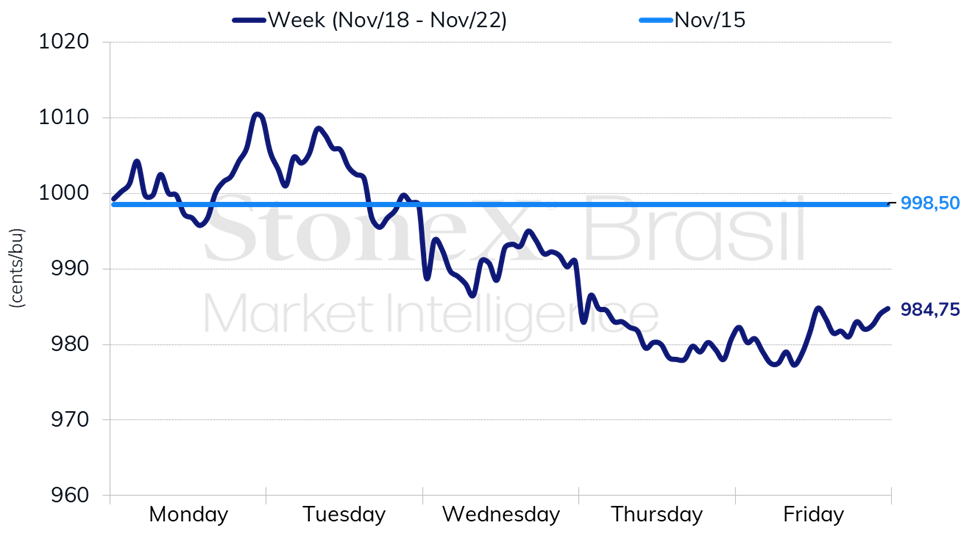
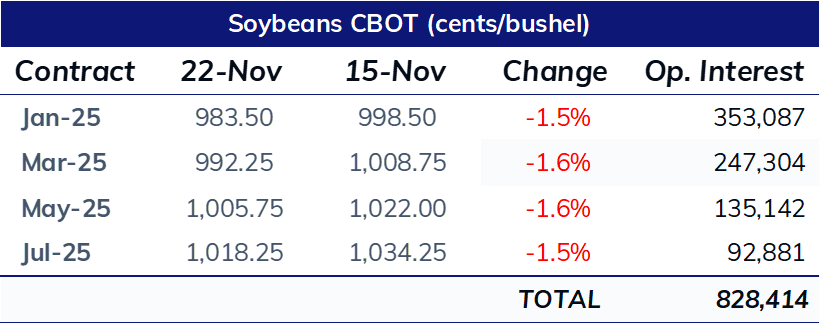
Last week, Chicago soybean prices ended slightly lower, despite speculative funds covering short positions on Monday (18). The January contract closed Friday (22) at 983.5 cents per bushel, down 1.5% over the period. Good crop progress in South America, along with doubts regarding U.S. biofuel policies, continued to weigh on prices.
In recent years, the U.S. has invested in renewable diesel production, whose main feedstock is soybean oil, also encouraging the expansion of domestic crushing capacity. However, next year’s government transition, with Donald Trump's election, has raised questions about the future of U.S. biofuel policies. The incoming Trump administration's team includes individuals with diverging views on biofuels, and there are incentives expiring in 2027 that need renewal to provide greater certainty for the renewable segment and sustain crushing investments.
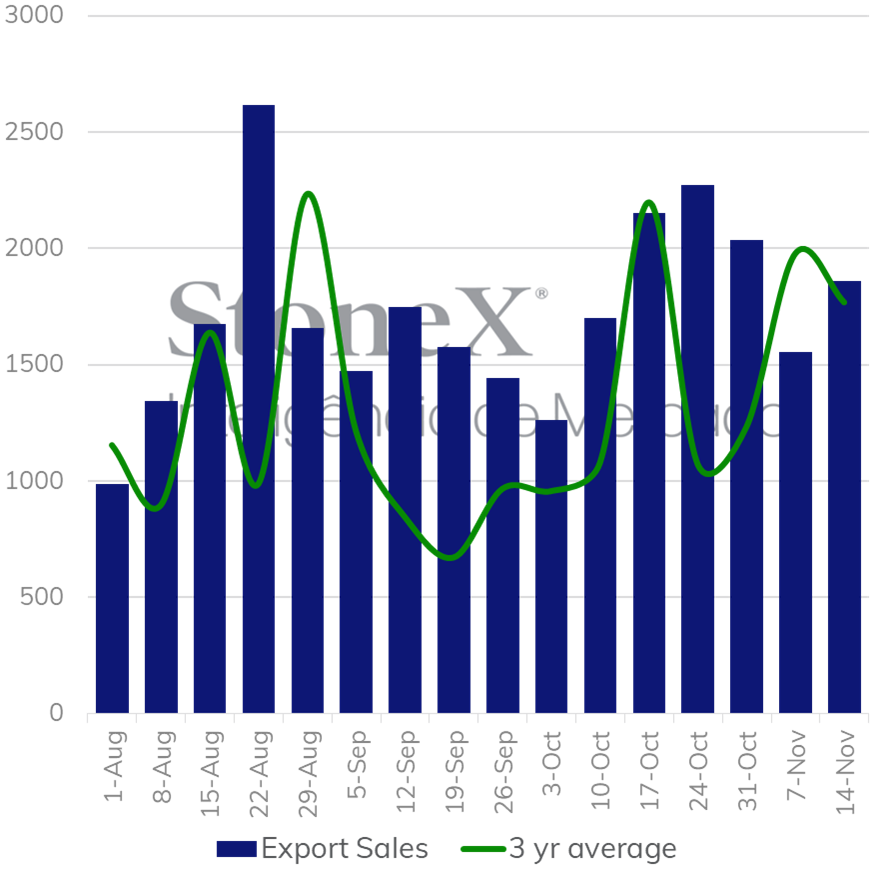
As for U.S. exports, during the week ending 11/14, 1.86 million tonnes of soybeans from the 24/25 crop were negotiated, exceeding the estimates ranging from 1 to 1.6 million tonnes. The cumulative total reached 31.6 million tonnes, consistent with USDA's export forecast. Sales to China remain weaker than last year by 1.4 million tonnes, although sales to other countries are ahead, pushing the overall total 2.6 million tonnes above last year’s pace.
Nevertheless, the market continues to monitor the Chinese economy. Despite recently announced government stimulus measures, there are concerns over China's growth trajectory and its impact on the protein segment, and consequently, the animal feed sector.
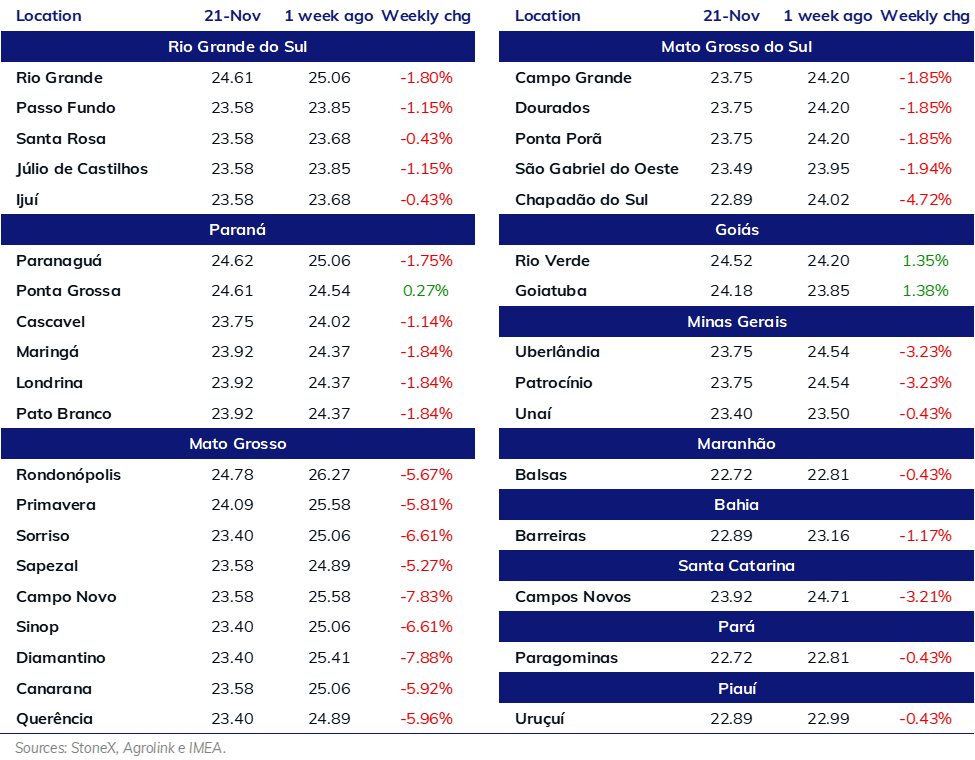
In Brazil, soybean planting for the 24/25 crop reached 88% of the total as of Friday (22), significantly higher than the 73.7% seen at the same time last year, according to StoneX. Favorable weather continues to help after initial delays caused by late rains.
In Argentina, planting also progressed rapidly, covering 36% of the estimated area as of Wednesday (20), a 20 percentage point increase within a week.
Weather conditions remain favorable in South America's production areas, with significant rainfall across most agricultural zones and forecasts predicting continued precipitation over the next two weeks.
On the demand side, Brazilian soybean exports are losing momentum, reaching 1.48 million tonnes by November 14th, with monthly shipments expected to fall below 3 million tonnes—lower than the 5.2 million tonnes exported in November 2023. Still, since January, Brazilian soybean exports have totaled 95.8 million tonnes, a strong performance given the smaller 23/24 crop.
In Argentina, soybean meal exports remain robust, with the country regaining its position as the world’s largest exporter of this soybean derivative. Last year, due to severe crop losses in Argentina, Brazil held the top spot in soybean meal exports, aided by its growing crushing capacity. However, Argentina's soybean industry is primarily focused on processing soybeans into derivatives, while Brazil concentrates its exports on raw soybeans.
This week, market attention will remain on South America's crop progress and new demand data, as the final quarter is the peak period for U.S. soybean exports.