- Bearish Factors
- Global production for 24/25 significantly above consumption, according to the USDA;
- Comfortable S&D balance in the US;
- Concerns about the pace of global demand;
- Record production estimates for the 24/25 Brazilian crop;
- Accelerated planting in Brazil;
- Favorable weather in South America;
- Uncertainty about biofuel subsidies in the US.
- Bullish Factors
- New incentive measures adopted by the Chinese government;
- Speculative fund short covering;
- Increased renewable diesel production and consumption in the US;
- Cut in US production estimates, which were already below record levels.
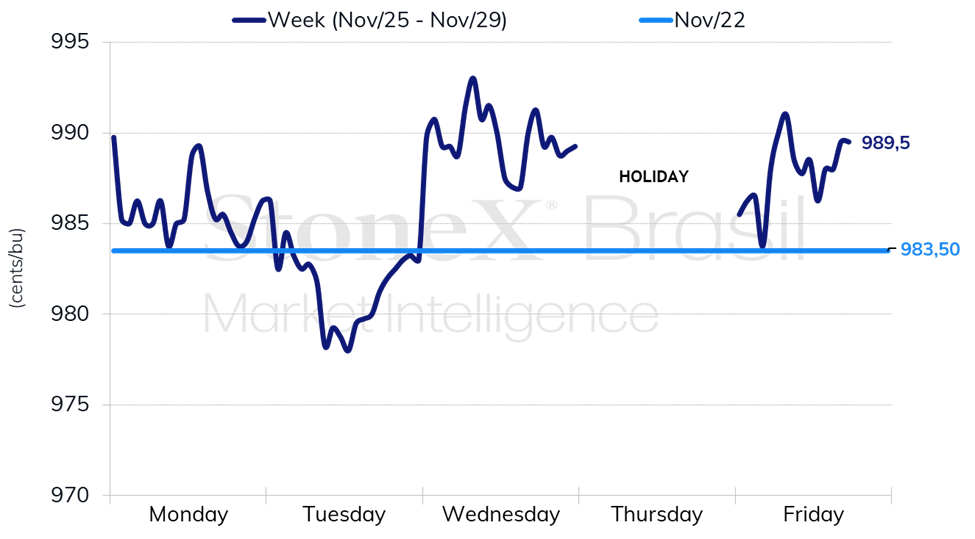
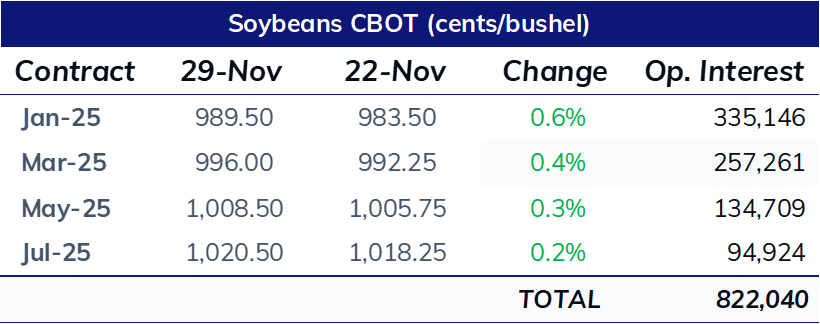
Soybean prices in Chicago ended the previous week with a slight increase, but overall fluctuation during the period was limited. Moreover, the Thanksgiving holiday on 11/28 resulted in lower trading volumes. The January contract closed on Friday (11/29) at 989.5 cents per bushel, a 0.6% drop.
The soybean market continues to face prospects of a looser global balance, with 24/25 production estimates significantly exceeding consumption. Even with a reduction in US production in the last USDA report, the country's balance remains comfortable.
In South America, soybean production prospects also remain positive, with record crop estimates in Brazil. Weather conditions here are being monitored, with slightly lower humidity recorded in southern Brazil recently, but heavier rains have already returned, alleviating concerns.
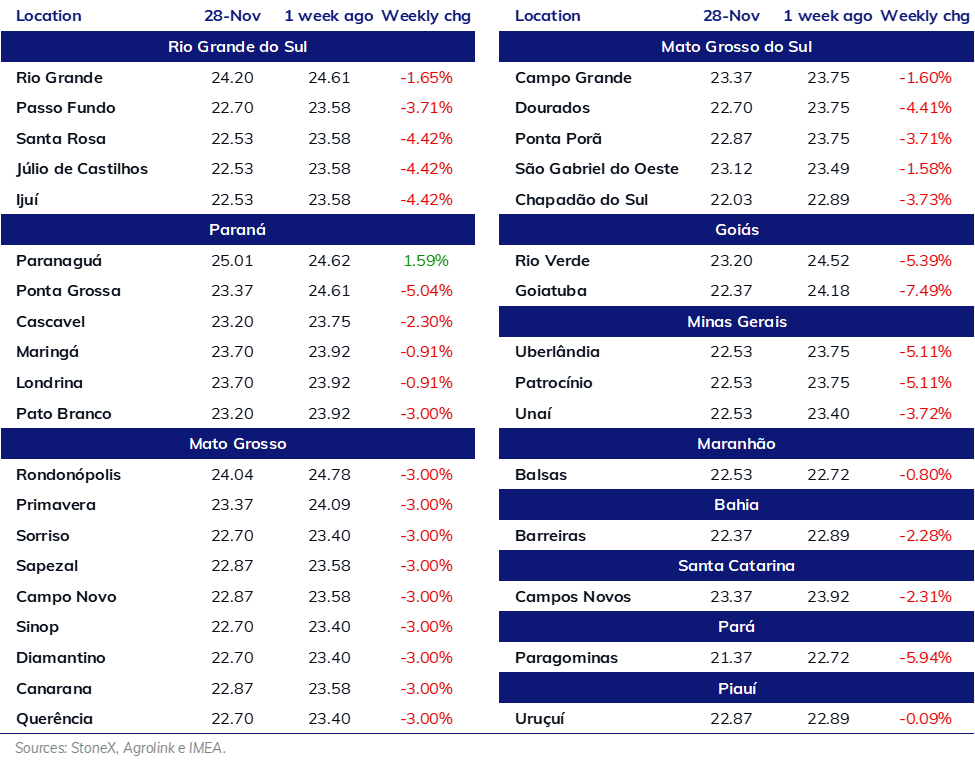
The planting of the 24/25 soybean crop is nearing completion. According to StoneX tracking, as of Friday (11/29), 92.4% of soybeans had been sown, 10 percentage points higher than the same period last year. Some states, such as Mato Grosso and Paraná, have already finished planting. Although the outlook remains positive, weather will remain on the radar in the coming weeks and months, as the grain filling period is critical for determining productivity. Additionally, during the harvest, which should be in full swing between mid-January and early February, there is a risk of excessive rains that could harm maturation and the harvest itself, leading to losses.
In Argentina, the planting of the 24/25 soybean crop reached 44.4% of the total area on Wednesday (11/27), according to the Buenos Aires Grain Exchange, an 8.6 percentage point weekly advance. As in Brazil, rains, even if delayed, have remained abundant, ensuring good crop conditions, with 97% classified as normal or excellent.
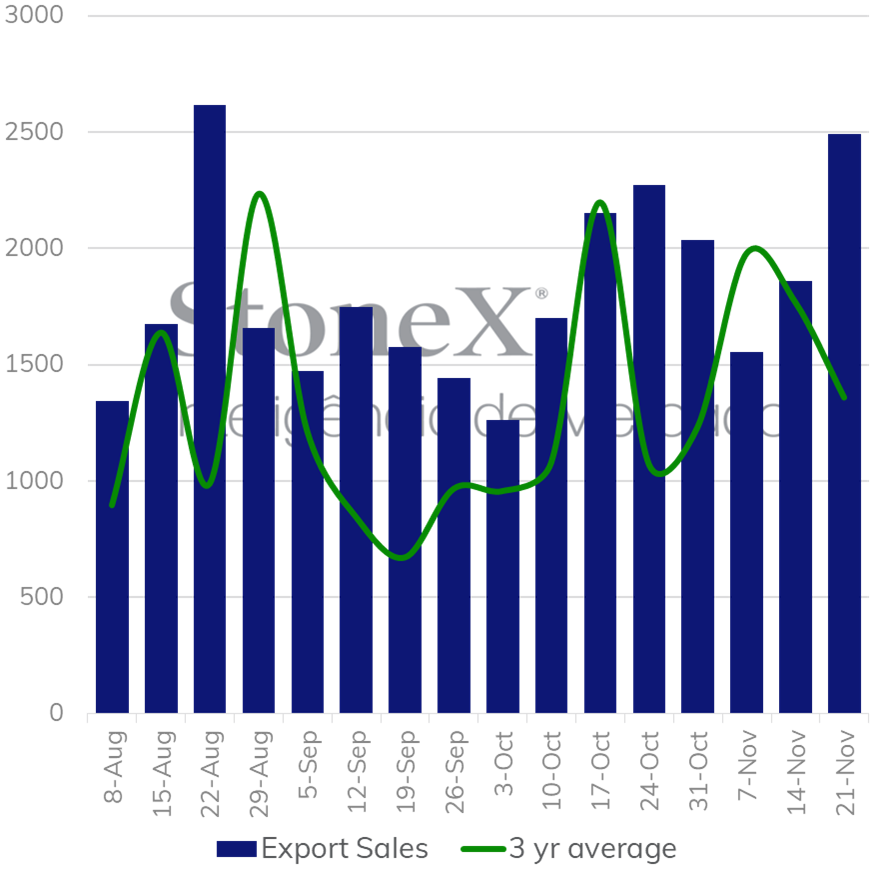
On the demand side, in the week ending 11/28, US export sales reached 2.49 million tonnes, a volume above the top of the estimates, which ranged from 1.5 to 2.4 million tonnes. Accumulated sales totaled 33.9 million tonnes of soybeans for the 24/25 crop year.
The market is also watching announcements related to potential tariffs that may be implemented by the Trump administration starting next year. Donald Trump stated on social media that he would raise import tariffs on Mexico and Canada by 25% and add an additional 10% to any tariffs on products from China. There is significant uncertainty about the potential demand for US soybean oil, which could be affected by the taxation of Canadian canola, potentially favoring demand for soybean derivatives. On the other hand, there is much uncertainty regarding the biofuel credit program in the US, with rumors that renewable diesel producers might be scaling back planned production for early 2025 due to doubts about subsidies.
Concerning potential US tariffs, if there is Chinese retaliation affecting soybeans, demand for Brazilian soybeans could increase further, causing a rearrangement of global grain flows. China would displace other buyers of Brazilian soybeans, who, in turn, would need to source the product from the US. Additionally, it should be noted that China currently holds a more comfortable soybean stock situation, which serves as a precaution in case of a trade war next year.
In Brazil, biodiesel production has remained robust, with the accumulated total between January and October reaching 7.55 million m³, already surpassing the total for 2023, which was 7.52 million m³. The mandatory blend increased by 2 percentage points, from B12 to B14. Production in October reached 846.6 thousand m³, a monthly record.
The trend is for soybean oil consumption to remain strong in the coming years as biodiesel production advances, including the Biocombustível do Futuro program. This will likely increase soybean crushing, requiring an expansion in processing capacity, as soybean oil is expected to continue accounting for the majority of the raw material used. Nonetheless, most Brazilian soybeans will still be exported.
This week, attention will likely remain focused on the progress of the South American crop, as well as any possible news regarding Donald Trump's second term in the US.