- Bearish Factors
- 24/25 global production considerably above consumption, according to the USDA;
- U.S. supply and demand balance still comfortable;
- Concerns about the pace of global demand;
- Production estimate above 170 MMT for Brazil's 24/25 crop;
- Good conditions for Argentina's crop;
- Uncertainty about biofuel subsidies in the U.S.
- Bullish Factors
- New incentive measures adopted by the Chinese government;
- Short covering by funds;
- Strong renewable diesel production and consumption in the U.S.;
- India's robust vegetable oil imports;
- Drier weather in southern Brazil and Argentina.
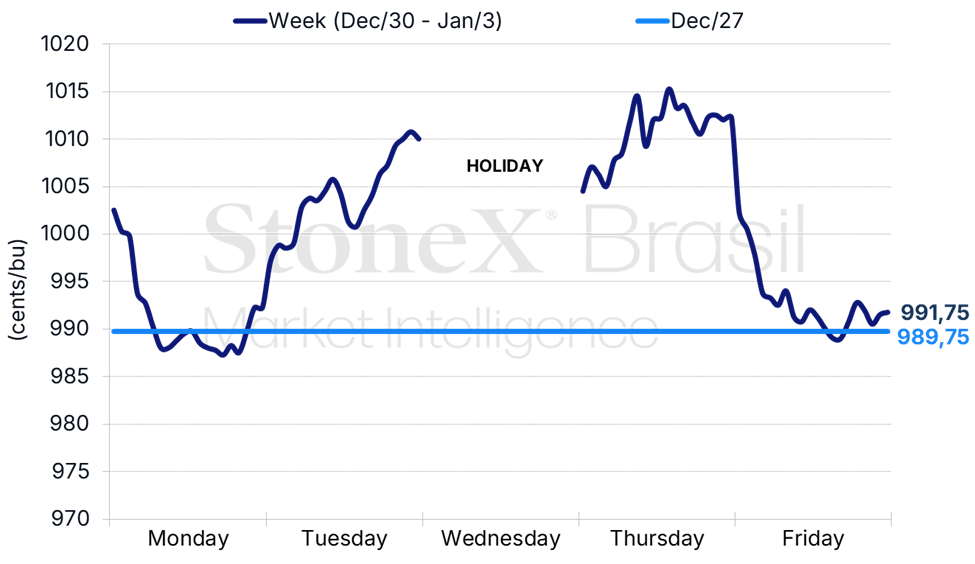
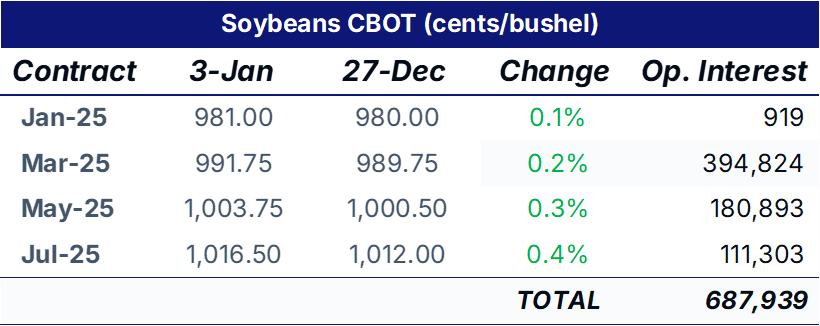
Last week, which included the last two sessions of 2024 and the first two sessions of 2025 on the CBOT, soybean prices rose during the period but gave back most of the gains, closing nearly flat. The March contract closed on Friday (Jan. 3) at 991.75 cents per bushel, a slight 0.2% increase.
The gains were driven by fund position adjustments, a fire at a crushing plant in Illinois, and speculation about drier weather in Argentina affecting the country's production potential. However, some factors weighed on prices, leading to declines, especially during the last session of the week.
Uncertainty regarding the renewal/extension of U.S. biofuel policies remains on the radar and could ultimately discourage investments in the sector, particularly renewable diesel, which has seen significant growth in recent years. The Biden administration has not addressed the issue, as seen with the 45Z credit rules at the end of its term. Expectations are that the lack of a solution before January 20, when Donald Trump takes office, could harm the sector, as the Republican administration may not prioritize the matter.
For now, estimates point to robust soybean crushing in the U.S., with the USDA projecting 65.6 million tonnes processed in 24/25, 5.4% more than the previous cycle. On the export side, projections are at 49.67 million tonnes, a 7.7% annual increase, with shipments closely monitored as Brazil's harvest approaches.
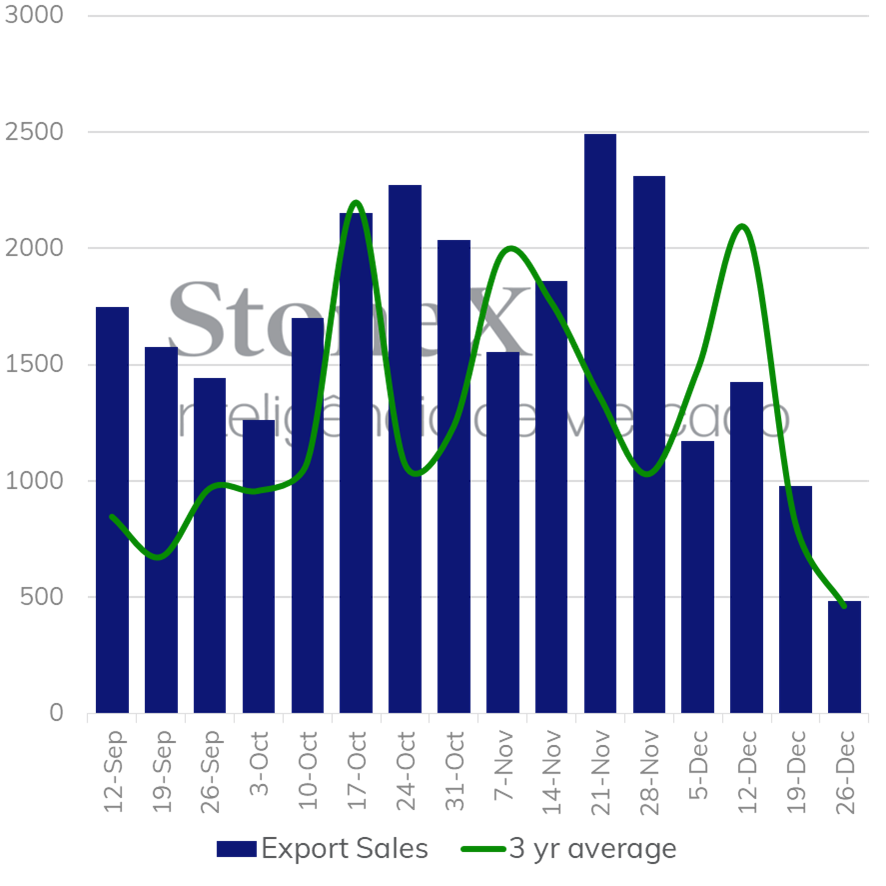
In the week ending December 26, U.S. export sales for the 24/25 crop stood at 484.7 thousand tonnes, well below market expectations of 1 to 1.8 million tonnes. Cumulatively, sales reached 40.2 million tonnes, nearly 4 million above the same week in 2023. However, sales to China are 750 thousand tonnes weaker, while sales to other destinations are 4.6 million higher than a year ago.
In any case, the main bearish factor was the progress of South America's crop, despite concerns about drier weather in Argentina.
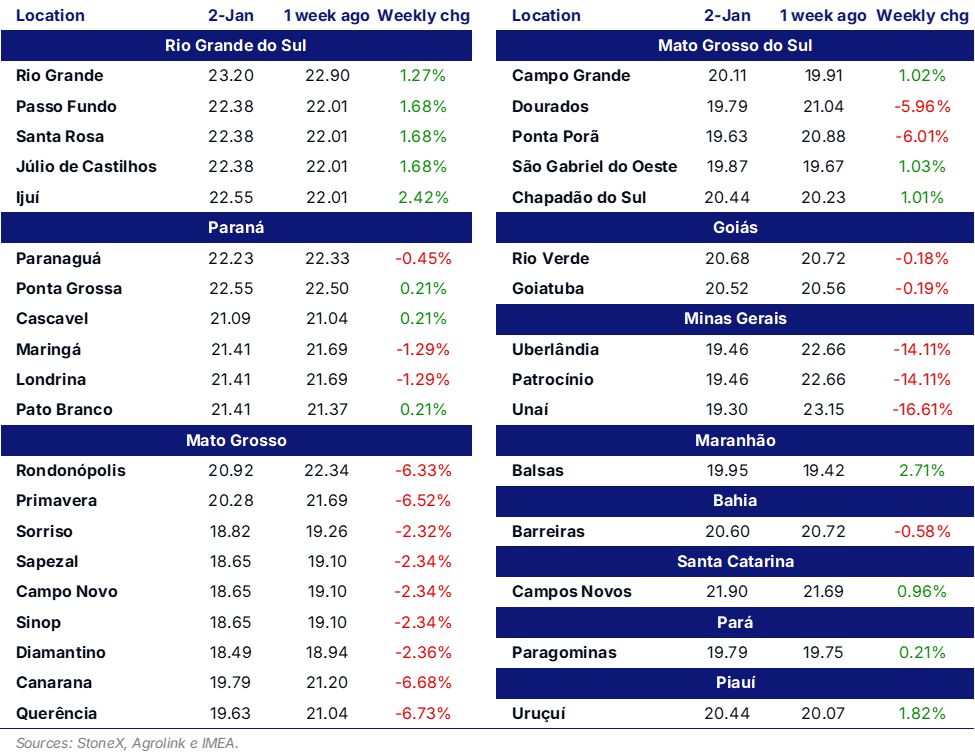
In Brazil, StoneX updated its 24/25 crop estimate, raising soybean production to 171.4 million tonnes, 3.1% higher than reported in December. This increase resulted from area and yield revisions.
National planted area rose to 47.1 million hectares, a 2% increase compared to the 23/24 cycle, with notable revisions in the North/Northeast and Center-West regions. The average yield for the country reached 3.64 tonnes per hectare, reflecting the favorable crop progress and highly positive prospects in several producing states. See the complete figures here.
For now, everything points to production exceeding 170 million tonnes for the oilseed, but weather remains on the radar, highlighting the possibility of excessive rains late in the cycle that could harm crops. Additionally, southern Brazil currently exhibits a drier pattern, especially in parts of Rio Grande do Sul, which warrants attention. Rio Grande do Sul's soybean crop has a later cycle, and a lack of moisture in the coming weeks could affect crops, particularly in reproductive stages.
This drier pattern is also present in Argentina. However, according to the Buenos Aires Grain Exchange, 81% of crops have adequate/excellent water conditions, a relatively high level but 7 percentage points lower than the previous report. Overall, 93% of plants are in good/excellent condition, but maintaining this scenario will depend on future rainfall. Part of the crops is already entering reproductive stages, but planting is not yet complete, reaching 92.7% of the estimated 18.4 million hectares, according to the exchange.
In this first full week of the year, South America's crop progress will be the main factor monitored by the market, with forecasts indicating that rainfall in Brazil will be concentrated in the northern half of the country, while precipitation in Argentina should also be lighter. Additionally, on Friday (Jan. 10), the USDA's monthly report, always highly anticipated by the market, will be released, with its January edition providing revised figures for the U.S. crop.