- Bearish drivers
- Global production for 24/25 above consumption, according to USDA;
- Supply and demand balance still not tight in the US;
- Concerns about global demand pace;
- Estimated record production for Brazil's 24/25 crop;
- Uncertainty about subsidies for biofuels in the US.
- Bullish drivers
- New stimulus measures adopted by the Chinese government;
- Short-covering by funds;
- Reduction in US production for 24/25;
- Drier weather in southern Brazil and Argentina;
- Potential for Argentina's crop to fall below 50 million tonnes.
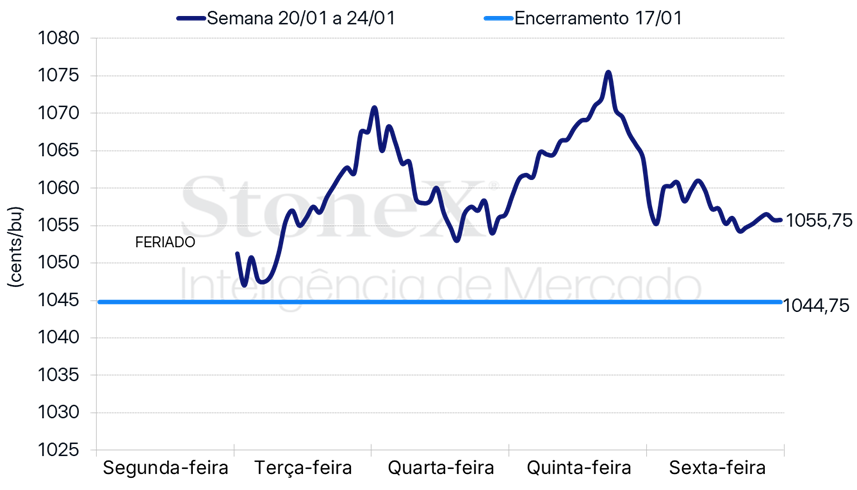
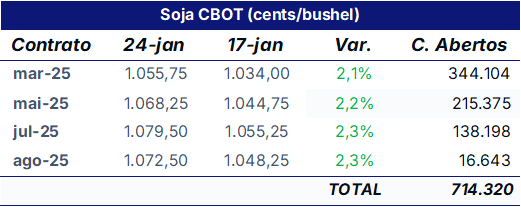
Last week was once again a bullish one for soybeans in Chicago, despite a few moments when prices came under pressure, with the March contract closing Friday (March 24) at 1055.75 cents per bushel, a gain of 2.1% over the period.
Concerns about the weather in South America continued to be the main factor influencing soybean's movements, with Argentine exchanges cutting their estimates for the country's 24/25 soybeans production as a result of drier weather.
The soybean cycle in Argentina begins at the end of October and the scarce rainfall between the second half of December and January affected part of the crops at key stages of development, in the reproductive periods. As a result, the Buenos Aires Exchange reduced its soybeans production estimate by 1 million tonnes to 49.6 million tonnes, in light of the worsening crop conditions, with the good/excellent percentage falling from 32% to 22% in one week, while the share in fair/poor condition rose from 21% to 28%. The Rosario Exchange currently estimates Argentine soybeans production at 50 million tonnes, noting that the USDA figure is 52 million.
In Brazil, StoneX will update its crop estimate in a week's time, on February 3, with the prospect of a reduction as the drought affects the southern states, particularly Rio Grande do Sul. In any case, for the time being, the national result is still expected to be a record for oilseed production. The harvest is still in its early stages, with 3.5% completed nationwide as of last Friday (24), according to a StoneX survey.
More widespread rainfall was recorded in soybean producing regions across Brazil this past weekend, but levels were relatively light in most areas. Forecasts for the next 10 days continue to show rain across the country, albeit at lighter levels in parts of the south, which is welcome and should not be enough to disrupt the harvest. Argentina has also seen more rain in recent days, with much of the producing region receiving precipitation. However, more rain is needed and forecasts are for more significant amounts over the next few days, with lighter rainfall expected from next weekend.
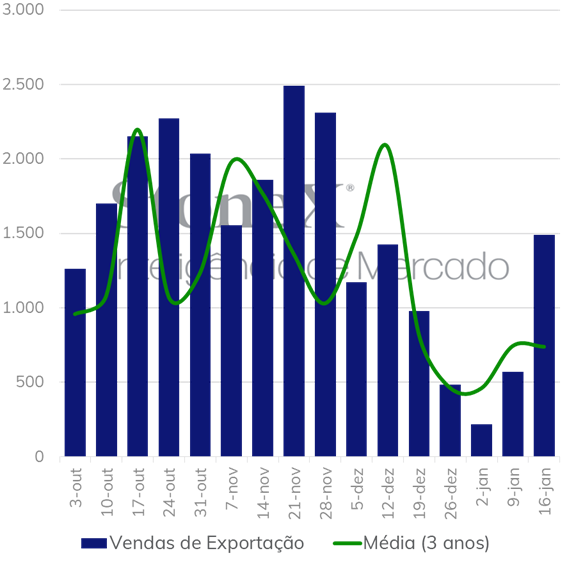
On the demand side, US exports continue to be on the radar as supply in South America begins to recover with the start of the Brazilian crop. For the week ending January 16, export sales of the US 24/25 crop reached 1.49 million tonnes, within the range of estimates of 600,000 to 1.8 million tonnes. This brings the cumulative total to 42.2 million tonnes, up from nearly 38 million tonnes a year ago. As a result, the current pace of sales is above what is needed to meet the USDA's export estimate of 49.67 million tonnes.
In any case, Brazil is expected to become the main source of global soybean imports from now on, especially Chinese purchases. Given this scenario, the news that China had banned soybeans from five companies in Brazil due to phytosanitary issues offered support to prices, but it was later clarified that this was a one-off situation with the blocking of specific locations (CNPJs) and that Brazil has more than 1500 authorized points to export soybeans to China throughout the country. As a result, shipments of Brazilian soybeans should not be affected.
Still on the demand side, one of last week's highlights was the announcement of a reduction in retenciones (export taxes) in Argentina. By the end of June, the tax on soybeans will be reduced from 33% to 26%, while that on meal and oil will fall from 31% to 24%. These reductions are aimed at increasing the competitiveness of the country's products and highlighting its leadership in meal and oil exports.
As the week begins, the market will continue to follow the weather in South America as well as any news related to Donald Trump's second term in office. In addition to geopolitical tensions with the threat of tariffs, US biofuels policies will also be monitored.