Bearish factors
- Record area and production estimate in Brazil;
- US export sales below the same period of the previous cycle;
- Even lower shipment in the Gulf region after hurricane Ida;
- Progress of US harvesting,
- Above-expected Quarterly Grain Stocks.
Bullish factors
- Possibility of a new La Niña;
- Higher than expected crushing in the US in August;
- US balance still does not suggest loose stocks;
- Crushing margin in recovery in China.
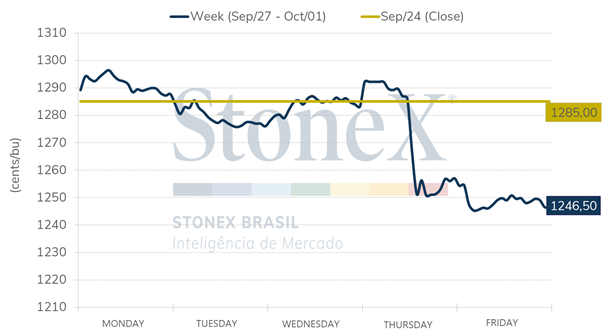
Soybean quotes in Chicago started last week slightly higher, but rallies were limited by good prospects for US crop yields as the harvest progresses. In this scenario, the October USDA demand and supply report, which will be released on Oct. 12, is expected to increase or at least sustain national productivity.
US export inspections for the week ended 09/23 reached 440,000 tonnes, about one third from the same period last year: 1.3 million. The situation of the Gulf ports after hurricane Ida has improved, but is not back to normal. On the other hand, it is noteworthy that sales of 334,000 tonnes of US soybean to China were announced on the day.
Late in the afternoon, the USDA crop follow-up report for the US 2021/22 cycle kept good/excellent conditions at 58%, as expected by the market. Harvesting reached 16%, against an average of 13%, with good yields reported.
Weekly Intraday - November/21 (CME)
Source: CME. Design: StoneX.
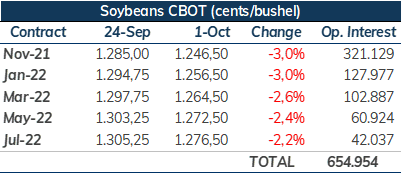
Source: CME. Design: StoneX.
On Tuesday, the settlement was negative, given prospects of a good US crop, with possibilities for yield review.
In addition, there is a longer-term concern about fertilizer prices in general, which could be an incentive to plant less corn and more soybean in the 2022/23 cycle, noting that urea prices have risen sharply in the face of natural gas rallies.
Wednesday closed in the positive field, with soybean prices recovering part of the previous day’s losses, in a position adjustment. Even so, the market monitors US export sales, which are considerably delayed compared to last year, as well as export capacity by the Gulf region’s terminals. On the positive side, the crushing margins in China are following a trend higher.
On Thursday, soybeans closed down again following the surprise with the quarterly US stocks report for September 1. This figure is equivalent to the ending stocks of the 2020/21 crop and was 6.97 million tonnes, well above average market estimates. It should be noted that this increase occurred due to a revision of 2.2 million tonnes in production, which went to 114.75 million.
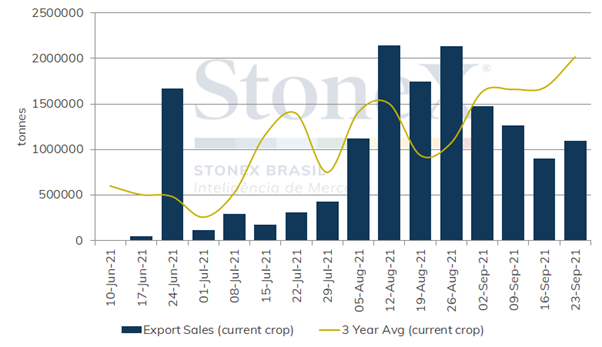
US export inspections for 2021/22 in the week ended 09/23 reached 1.09 million tonnes, less than half the same period last year. In accumulated terms, the shortfall represents 13.8 million tonnes, with China accounting for much of this difference.
Weekly US export sales - 2021/22
Source: USDA. Design: StoneX.
On Friday, soybeans continued to fall, with the market still absorbing the US stocks position.
Some rumors that there would be no change in US blending levels resulted in purchases in the soybean oil market, with the oil share rising higher.
Official US crushing data confirmed the higher result released by NOPA (National Oilseed Processors Association), with the USDA indicating that 4.58 million tonnes of soybean were processed in August. Between September 2020 and August 2021, crushing amounted to 58.27 million tonnes.
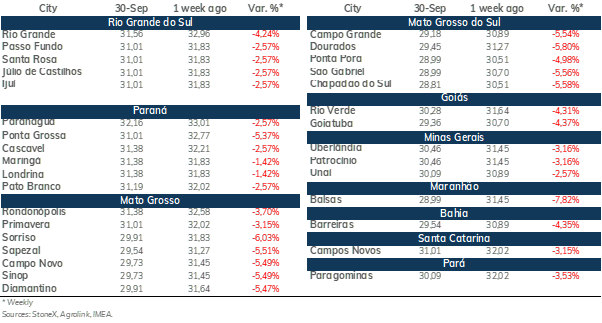
SPOT PRICES (USD/60kg-bag)