Bearish factors
- Record area and production estimate in Brazil;
- Sluggish US export sales;
- Even lower shipment in the Gulf region after hurricane Ida;
- Harvest progresses in the US with good production prospects,
- Above-expected Quarterly Grain Stocks.
Bullish factors
- Possibility of a new La Niña;
- Higher than expected crushing in the US in August;
- US balance still does not suggest loose stocks;
- Crushing margin in recovery in China.
Soybean quotes in Chicago started last week lower, amid concerns about the pace of US export sales and shipments.
US export inspections for the week ended 09/30 reached 844,000 tonnes, much below the volume seen in the same period last year, which exceeded 2 million tonnes.
The good prospects for the US harvest are also highlighted. StoneX revised its estimate for the 2021/22 crop in the country, raising the national average productivity to 3.45 tons per hectare, which resulted in an increase of expected production to 120.7 million tonnes, even considering the smaller area released by the USDA in the September supply and demand report. Higher productivity in central belt states more than compensated for the decline observed in North Dakota.
Late in the afternoon, the USDA crop follow-up report kept the crops’ good/excellent conditions unchanged at 58%, with harvesting reaching 34% of the total, above the average 26% for the period.
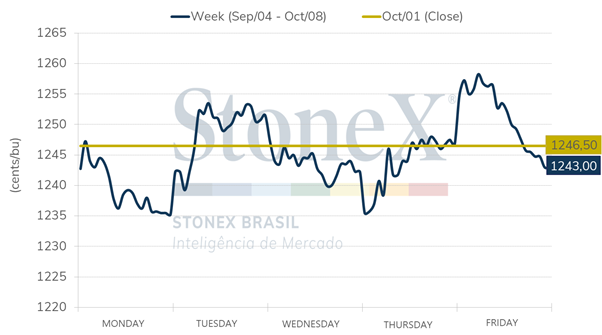
Weekly Intraday - November/21 (CME)
Source: CME. Design: StoneX.
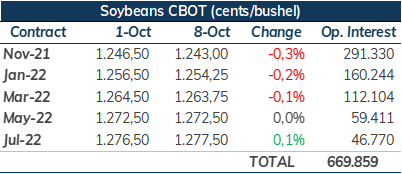
Source: CME. Design: StoneX.
On Tuesday, soybean rose higher again, led by the soybean oil market and in the opposite direction of corn.
The market speculates what will happen to blending mandates in the US. Even if there is a review to cut these mandates, the greatest impact should be on ethanol, while biodiesel and renewable diesel should suffer less. It is important to point out that several fossil oil refining plants have been converted to renewable diesel in the country.
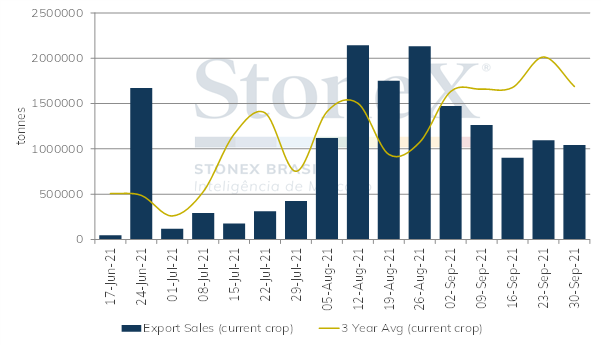
Soybean prices closed lower again on Wednesday, as a result of profit-taking on the soybean oil market. In addition, the several days without US soybean sales announcements to China fueled concerns about US exports in the 2021/22 cycle.
Negotiations are considerably delayed compared to the same period last year, and the last quarter of the year is the window of larger volumes shipped from the country.
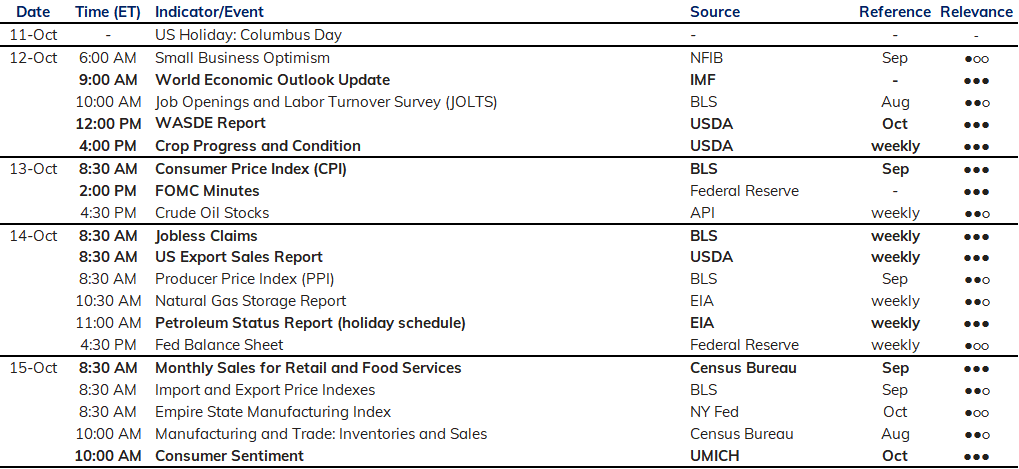
In addition, the market bets that the next USDA monthly report, which will be released on Tuesday (12), should raise the expected productivity for the US crop, or at least maintain the current level. As such, there is virtually no betting on the possibility of production cuts for the country’s 2021/22 cycle.
Once again, soybean quotes were driven by soybean oil and closed Thursday in the positive field.
US export inspections for the week ending 09/30 reached 1.04 million tonnes, coming in closer to the highest estimates, which ranged from 600,000 to 1.2 million tonnes. However, this level remains well below that recorded in the same period of 2020, which was 2.6 million tonnes, with a lag of over 15 million in the accumulated 2021/22 crop-year. It should be noted that the shipping capacity in the US Gulf ports remains limited, as a result of hurricane Ida.
Weekly US export sales - 2021/22
Source: USDA. Design: StoneX.
On Friday, the lack of US soybean sales announcements in a period of increased availability as the harvest advances in the country, weighed over prices, which ended lower, also under the influence of soybean oil in another profit-taking movement.
In the coming weeks, US soybean sales need to be closely monitored, since if there is no recovery from the expected pace, the USDA number for the 2021/22 season will become increasingly difficult to achieve. After the best window of US exports, which is the fourth quarter of the year, Brazil already starts to enter the market strong, and the prospects point to a record crop in the world’s leading soybean producer.
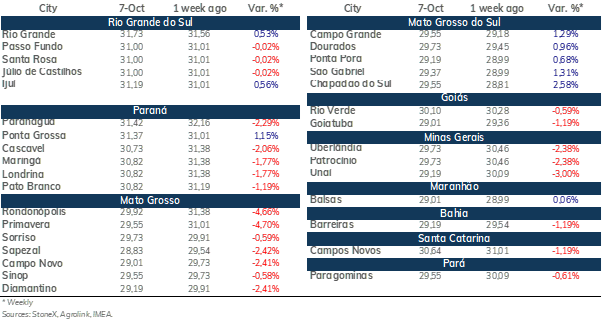
SPOT PRICES (USD/60kg-bag)