BEARISH DRIVERS
- World 2022/23 production estimated above consumption;
- Fight on inflation may generate recession;
- Possibility of record production in Brazil;
- Soy dollar in Argentina;
- Covid-19 on the rise in China.
BulliSH DRIVERS
- Concerns about the weather for 2022/23 in South America;
- Relaxed anti-COVID measures in China;
- Delayed soybean planting in Argentina due to weather;
- Prospects of increase soybean crushing in the US in coming years;
- Increased mandatory biodiesel blend in Brazil in 2023.
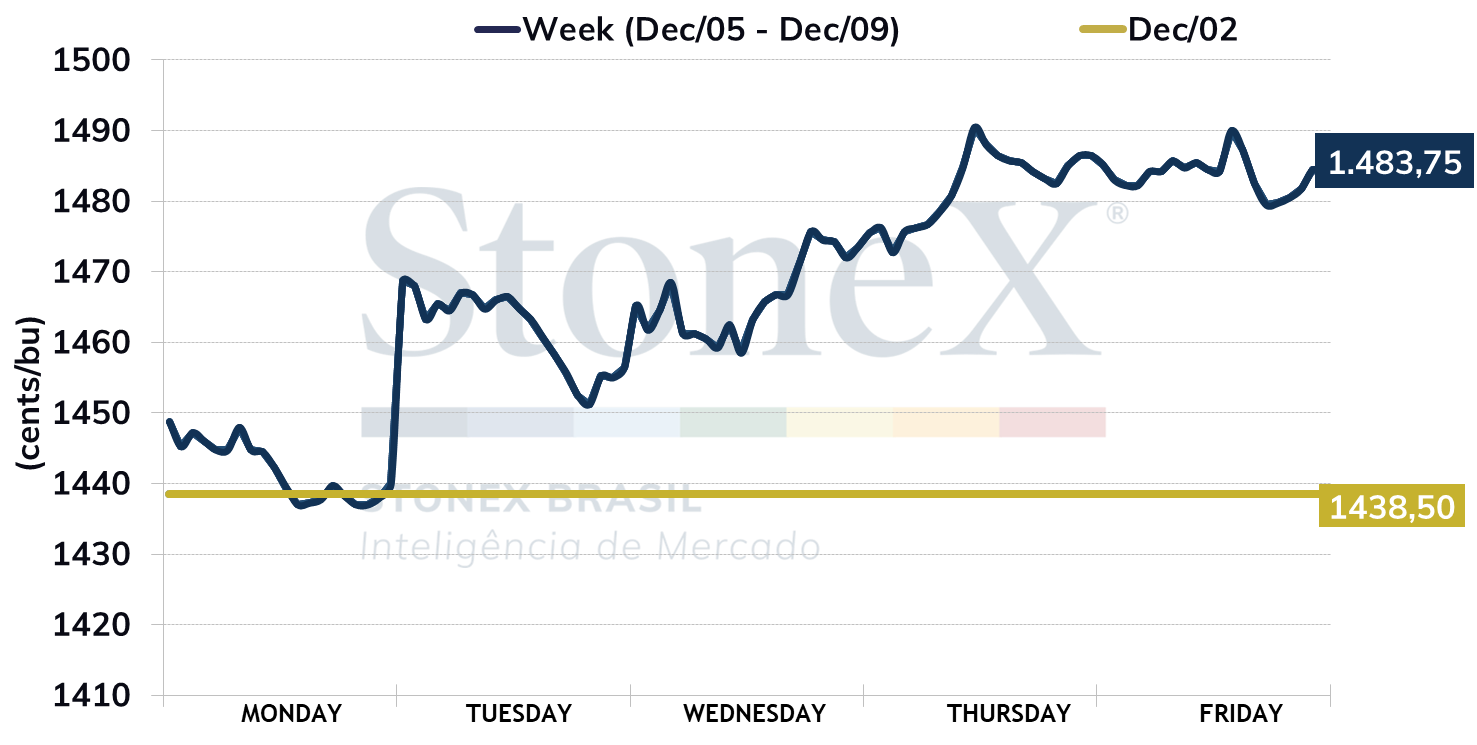
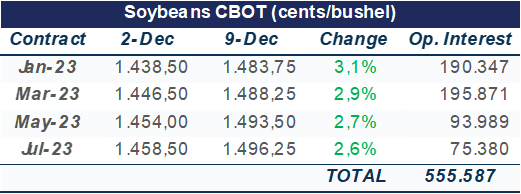
The upward trend prevailed for soybean prices in Chicago, with the January/23 contract ending Friday (9) at 1483.75 cents per bushel.
The week was marked by the release of supply and demand data, with Conab's Crop Survey and the USDA Supply and Demand Report (WASDE).
Conab brought an estimate of Brazilian soybean production for 2022/23 at 153.48 million tonnes, a marginal drop compared to last month's number, which had been 153.54 million. This small adjustment was conditioned by the review in productivity, since planted area was increased to 43.41 million hectares.
The company pointed out that the prospects remain, in general, positive, even with weather problems in virtually all producing states. In Mato Grosso, for example, there was replanting in some specific areas, due to water stress. In Goiás, some regions recorded up to 25 days without rain, which resulted in planting suspension. As such, delays compared to last year, not only in Mato Grosso and Goiás, have been a trend, because of weather irregularities. These delays do not tend to negatively impact the crops, if the rainfall volumes guarantee good development of the plants. The biggest concern is the safrinha crop window, in early 2023.
Weekly Intraday - January/23 (CME)
Source: CME. Design: StoneX.
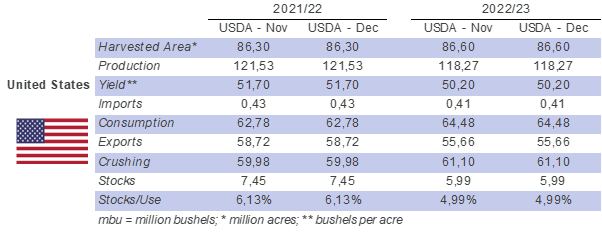
As for the USDA report, major adjustments were not expected in supply and demand numbers, since the December release usually does not bring major surprises. This perspective was confirmed, with US balance sheets for the 2021/22 and 2022/23 crops remaining stable compared to the November report.
Production in Brazil and Argentina was also not adjusted, highlighting the increase in Argentine exports for 2022/23 by half a million tonnes, to 7.7 million. Although the country focuses its exports on meal and oil, the more favorable exchange rate for the complex (soy dollar) tends to encourage grain exports as well.
On the supply side, there were no adjustments to the Chinese numbers, with the prospect of imports from the country in the 2022/23 cycle maintained at 98 million tonnes.
US supply and demand balance (million tonnes)
Source: USDA. Design: StoneX.
On the other hand, it should be noted that Chinese soybean imports ended November at 7.35 million tonnes, below market expectations, which was waiting for a number closer to 9 million, since the price of soybean meal in the country reached levels records, in light of lower inventories. Anyway, for December, the bets are on strong import volumes, before the Lunar New Year period, which will take place in January 2023.
Still on the foreign trade, US soybean export inspections in the week ended December 1 were at 1.7 million tonnes, lower than in the previous week and 2021. In accumulated terms, 21.1 million tonnes of soybeans were inspected for shipment, against 23.8 million at the same time last year.
The country's export sales, in the same week ended December 1, surprised the market, reaching 1.7 million tonnes for 2022/23, when expectations ranged from 600,000 to 1.2 million. In accumulated terms, 38.87 million tonnes were traded, against 38.74 in the same period of 2021.
Returning to South America, concerns about the Argentine crop remain key. According to the Buenos Aires exchange, until last Wednesday, 37.1% of the soybean area estimated for the country (16.7 million hectares), had been sown, 19.1 percentage points behind the same period a year ago. The lack of surface moisture in north-central Santa Fe and downtown Ente Rios is of greatest concern considering the planting window. It should also be noted that, in the producing areas further north of the country, the lack of rain combined with elevated temperatures could delay sowing, scheduled to start in December.
Although production cuts for the country are not yet being announced, this possibility is gaining more and more strength, which impacts the global supply and demand balance, even considering Brazilian production above 150 million tonnes.