Bearish drivers
- World 2022/23 production estimated above consumption;
- Fighting inflation can generate recession;
- Possibility of absolute record production in Brazil;
- Signs of economic slowdown in China;
- USDA Agricultural Forum brings production growth for 2023/24 US crop.
Bullish drivers
- Relaxation of anti-COVID measures in China;
- Considerable crop losses in Argentina, due to the weather;
- US balance sheet estimated at the Agricultural Forum does not indicate loose stocks;
- Possibility of increased mandatory biodiesel blend in Brazil, from April 2023.
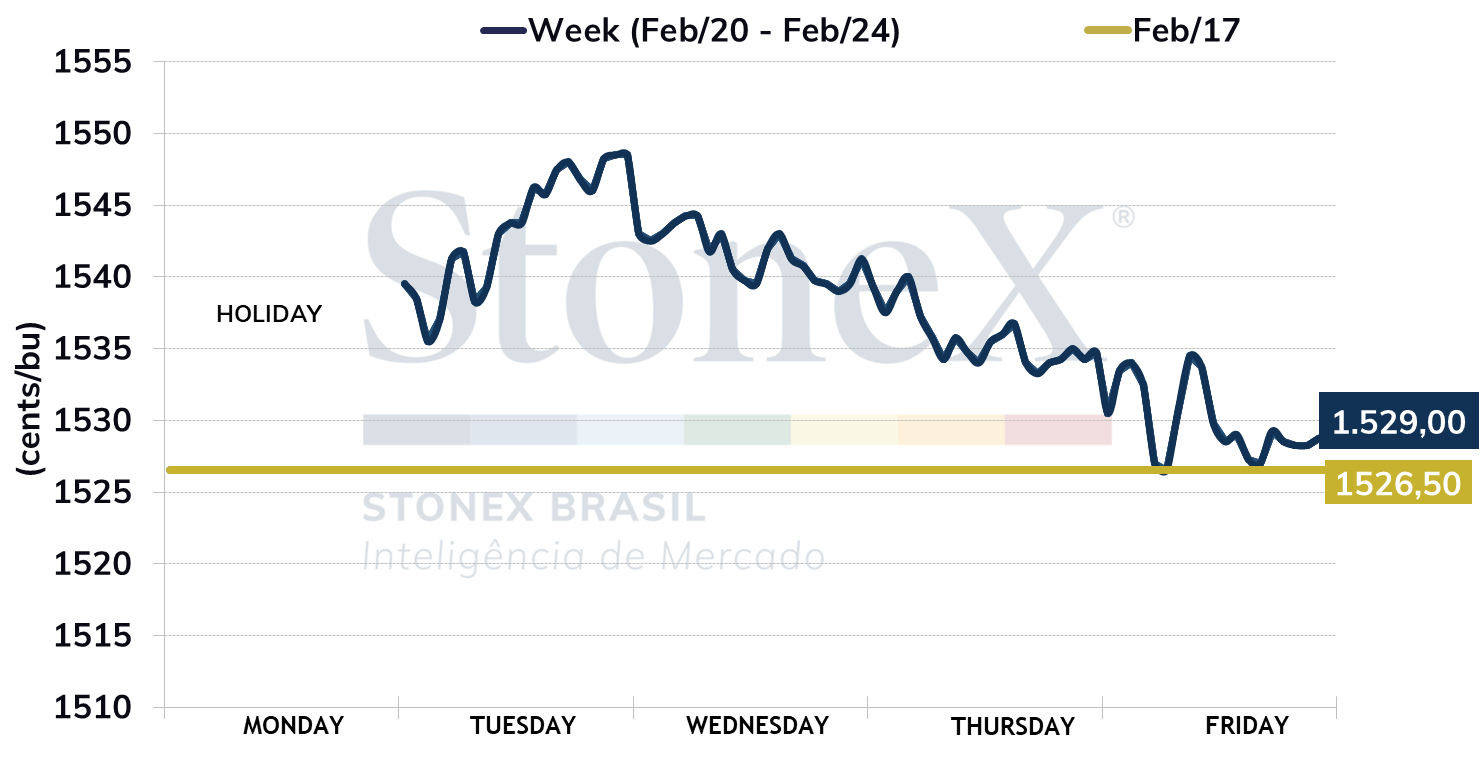
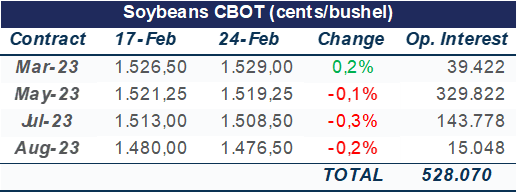
Last week was shorter in Chicago due to the President's Day holiday in the US on Monday (20). Soybean prices started the period higher, but retreated in the following trading sessions and ended the week practically stable. The March/23 contract closed Friday (24) at 1529 cents per bushel.
The Argentine crop continued to be closely monitored, given the adverse dry weather that has been hitting the country. On the weekend of February 18, early frosts were recorded in the country, in a period when the phenomenon does not occur. These frosts affected the western region of Argentina's agricultural area, a situation that, together with the irregular weather and high temperatures, led the Buenos Aires Grains Exchange to make yet another cut in its estimate for the country's 22/23 soybean crop, which fell to 33.5 million tonnes, 4.5 million less than the previous number.
It should be noted that the size of the losses due to frosts cannot yet be fully evaluated, but mainly the areas of San Luis, south of Córdoba, north of La Pampa and west of Buenos Aires had their later planting crops affected.
Another number updated by the Buenos Aires Grains Exchange was that of crop conditions, with the good/excellent percentage falling to just 3%, 6 points less than a week before. In addition, the percentage of crops in poor conditions increased to 60%, a situation that reinforces the scenario of expected losses for the country's soybean crop.
Thus, the idea is increasingly consolidated that Argentina will need to import significant amounts of soybean to be able to crush volumes at least close to what is usually processed in the country. As a result, it is already expected that Argentina will import major volumes of soybeans from Brazil. Furthermore, the demand for Brazilian meal and oil should also gain strength, occupying some of the space of Argentine products in the international market.
Weekly intraday—March/23 (CME)
Source: CME. Design: StoneX.
In Brazil, it should be noted that StoneX will update its crop numbers on Wednesday (1). The harvest is still delayed, having reached 31.5% of the total last Friday (24), but the prospects for the result in the central region of the country, including the state of Mato Grosso, are very positive. With this, the losses in Rio Grande do Sul should be compensated for the most part, ensuring that an excellent national result.
The US supply side was also highlighted in the previous week, with the USDA Agricultural Forum bringing estimates for the country's 23/24 crop. The USDA kept soybean planted area stable from the previous cycle, at 35.4 million hectares, but with a slight increase in harvested area and a recovery in productivity, to 3.5 tonnes per hectare, which would result in increased production to 122.7 million tonnes. Despite the prospect of greater production, this result was not as low as expected by the market, since there was no increase in the planted area.
Furthermore, it should be noted that estimates for demand increased year-on-year, both for domestic consumption and exports.
In any case, greater production would also guarantee an increase in estimated ending stocks, to 7.9 million tonnes, a volume that still means a very tight balance for the country.
Still on the US, the pace of sales and shipments of soybeans in the 2022/23 cycle continues to be monitored, at a time when the Brazilian crop will take center stage in world exports.
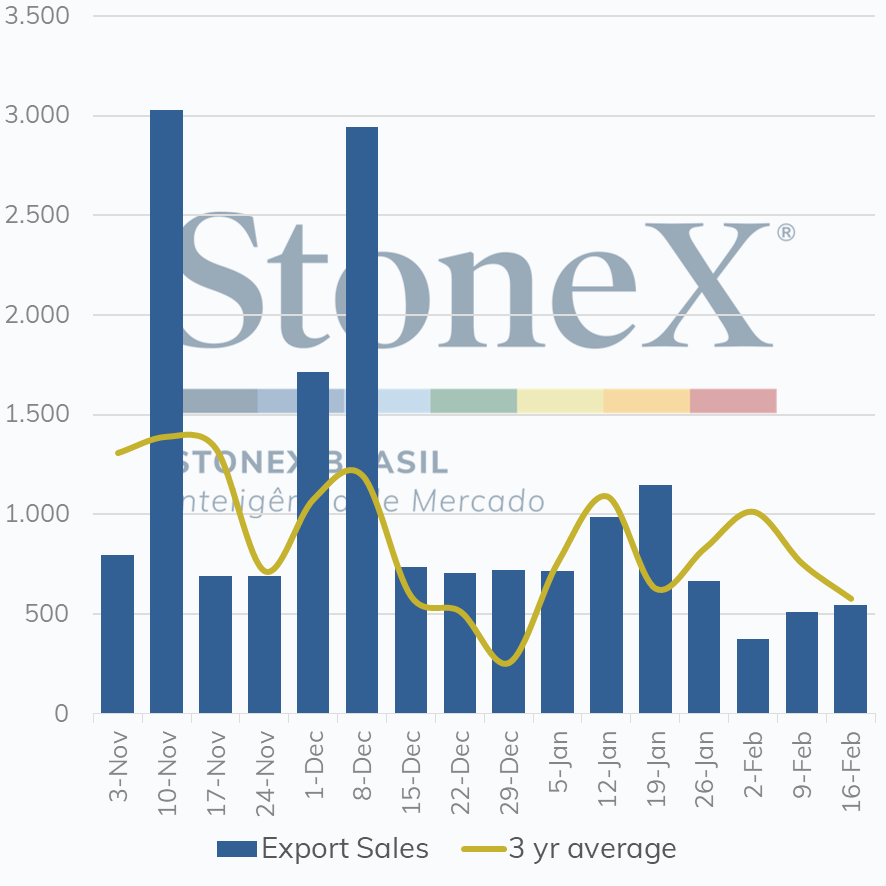
In the week ended February 16, export sales for the US 2022/23 crop reached 544,900 tonnes, a volume within the range of estimates, which ranged from 300,000 to 850,000 tonnes. The accumulated reaches 48.6 million tonnes, against 49.3 million in the same period last year. Of this total, 40.8 million tonnes of soybeans have already been shipped.
Weekly US export sales (000 tonnes)
Fonte: USDA. Elaboração: StoneX.
This week, in addition to StoneX's estimates, the highlight is the export data for the month of February in Brazil, which will also be released on Wednesday (1).