Bearish drivers
- Estimated global production for 2022/23 above consumption, according to USDA;
-
Combating inflation may lead to a recession;
-
Possibility of an absolute production record in Brazil;
-
Signs of economic slowdown in China and ASF outbreak;
-
Agricultural Forum shows production growth for 2023/24 in the US.
Bullish drivers
- Relaxation of anti-Covid measures in China;
-
Considerable crop losses in Argentina due to the climate;
-
US balance estimated at the Agricultural Forum does not indicate loose stocks;
-
Increase in mandatory biodiesel blending in Brazil, starting in April 2023.
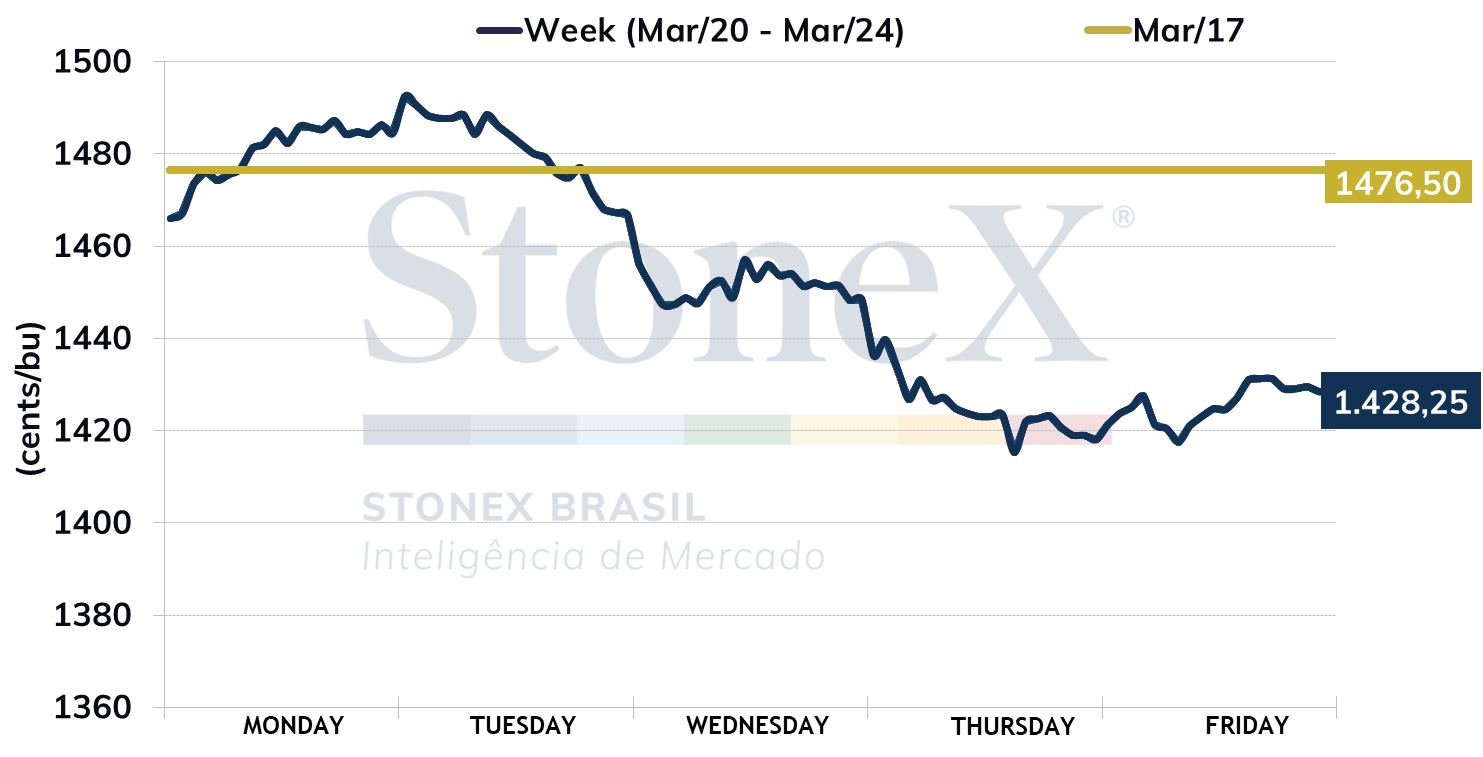
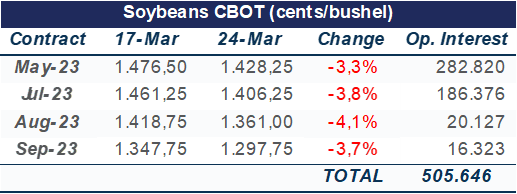
Last week was bearish for soybean prices in Chicago, with the May/23 contract ending Friday (24) at 1428.25 cents per bushel.
There was considerable performance by funds on the sell side, which conditioned the weekly retreat, at a time when risk aversion continued to be present, following the banking crisis in the US.
Even so, the market kept an eye on the result of the US crop and also on demand for soybean.
The Buenos Aires Exchange (BCBA) reported that the first batches of soybeans began to be harvested in Argentina, in the central area of the country's agricultural region, registering extremely poor yields, below the historic lows and also what was expected for the cycle. With that, the BCBA warns that if this situation continues, further cuts in the country's production estimate, currently at 25 million tonnes, are not ruled out.
It should be noted that the rains recently recorded in the country are not expected to be enough to improve the prospects for the 2022/23 soybean crop, which is heading towards a result almost 50% lower than initial estimates, at 48 million tonnes.
The conditions of Argentine crops remain, in general, very bad, with 73% of the plants in this category, while only 2% are rate as good/excellent.
Weekly intraday - May/23 (CME)
Source: CME. Design: StoneX.
On the other hand, the advance of the harvest in Brazil, which reached 69.2% of the total last Friday (24), according to StoneX, is showing excellent results in most of the producing region, more than offsetting the losses recorded in Rio Grande do Sul.
StoneX will update its estimate for the 2022/23 Brazilian crop next Monday (April 3), but the result above 150 million tonnes is practically consolidated. It should be noted that other private consultancies are also updating their numbers and even bringing new increases to production in Brazil.
With that, the market absorbs how the balance of global supply and demand for the oilseed will be. Will the Brazilian crop be able to offset the Argentine losses? How big will Argentina's soybean imports and crushing be? Will Brazil increase its share in the world market for soybean meal given Argentine losses?
Furthermore, Chinese demand continues to be closely watched amid more significant African swine fever cases in the country, with prospects that they will affect the amount of meat produced further down the road because of animal culling, including breeders, to prevent the spread of the disease.
In any case, Chinese soybean imports increased in January and February, in the annual comparison, and the perspectives are that the country will continue to receive a lot of soybeans, mainly Brazilian, in the coming months. From the beginning of March until the 17th, Brazil shipped 7.3 million tonnes of soybeans (to all destinations). The weekly data will be updated this afternoon, but March is set to be a month of very high soybean exports. Ship line-up data indicate that shipments in March could be close to 15 million tonnes.
While Brazilian exports gain strength, US sales and shipments tend to be weaker, following the usual seasonality observed in the export market.
In the week ended March 16, US net sales of 2022/23 soybeans were just 152.5 million tonnes, below the bottom of estimates, which ranged from 400,000 to 900,000. In accumulated terms, sales are at 49.5 million tonnes, below the same period last year, when they reached 54 million. Shipments, on the other hand, were seen at 43.5 million tonnes, while last year they were around 42 million.